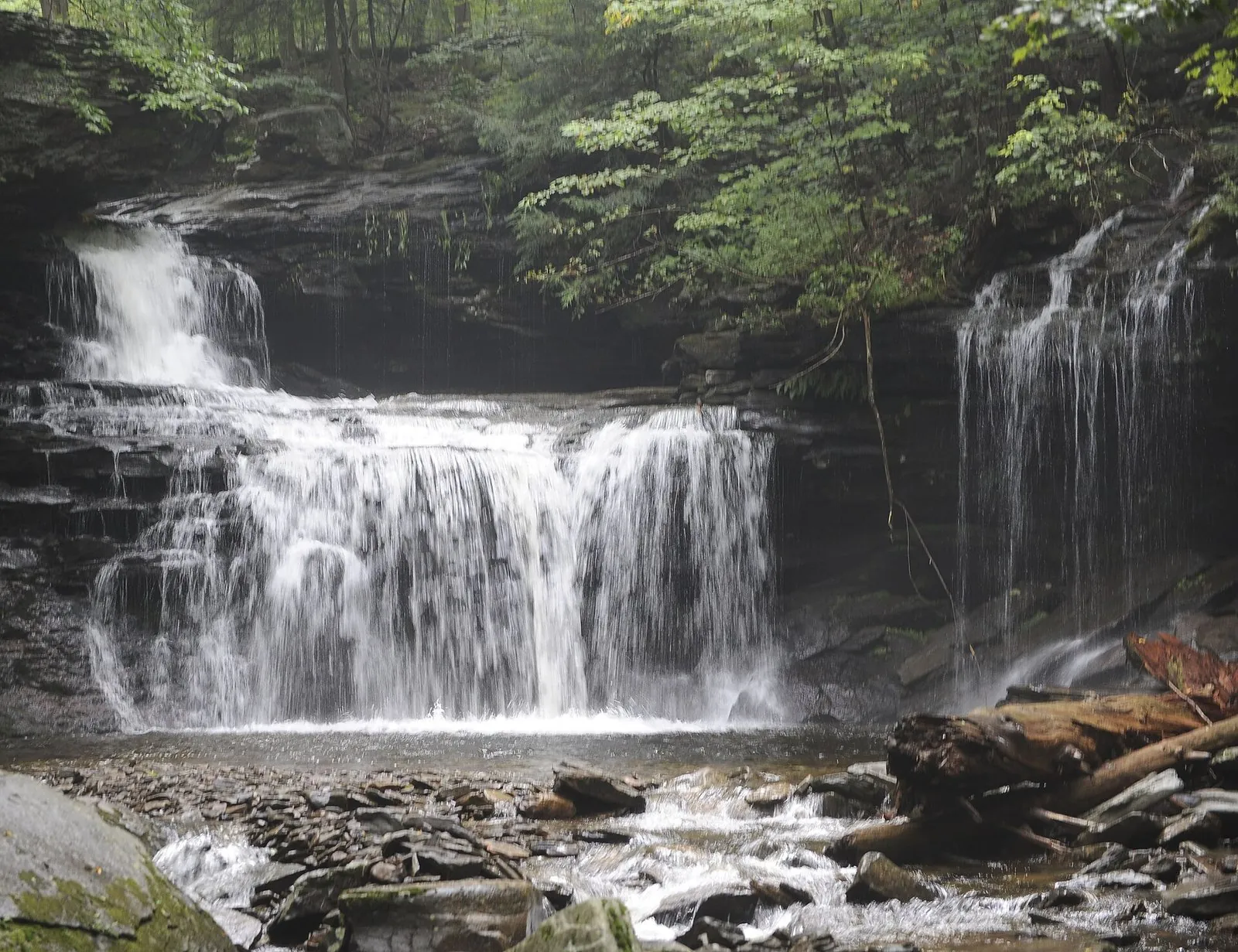
One state park, Ricketts Glen, has 22 named waterfalls, and a single 7.2-mile trail passes 21 of them. That’s the best argument that Pennsylvania belongs among the great waterfall states of the East, and it’s only the start. The waterfalls in Pennsylvania run from the state’s tallest, Raymondskill Falls in the Delaware Water Gap, to the privately run “Niagara of Pennsylvania” at Bushkill, the boulder-choked gorge at McConnells Mill north of Pittsburgh and the waterfall that Frank Lloyd Wright built a house over. This guide ranks 40 of them by region, with heights where they’re published, trail lengths, fees and the rules on swimming.
Quick answer: Go to Ricketts Glen for the best waterfall hike in the state (the Falls Trail; Ganoga Falls is 94 feet), Raymondskill Falls for the tallest (a 0.3-mile trail), and Bushkill Falls for eight falls on boardwalk trails ($24 for adults since September 24, 2026; closed December to March). In the west, see Cucumber Falls at Ohiopyle and Hells Hollow Falls at McConnells Mill. Dingmans Falls and Glen Onoko Falls are closed. Come in spring for the strongest flow or mid-October for color, and don’t plan on swimming near the falls.
Last updated October 1, 2026. Trail lengths, fees, rules and closures were checked that day against the National Park Service, the Pennsylvania Department of Conservation and Natural Resources (DCNR), Bushkill Falls and county park pages. Where a waterfall’s height or details come from guidebooks rather than an official source, we say so.
- Closed: Dingmans Falls (with Silverthread Falls) in the Delaware Water Gap, for bridge and trail work with no reopening date, and Glen Onoko Falls near Jim Thorpe, closed since 2019 for a DCNR rebuild.
- New prices: Bushkill Falls raised admission on September 24, 2026 to $24 for adults, $22 for seniors and military and $12 for children 4 to 10.
- Seasonal: Bushkill closes from December through March; Raymondskill’s upper parking lot closes from early January to mid-April; Ricketts Glen’s Falls Trail closes in winter except to equipped ice climbers and hikers.
- Swimming: in the Delaware Water Gap it’s banned within 50 feet upstream of any waterfall and in the falls themselves. Most waterfalls are not swimming spots.
- Free: every state park waterfall is free to visit; Pennsylvania state parks charge no entrance or parking fee.
On this page: At a glance | How to visit | Poconos and Water Gap | Ricketts Glen and the northeast | Central and southeast | Laurel Highlands and the west | Easy or hard | Swimming | By season | FAQ
The best waterfalls in Pennsylvania at a glance
Heights are given only where an official source publishes them. Drive times are free-flow estimates from Philadelphia City Hall and downtown Pittsburgh.
| Waterfall | Height | Walk | Fee | From Philadelphia | From Pittsburgh |
|---|---|---|---|---|---|
| Ricketts Glen Falls Trail | 21 falls, 11 to 94 ft | 3.2-mile or 7.2-mile loop, difficult | Free | 3 hr | 4 hr 45 |
| Raymondskill Falls | Tallest in PA (NPS) | 0.3 mile, easy to moderate | Free | 2 hr 30 | 5 hr 30 |
| Bushkill Falls | 8 falls | 15 minutes to 2 hours on stairs | $24 adults | 2 hr 15 | 5 hr 15 |
| Hawk Falls | 25 ft | 0.6 mile | Free | 1 hr 45 | 4 hr 45 |
| Tumbling Waters | – | 2.8-mile loop, moderate | Free | 2 hr 15 | 5 hr 30 |
| Hackers Falls | – | 1.4 miles | Free | 2 hr 30 | 5 hr 30 |
| Salt Springs (Fall Brook) | 3 falls | Short gorge walk | Free | 3 hr | 5 hr 45 |
| Cucumber Falls | – | 0.4 mile from town, difficult | Free | 4 hr 45 | 1 hr 30 |
| Jonathan Run Falls | – | 1.6-mile trail | Free | 4 hr 45 | 1 hr 30 |
| Hells Hollow Falls | – | 0.5 mile, easiest | Free | 5 hr 30 | 45 min |
| Kildoo Falls | – | Part of a 3-mile loop | Free | 5 hr 30 | 45 min |
| Dingmans Falls | Second-tallest in PA | Closed | – | 2 hr 15 | 5 hr 30 |
How to visit Pennsylvania’s waterfalls
Timing. Flow is strongest in spring, from snowmelt in March and April through May rains, and after any heavy summer storm. Late summer can shrink smaller falls to a trickle. October adds fall color around the falls, especially in the northern tier and the Poconos, and is the most crowded month. Winter turns many falls to ice, but trails get dangerous, and some close.
Fees. Waterfalls in Pennsylvania state parks, state forests and the Delaware Water Gap cost nothing to visit; the state charges no entrance or parking fee at its parks, and the Water Gap has no general entrance fee, though some of its sites charge amenity fees in summer. Bushkill Falls is private and charges admission. Fallingwater charges for its house tours, though its Grounds Pass costs $18.
Safety. Waterfall trails are wet, rocky and steep, and people are hurt every year. Wear boots with real tread, stay on the trail and behind railings, never climb on the falls or the cliffs beside them, and keep away from the brink. In the Delaware Water Gap, climbing falls, pools and adjacent cliffs is prohibited outright. Glen Onoko’s trail was closed in 2019 after repeated rescues and deaths, a reminder of what happens when people go off-trail.
Crowds. Ricketts Glen, Bushkill and Hawk Falls fill on fall and summer weekends; arrive by 9am, or come midweek. DCNR warns that Hickory Run’s trailhead parking can fill early even on weekdays. For park rules, cabins and campgrounds near the falls, see our guide to Pennsylvania state parks.
Waterfalls in Pennsylvania’s Poconos and the Delaware Water Gap
The northeast corner of the state has the tallest falls and the easiest access, within about 1.5 to 2.5 hours of New York and Philadelphia. For the rest of the region, see our guide to things to do in the Poconos.
1. Raymondskill Falls
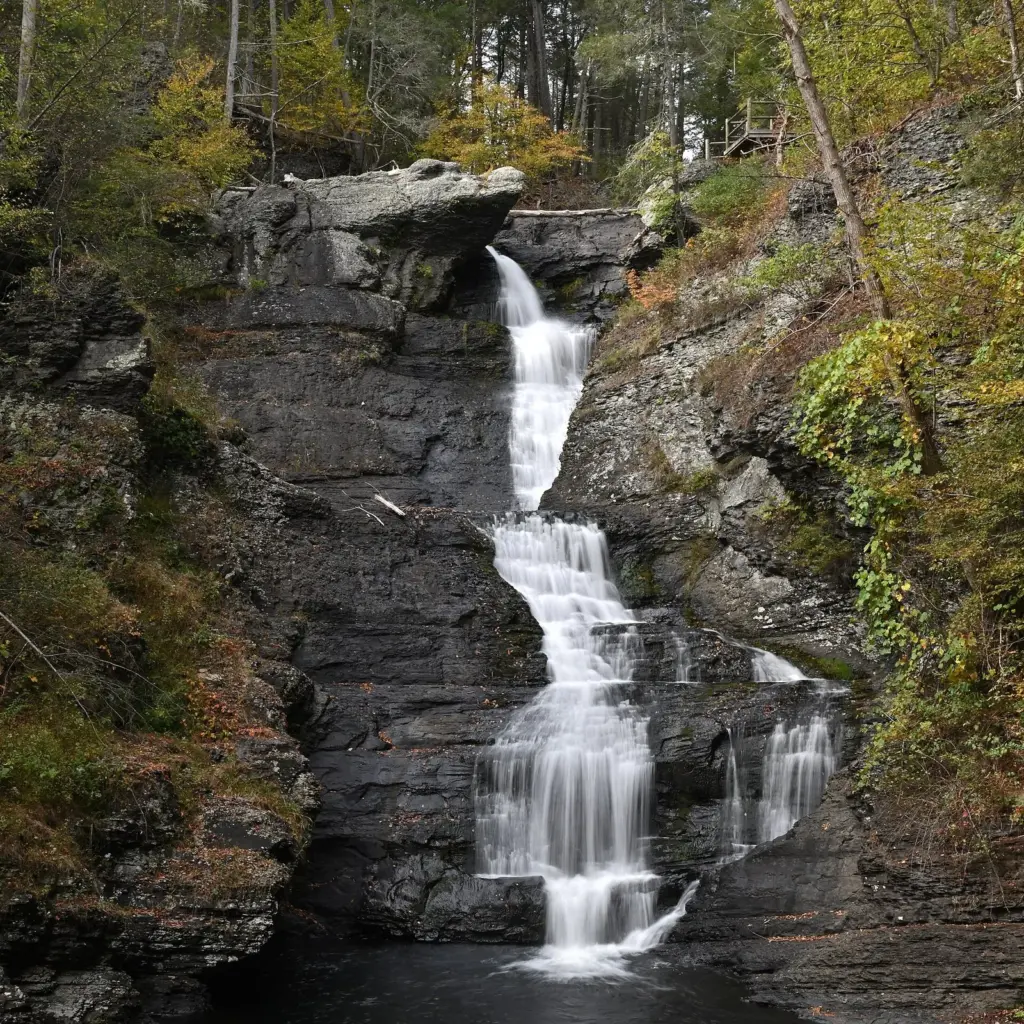
Free; tallest in Pennsylvania; short but steep. The National Park Service calls Raymondskill the tallest waterfall in Pennsylvania. It drops in three tiers through a hemlock ravine, and two viewing platforms sit along a 0.3-mile earthen trail (a short loop with an out-and-back spur, easy to moderate, with 178 feet of elevation change). Pets aren’t allowed on the trail, and food, picnics and alcohol are banned at the site.
Plan it: Raymondskill Road off US 209, a few miles south of Milford; about 1 hour 30 minutes from Manhattan, 2 hours 30 minutes from Philadelphia and 5 hours 30 minutes from Pittsburgh. The upper parking lot closes from early January to mid-April. Allow 45 minutes. Best for: everyone, especially in spring.
2. Dingmans Falls
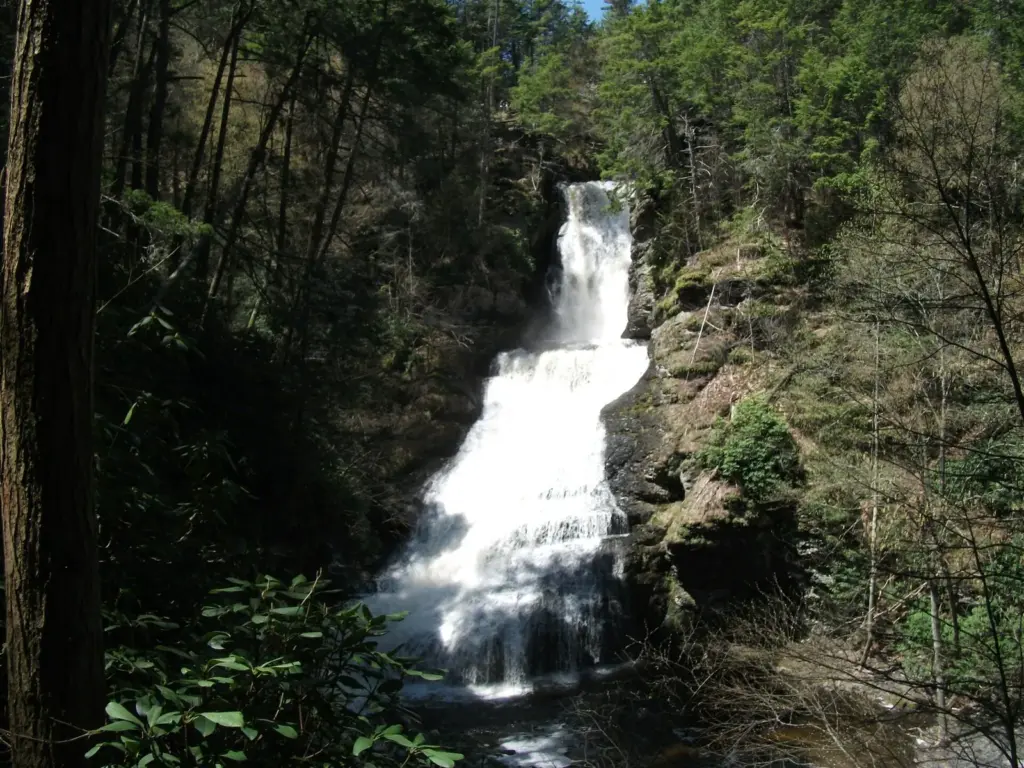
Closed in 2026. NPS describes Dingmans as the second-tallest waterfall in Pennsylvania, at the end of a boardwalk through rhododendron and hemlock. The access road, visitor center and trail are closed for bridge replacement and trail rehabilitation, with all traffic, including pedestrians, banned during construction and no reopening date announced.
Plan it: Near Dingmans Ferry; about 1 hour 30 minutes from Manhattan and 2 hours 15 minutes from Philadelphia. Check the NPS Current Conditions page before you go; until it reopens, Raymondskill is five miles north. Best for: a future trip.
3. Silverthread Falls
Closed in 2026. This narrow ribbon of water drops into a slot beside the Dingmans Falls Trail, the first waterfall most visitors pass on the way to Dingmans. It reopens when the Dingmans site does.
Plan it: Same access as Dingmans Falls. Best for: pairing with Dingmans once the work is finished.
4. Hackers Falls
Free; quieter; a real hike. Hackers Falls sits in the Cliff Park trail system, which links more than 9 miles of trails above the Delaware. The Hackers Falls Trail is 1.4 miles and starts across the road from Raymondskill’s lower parking lot, so the two make an easy pair. Climbing and swimming are banned on or within 50 feet of the falls, and food, picnics and alcohol are prohibited in the Cliff Park area.
Plan it: Near Milford, about 2 hours 30 minutes from Philadelphia. Allow 1.5 hours. Best for: hikers who want fewer people.
5. Tumbling Waters
Free; a full loop with a waterfall in the middle. At the Pocono Environmental Education Center in the Water Gap, the Tumbling Waters Trail is a 2.8-mile moderate loop (orange blazes, 254 feet of elevation change) past a waterfall framed by rhododendrons, a hemlock ravine, two ponds, old farm remnants and views over the Delaware River valley.
Plan it: Trailhead across from group lodges A and B at the center; about 1 hour 45 minutes from Manhattan and 2 hours 15 minutes from Philadelphia. Swimming and wading are banned within 50 feet of the waterfall. Allow 2 hours. Best for: families who like a varied walk.
6. Bushkill Falls: the Main Falls
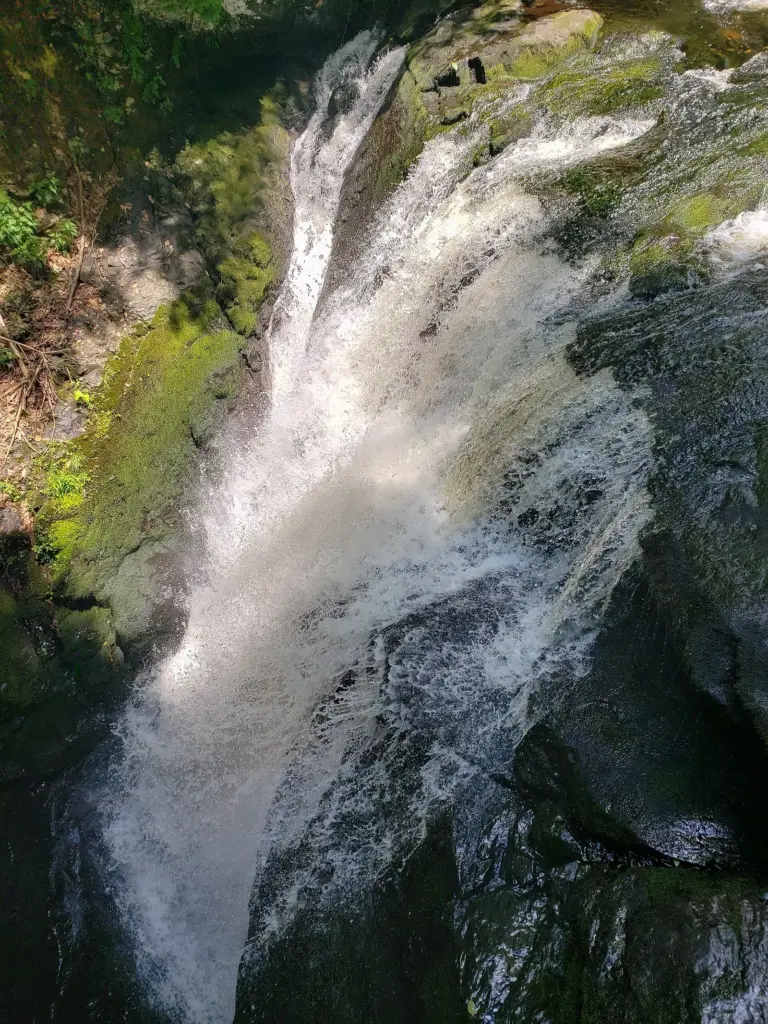
Paid; April to November; the easy showpiece. Bushkill Falls is a private park that bills itself as the “Niagara of Pennsylvania,” with eight waterfalls on a network of trails, bridges and stairways. The Green Trail reaches the Main Falls in about 15 minutes, with steps but no climbing.
Plan it: 138 Bushkill Falls Trail, Bushkill; about 1 hour 45 minutes from Manhattan, 2 hours 15 minutes from Philadelphia and 5 hours 15 minutes from Pittsburgh. Admission since September 24, 2026: $24 adults, $22 seniors 62 and up and active military, $12 children 4 to 10, free 3 and under, per Bushkill Falls’ admission page. Closed December through March; hours vary by season and weather. Leashed pets are allowed. Best for: families and first-timers.
7. Bushkill Falls: Lower Gorge Falls
Included with admission. The Yellow Trail adds Lower Gorge Falls to the Main Falls on a 45-minute loop, which is the right choice for most visitors: it shows you the gorge from below without the full climb of the longer trails.
Plan it: Start from the main entrance; all trails involve stairs. Best for: families with school-age kids.
8. Bushkill Falls: Upper Canyon
Included with admission. Also on the 45-minute Yellow Trail, the Upper Canyon falls sit upstream of the Main Falls in the same rocky gorge, adding a second big view without much extra walking.
Plan it: Yellow Trail. Wear shoes with grip; the boardwalks are wet near the falls. Best for: photographers.
9. Bushkill Falls: Laurel Glen
Included with admission. The third fall on the Yellow Trail, Laurel Glen rounds out the 45-minute loop, which is why that route is the best value for most visitors.
Plan it: Yellow Trail. Allow 45 minutes for the whole loop. Best for: a breather.
10. Bushkill Falls: Pennell Falls
Included with admission. The Blue Trail, about 1 hour 15 minutes, is the route to Pennell Falls, and it takes you farther from the crowds around the Main Falls.
Plan it: Blue Trail; more stairs and distance than the Yellow loop. Best for: fit walkers who want all of the park.
11. Bushkill Falls: Bridal Veil Falls
Included with admission. The Red Trail is the only route to Bridal Veil Falls. Take it if you’ve come all this way and want to see every fall the park has, and allow extra time.
Plan it: Red Trail; ask at the entrance how long it’s taking that day, and wear good shoes. Best for: completists.
12. Shohola Falls
Free; quick roadside stop. Shohola Falls drops through a rocky gorge just below the dam of Shohola Lake, a large waterfowl impoundment on Pennsylvania Game Commission land along US 6, about 10 miles west of Milford. A short loop trail leads from the parking area down to the falls.
Plan it: US 6 in Pike County, about 1 hour 45 minutes from Manhattan and 2 hours 45 minutes from Philadelphia. It’s on state game lands, so wear orange during hunting seasons. Allow 45 minutes. Best for: a stop on the way to Lake Wallenpaupack.
13. Hawk Falls
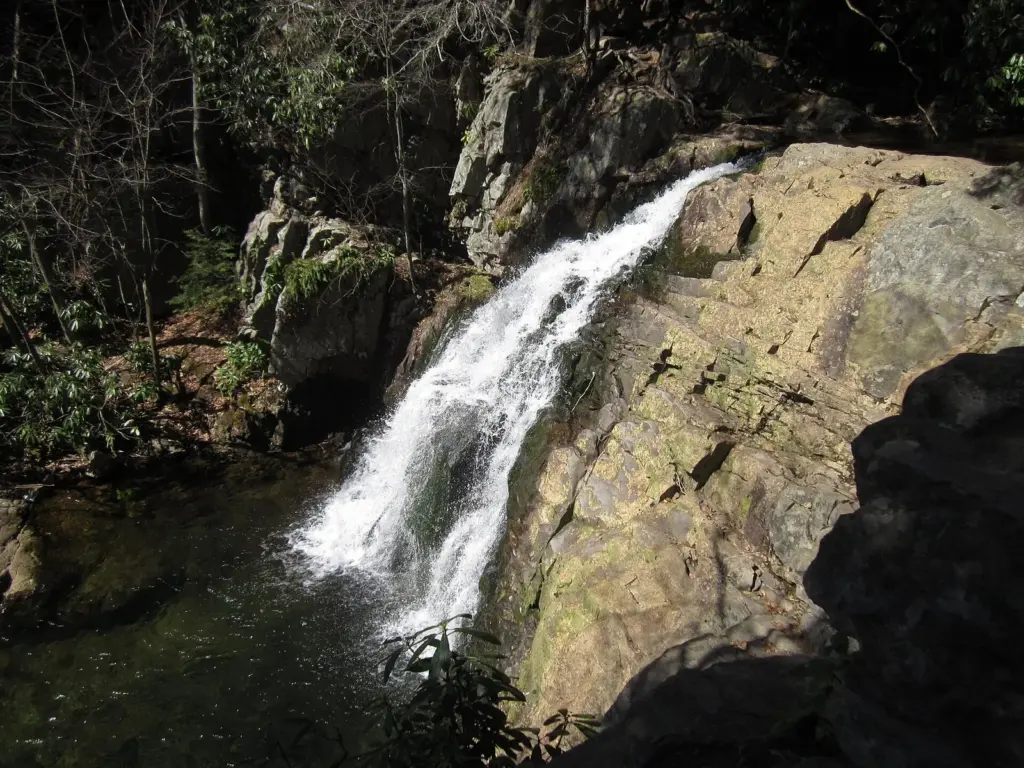
Free; the best short waterfall walk near Philadelphia. In Hickory Run State Park, the 0.6-mile Hawk Falls Trail leads to a 25-foot natural waterfall on the east side of the park. It’s an easy pairing with the park’s famous Boulder Field. The trail is often icy in winter.
Plan it: Hickory Run, Carbon County, about 1 hour 45 minutes from Philadelphia and 2 hours from Manhattan. Parking fills early on weekends. Allow 1 hour. Best for: families and Philadelphia day-trippers.
14. Sand Spring Run cascades
Free; small falls, big atmosphere. Hickory Run’s Shades of Death Trail follows Sand Spring Run past a chain of small natural cascades. None are big, but the shady gorge lives up to the trail’s name.
Plan it: Hickory Run State Park; combine with Hawk Falls. Best for: a moody walk in any season.
15. Glen Onoko Falls
Closed. Once one of the most popular waterfall hikes in the state, the Glen Onoko trail near Jim Thorpe closed in 2019 after repeated rescues and deaths on its steep, eroded route. DCNR has been rebuilding it with stone walls and steps, and the trail stays off-limits through 2026 with no reopening date. Don’t ignore the closure; choose Hawk Falls or Ricketts Glen instead.
Plan it: Lehigh Gorge State Park near Jim Thorpe; check DCNR for updates. Best for: waiting.
Ricketts Glen and the northeast
16. Ganoga Falls
Free; the highest at Ricketts Glen. Ganoga Falls, at 94 feet, is the tallest of Ricketts Glen’s 22 named waterfalls, a long, lacy drop down a wall of layered rock on the Ganoga Glen side of the Falls Trail.
Plan it: Ricketts Glen State Park, 695 State Route 487, Benton; about 3 hours from Philadelphia and Manhattan, and 4 hours 45 minutes from Pittsburgh. PA 487 from Red Rock up to the lake is very steep. Best for: the headline photo.
17. F.L. Ricketts Falls
Free; one of the prettiest on the trail. On the Glen Leigh branch of Kitchen Creek, this 38-foot fall pours over stepped rock into a clear pool, one of eight named falls on that side of the glen.
Plan it: Glen Leigh section of the Falls Trail. Best for: hikers doing the full loop.
18. Ganoga Glen
Free; the western half of the Falls Trail. The Ganoga Glen side of the trail descends past a string of falls, including Ganoga itself, on rocky, often wet steps. DCNR rates the Falls Trail system “most difficult” and asks hikers to be in good condition and wear sturdy boots.
Plan it: Combine Ganoga Glen, Glen Leigh and the Highland Trail for a 3.2-mile loop that passes most of the falls. Start early in October. Best for: fit hikers.
19. Glen Leigh
Free; the eastern half. Glen Leigh’s chain of falls on Kitchen Creek mirrors Ganoga Glen across the ridge. Many hikers go up one glen and down the other on the 3.2-mile loop.
Plan it: Glen Leigh section; slippery after rain. Best for: hikers who want the classic loop.
20. The lower Falls Trail
Free; old trees and more falls. Below where the two glens meet, the Falls Trail continues down Kitchen Creek through the Glens Natural Area, a National Natural Landmark with old-growth timber. Hiking both the upper and lower sections makes the full 7.2-mile loop and adds the remaining falls.
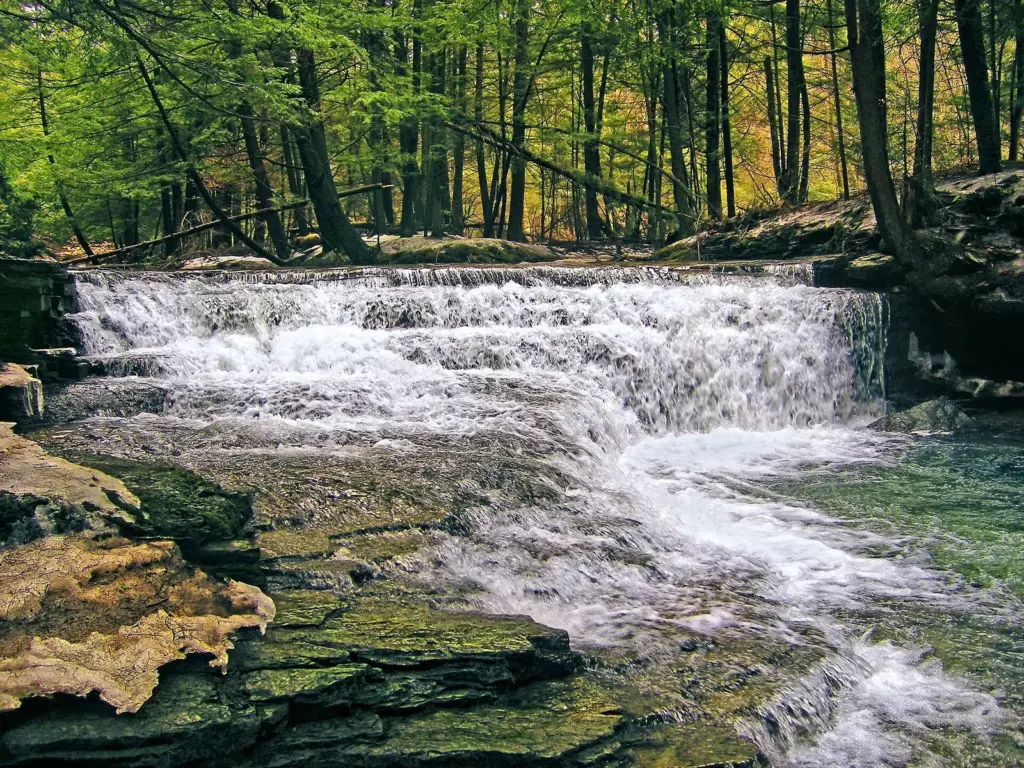
Plan it: Allow 4 to 5 hours for the full loop. The trail closes in winter except to equipped ice climbers and hikers. Best for: a full day on the trail. For the park’s cabins and camping, see our state parks guide.
21. Salt Springs State Park: the Fall Brook falls
Free; a hidden gem in the far northeast. In Susquehanna County, Salt Springs protects old-growth hemlocks, many more than 300 years old, and the rocky gorge where Fall Brook drops over three waterfalls. The volunteer Friends of Salt Springs Park run the park with DCNR.
Plan it: Near Montrose, about 3 hours from Philadelphia and Manhattan. Allow 1 to 2 hours. Best for: quiet and big trees.
22. Seven Tubs
Free; potholes and cascades. In Pinchot State Forest near Wilkes-Barre, Wheelbarrow Run drops through a series of small waterfalls into round glacial potholes, the “tubs,” carved into the sandstone by meltwater at the end of the ice age. The bridges and paths above the gorge give the best views.
Plan it: Off PA 115 near Wilkes-Barre, about 1 hour 45 minutes from Philadelphia. Stay out of the tubs: the rock is slick and the water deceptively strong. Best for: a short stop with kids.
23. Nay Aug Falls
Free; a gorge in the middle of a city. Scranton’s Nay Aug Park, the city’s largest, holds a waterfall on Roaring Brook in the rock chasm of Nay Aug Gorge. It’s a short walk from the park’s main areas; stay behind the barriers, since people have needed rescue from the rocks.
Plan it: Scranton, about 2 hours 15 minutes from Philadelphia and Manhattan. Pair with Steamtown. Best for: a city break with a waterfall.
Central and southeastern Pennsylvania
24. Rainbow Falls
Free; a small gorge near Raystown Lake. At Trough Creek State Park, Great Trough Creek cuts through Terrace Mountain, and rugged trails lead to Rainbow Falls and Balanced Rock, a boulder perched at a cliff edge above the gorge.
Plan it: Huntingdon County, about 2 hours 45 minutes from Pittsburgh and 3 hours 45 minutes from Philadelphia. Allow 2 hours. Best for: a Raystown Lake weekend.
25. The Turkey Path falls, Pennsylvania Grand Canyon
Free; waterfalls on the way into a canyon. Leonard Harrison State Park’s Turkey Path Trail (1 mile, yellow blazes) passes waterfalls on its way down an 800-foot descent to the bottom of Pine Creek Gorge, where it meets the Pine Creek Rail Trail. The climb back up is the hard part.
Plan it: 10 miles west of Wellsboro, about 4 hours 30 minutes from Philadelphia and 4 hours 45 minutes from Pittsburgh. The trailhead has restrooms and water. Best for: fit hikers on a Grand Canyon weekend.
26. Ringing Rocks Park waterfall
Free; Bucks County’s oddity. Ringing Rocks County Park is famous for a field of boulders that ring like bells when struck with a hammer, and a short walk away, a waterfall drops through the woods. It’s best after rain.
Plan it: Near Upper Black Eddy, about 1 hour 15 minutes from Philadelphia and 1 hour 30 minutes from Manhattan. Bring a hammer for the rocks. Best for: families on a New Hope weekend.
The Laurel Highlands and western Pennsylvania
Western Pennsylvania’s falls cluster around Ohiopyle and the gorges north of Pittsburgh. For the region’s other sights, from Fallingwater to Flight 93, see our guide to things to do in the Laurel Highlands.
27. Ohiopyle Falls
Free; the falls in the middle of town. Ohiopyle Falls is a wide, powerful drop on the Youghiogheny River right beside the borough of Ohiopyle, with viewing areas by the visitor center. Rafters launch just below it for the Lower Yough.
Plan it: Ohiopyle, about 1 hour 30 minutes from Pittsburgh and 4 hours 45 minutes from Philadelphia. State park parking is free; some borough lots charge. Best for: everyone.
28. Cucumber Falls
Free; the photogenic one. Cucumber Run drops off a rock ledge into a pool in a hemlock glen just outside Ohiopyle. You can reach it from a small parking area on the road, or walk the 0.4-mile Cucumber Falls Trail from town, rated difficult, which follows the river past Entrance Rapid before climbing over rock to the falls.
Plan it: Ohiopyle State Park; the roadside lot fills fast. Allow 45 minutes. Best for: photographers.
29. Jonathan Run Falls
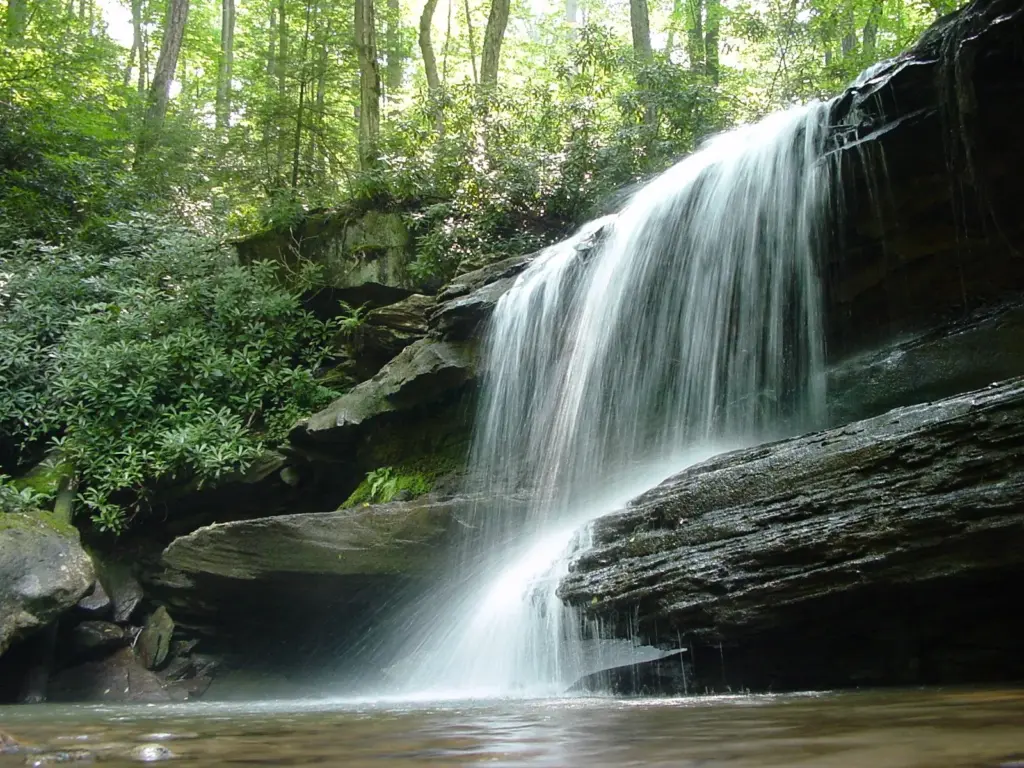
Free; a hike-in waterfall. Jonathan Run Trail (1.6 miles) climbs from near the Great Allegheny Passage up a side stream past a series of falls, the biggest dropping from an overhanging ledge. It’s a fine add-on to a bike ride on the GAP.
Plan it: Ohiopyle State Park, near the GAP. Wear shoes that can get wet; there are stream crossings. Best for: hikers and cyclists.
30. The Meadow Run Cascades
Free; rocky creek scenery. The 3.2-mile Meadow Run Trail follows a rock-strewn creek past the Cascades and Flat Rock; the nearest trailhead for them is on Dinnerbell Road just east of PA 381.
Plan it: Ohiopyle State Park. Sections are rocky. Best for: a quieter walk away from the falls crowds.
31. The Meadow Run natural waterslides
Free; summer fun with real risk. Where Meadow Run slides over smooth bedrock near PA 381, generations of visitors have ridden the natural waterslides. It’s a summer favorite, but the rock is hard and the current strong; wear old shorts, check the flow and follow the park’s posted guidance.
Plan it: Ohiopyle State Park, near PA 381. Avoid after heavy rain. Best for: teenagers and adventurous families in July and August.
32. Bear Run at Fallingwater
Paid; one of the most famous waterfall views in America. Frank Lloyd Wright set Fallingwater’s terraces directly over the falls of Bear Run. You can see the classic view from below the falls on a Grounds Pass ($18 in 2026) without touring the house, or join a guided house tour ($42). Fallingwater is closed on Wednesdays.
Plan it: Mill Run, about 1 hour 30 minutes from Pittsburgh; book ahead. Best for: architecture and waterfall lovers alike.
33. Adams Falls, Linn Run
Free; a picnic-area waterfall. At Linn Run State Park near Ligonier, DCNR’s “lovely waterfall,” Adam Falls, sits beside the Adams Falls Picnic Area, and the 1-mile Adam Falls Trail loops along the old Linn Run Road past big rock formations and wildflowers.
Plan it: Near Rector, about 1 hour 30 minutes from Pittsburgh. Rated more difficult despite its length. Best for: a family picnic.
34. Cole Run Falls
Free; a Forbes State Forest find. Cole Run Falls is a small waterfall in the woods of Forbes State Forest, which the regional tourism bureau lists alongside Ohiopyle’s better-known falls.
Plan it: Somerset County, about 1 hour 30 minutes from Pittsburgh. Get directions and road conditions from Forbes State Forest before you go. Best for: quiet explorers.
35. Kildoo Falls
Free; McConnells Mill’s gorge falls. McConnells Mill’s 3-mile Kildoo Trail loop starts at either end of the 1874 covered bridge; the easier eastern-bank section leads to Kildoo Falls, and the rockier remainder of the loop shows off the boulder-filled Slippery Rock Creek Gorge.
Plan it: Lawrence County, about 45 minutes from Pittsburgh. Never swim or wade in Slippery Rock Creek; its currents are dangerous. Best for: Pittsburgh hikers.
36. Hells Hollow Falls
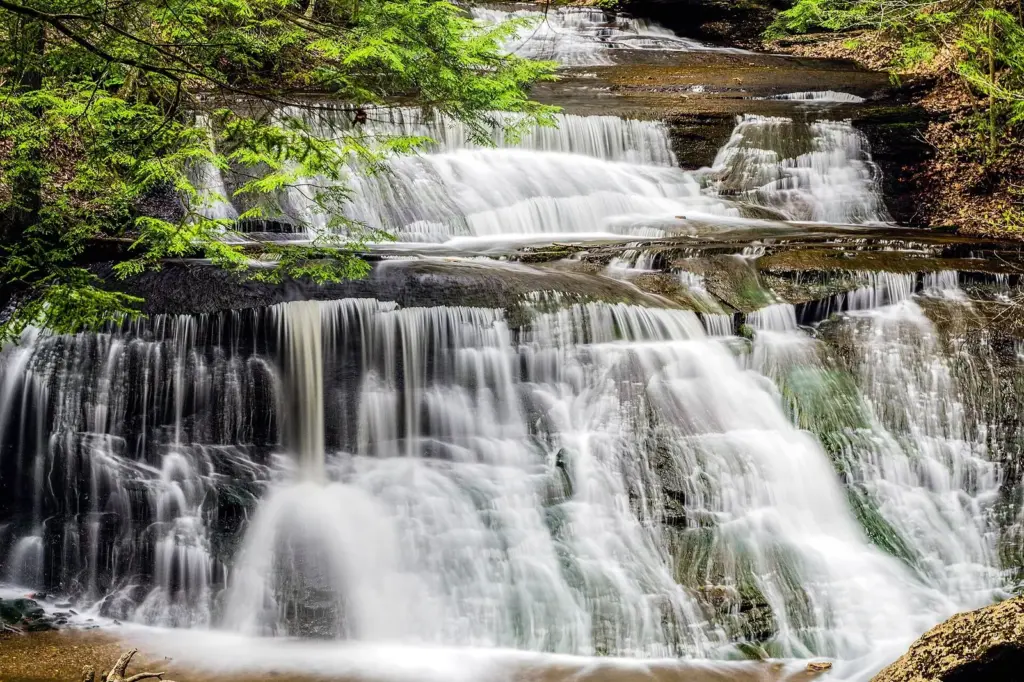
Free; the easiest good waterfall walk near Pittsburgh. From the Hells Hollow parking lot, the 0.5-mile Hells Hollow Trail (rated easiest) crosses Hell Run, passes an old lime kiln and ends at Hells Hollow Falls, which spreads over stepped ledges. The main trail is smooth and level, but the section by the falls can be slippery.
Plan it: McConnells Mill State Park, about 45 minutes from Pittsburgh. Allow 45 minutes. Best for: families with small children.
37. Buttermilk Falls, Beaver County
Free; a county park waterfall. Beaver County’s Buttermilk Falls Park near Homewood is a natural area built around a 40-foot sandstone formation and waterfall. The stone is Homewood Sandstone, once quarried for bridges, tunnels and Pittsburgh’s Western Penitentiary.
Plan it: Near Homewood, about 40 minutes north of Pittsburgh. Best for: a short trip from the city.
38. Springfield Falls
Free; short and steep. Also called Leesburg Falls, Springfield Falls is a wide waterfall of about 20 feet on state game lands near Volant in Mercer County, reached by a short, steep and slippery path down to its base.
Plan it: About 1 hour from Pittsburgh. Wear orange in hunting season and good shoes always. Best for: a stop on a Volant or McConnells Mill day.
39. Fall Run Park
Free; Pittsburgh’s closest waterfall. Fall Run Park in Shaler Township, just north of Pittsburgh along Route 8, is a small nature reserve with an easy trail along Fall Run to a waterfall of about 25 feet, roughly half a mile in, with bridges at the stream crossings.
Plan it: About 15 minutes from downtown Pittsburgh. Best for: a quick after-work walk.
40. Big Run Falls, Cascade Park
Free; history and a waterfall. New Castle’s Cascade Park, a former amusement park that operated from the 1890s into the early 1980s, keeps Big Run Falls, a 20- to 25-foot waterfall reached by a short walk to an overlook in the middle of the park.
Plan it: New Castle, about 1 hour from Pittsburgh. Best for: an easy stop with history.
Easy waterfall walks and harder hikes
Pennsylvania has waterfalls for every ability. These are the easiest to reach and the ones that demand real effort, from the official trail descriptions.
| Waterfall | The walk | Effort |
|---|---|---|
| Ohiopyle Falls | Viewing areas beside the visitor center in town | Easiest |
| Bushkill Falls (Main Falls) | Green Trail, about 15 minutes, with steps | Easy |
| Raymondskill Falls | 0.3 mile with 178 feet of elevation change | Easy to moderate |
| Hells Hollow Falls | 0.5 mile, smooth and level until the falls | Easy |
| Hawk Falls | 0.6 mile; often icy in winter | Easy to moderate |
| Cucumber Falls | Short walk from a roadside lot, or 0.4 mile from town on a difficult path | Easy to difficult |
| Tumbling Waters | 2.8-mile loop, 254 feet of climbing | Moderate |
| Kildoo Falls | Easier eastern section of a 3-mile loop | Moderate to difficult |
| Turkey Path falls | 1 mile down 800 feet into Pine Creek Gorge, and back up | Difficult |
| Ricketts Glen Falls Trail | 3.2 or 7.2 miles on steep, wet rock | Most difficult |
Photographing Pennsylvania’s waterfalls
Overcast days are best: bright sun creates harsh contrast between white water and dark gorges, while cloud cover evens the light and deepens the greens. Early morning also keeps you ahead of the crowds at Ricketts Glen and Bushkill. For the silky look, use a tripod or a steady rock and a slow shutter speed of a half second or longer; a polarizing filter cuts glare on wet rock and leaves. Spring flow gives the biggest falls, while October puts color in the frame.
Stay on the trail for every shot. Many injuries at Pennsylvania waterfalls happen to people stepping onto wet rock for a better angle, and climbing falls, pools and cliffs is banned outright in the Delaware Water Gap. Protect your gear with a dry bag: spray reaches farther than you’d think at the bigger falls.
Can you swim at Pennsylvania’s waterfalls?
Mostly, no, and the rules exist for good reasons: plunge pools hide rocks and undercurrents, and the rock around falls is slick. In the Delaware Water Gap, NPS bans swimming and wading within 50 feet upstream of any waterfall and in the falls themselves, and bans climbing falls, pools and cliffs. In state parks, swim only where the park designates a swimming area or beach. Bushkill Falls is for looking, not swimming.
The well-known exceptions are spots where people slide or wade at their own risk, such as the Meadow Run natural waterslides at Ohiopyle, and creek swimming areas a park sets aside, such as Loyalsock Creek at Worlds End. Check the park’s current guidance, avoid high water after storms, and never swim alone.
Waterfalls in Pennsylvania by season
Spring (March to May): peak flow from snowmelt and rain. Every fall on this list is at its fullest. Trails are muddy.
Summer (June to August): lush green gorges and cooler air in the hemlock ravines, but smaller falls can thin out in dry spells. Go after a storm. Crowds peak on weekends.
Fall (September to November): October color around Ricketts Glen, the Poconos and Ohiopyle, with moderate flow. The busiest time at the big-name falls, so arrive early. Bushkill closes after November.
Winter (December to February): frozen falls are spectacular, but trails turn dangerous: Ricketts Glen’s Falls Trail closes except to equipped ice climbers and hikers, Hawk Falls’ trail is often icy, Bushkill is closed and Raymondskill’s upper lot is shut. Bring traction devices and choose short, flat approaches.
Waterfalls near Philadelphia, Pittsburgh and New York
From Philadelphia: Ringing Rocks (1 hour 15 minutes), Hawk Falls and the Hickory Run cascades (1 hour 45 minutes), Seven Tubs (1 hour 45 minutes), Bushkill and Tumbling Waters (2 hours 15 minutes) and Raymondskill (2 hours 30 minutes).
From Pittsburgh: Fall Run Park (15 minutes), Buttermilk Falls (40 minutes), Hells Hollow and Kildoo at McConnells Mill (45 minutes), Springfield Falls and Cascade Park (1 hour), and Ohiopyle’s falls, Linn Run and Fallingwater (1 hour 30 minutes).
From New York: Raymondskill, Dingmans (when reopened) and Ringing Rocks (about 1 hour 30 minutes), Bushkill, Tumbling Waters and Shohola (about 1 hour 45 minutes), and Hawk Falls (about 2 hours).
What’s changed, and what to skip
- Dingmans and Silverthread Falls are closed for construction, with no reopening date announced.
- Glen Onoko is still closed. Don’t climb around the barriers; the route is genuinely dangerous.
- Bushkill raised its prices on September 24, 2026, and closes from December through March.
- Skip: Ricketts Glen in sneakers or after dark, the big falls on October Saturday afternoons, swimming in any plunge pool, and leaving valuables in cars at remote trailheads.
Pennsylvania Waterfalls FAQ
What is the tallest waterfall in Pennsylvania?
The National Park Service says Raymondskill Falls, in the Delaware Water Gap National Recreation Area near Milford, is the tallest waterfall in Pennsylvania. It drops in three tiers and is reached by a 0.3-mile trail with two viewing platforms. Dingmans Falls, five miles south and currently closed, is the second tallest.
Where are the best waterfalls in Pennsylvania?
Ricketts Glen State Park has the best concentration: 22 named waterfalls, 21 of them on the Falls Trail. The Poconos and the Delaware Water Gap have Raymondskill, Bushkill and Hawk Falls; the Laurel Highlands have Ohiopyle’s falls and Cucumber Falls; and McConnells Mill, north of Pittsburgh, has Hells Hollow and Kildoo Falls.
Are there waterfalls in the Poconos?
Yes, many. The best include Raymondskill Falls, Bushkill Falls (eight falls on private trails, $24 for adults), Hawk Falls in Hickory Run State Park, Tumbling Waters, Hackers Falls and Shohola Falls. Dingmans Falls and Glen Onoko Falls are closed in 2026.
Can you swim at waterfalls in Pennsylvania?
Generally no. In the Delaware Water Gap, swimming and wading are banned within 50 feet upstream of waterfalls and in the falls themselves. In state parks, swim only at designated areas. Some spots, such as Ohiopyle’s Meadow Run waterslides, allow sliding at your own risk; check conditions first.
When is the best time to see waterfalls in Pennsylvania?
Spring, from March to May, for the strongest flow; October for fall color with moderate flow; and any time after a heavy rain. Late summer can leave smaller falls thin. Winter ice is beautiful but makes trails dangerous, and some, like Ricketts Glen’s Falls Trail, close.
How long is the Ricketts Glen Falls Trail?
The full Falls Trail loop is 7.2 miles if you hike both the upper and lower sections. A 3.2-mile loop using the Highland Trail and the Ganoga Glen and Glen Leigh sides passes most of the falls. DCNR rates it most difficult: wear sturdy boots and allow 3 to 5 hours.
Is Bushkill Falls worth the money?
For families and anyone who wants big falls with easy, well-built access, yes: $24 gets you eight waterfalls on trails from 15 minutes to about 2 hours. Serious hikers on a budget will find free, wilder falls at Ricketts Glen, Raymondskill and Hawk Falls.
Related Pennsylvania Guides
- Pennsylvania state parks: Ricketts Glen, Hickory Run, Ohiopyle and the rest, with camping and cabins.
- Things to do in the Poconos: the region around Bushkill, Raymondskill and Hawk Falls.
- Things to do in the Laurel Highlands: Ohiopyle, Fallingwater and the western falls.
Sources and How We Checked
Everything on this page was checked on October 1, 2026 against the official sources below and compiled from them; we don’t claim first-hand visits. Drive times are free-flow estimates from OpenStreetMap-based routing (the Valhalla engine), rounded to the nearest 15 minutes.
- NPS, Raymondskill Creek Trail, Hackers Trail and Tumbling Waters Trail: lengths, difficulty and rules.
- NPS, Delaware Water Gap waterfalls: swimming and climbing rules.
- DCNR, Ricketts Glen, plus DCNR’s pages for Hickory Run, Ohiopyle, McConnells Mill, Linn Run, Leonard Harrison, Trough Creek and Salt Springs.
- Bushkill Falls, trails and admission: falls, trail times, prices and season.
- Beaver County, Buttermilk Falls Park.
Closure details for Dingmans Falls and Glen Onoko come from NPS and DCNR notices from September 2026. For Shohola Falls, Seven Tubs, Nay Aug Falls, Cole Run Falls, Springfield Falls, Fall Run Park and Cascade Park, confirm access and hours with the local park or tourism office before you go.
Pennsylvania Tourism Guide is an independent publication. We are not affiliated with the National Park Service, DCNR, Bushkill Falls, Fallingwater, the Pennsylvania Game Commission, Beaver County or any park named here, and no one paid to be included.
Photo Credits
- Waterfall on the Falls Trail, Ricketts Glen State Park: photo by pickupimage, via Wikimedia Commons (CC0)
- Raymondskill Falls: photo by G. Edward Johnson, via Wikimedia Commons (CC BY 4.0)
- Dingmans Falls: photo by Doug Kerr from Albany, NY, United States, via Wikimedia Commons (CC BY-SA 2.0)
- Main Falls, Bushkill Falls: photo by Renata3, via Wikimedia Commons (CC BY-SA 4.0)
- Hawk Falls, Hickory Run State Park: photo by Doug Kerr from Albany, NY, United States, via Wikimedia Commons (CC BY-SA 2.0)
- Fall Brook, Salt Springs State Park: photo by Nicholas, via Wikimedia Commons (CC BY 2.0)
- Jonathan Run Falls, Ohiopyle State Park: photo by Hubert Stoffels from Pittsburgh, USA, via Wikimedia Commons (CC BY 2.0)
- Hells Hollow Falls, McConnells Mill State Park: photo by J7u, via Wikimedia Commons (CC BY-SA 4.0)