For three days in July 1863, the fields around a Pennsylvania crossroads town of about 2,400 people held more than 160,000 soldiers, and when it was over, some 51,000 had been killed, wounded, captured or missing. Four months later Abraham Lincoln came to dedicate a cemetery and spoke for about two minutes. The best things to do in Gettysburg start there: the battlefield, now a national military park you can drive, walk or ride through for free, and the cemetery where the Gettysburg Address was given. Then there’s a lively small town of museums, historic houses, taverns and ghost tours. This guide covers how to see it well, with 2026 prices, a stop-by-stop battlefield route, and one- and two-day plans.
Quick answer: Start at the Gettysburg Museum and Visitor Center with the film, the Cyclorama painting and the museum ($20.75 for adults as of September 2026). Then tour the battlefield in battle order, ideally with a Licensed Battlefield Guide in your own car ($82 for two hours for up to six people) or on the park’s free self-guided auto tour, making time for Little Round Top, the Wheatfield and the Angle. Walk the Soldiers’ National Cemetery at the end of the day, spend the evening in town, and give a second day to the Seminary Ridge Museum, the Eisenhower farm and the town’s museums.
Last updated September 30, 2026. Prices, hours and closures were checked on September 24, 2026 against the National Park Service and each museum’s website.
- What’s free: the battlefield, the park roads and the Museum and Visitor Center building. You pay for the film, Cyclorama and museum ticket, guided tours and the town’s private museums.
- Guides: the NPS-approved rate for a Licensed Battlefield Guide is $82 for two hours and $117 for three, for one to six people in your car, as of September 2026.
- Little Round Top is open: it reopened in June 2024 after a 22-month rehabilitation of its trails and parking.
- Park hours: battlefield roads open 30 minutes before sunrise and close 30 minutes after sunset.
- Coming up: Dedication Day on November 19, 2026 marks the 163rd anniversary of the Gettysburg Address.
On this page: At a glance | The battle in five minutes | How to tour | Battlefield stops | The civilians | Driving route | Going deeper | Who’s who | Walking | Monuments | The Address | Museums and town | Photography | Ghost tours and evenings | With kids | What to bring | Accessibility | Cost | Where to eat | Where to stay | By season | Itineraries | Getting there | FAQ
Things to Do in Gettysburg at a Glance
Gettysburg National Military Park wraps around the town on three sides, so the battlefield, the cemetery and the town center are all within a few minutes’ drive. These are the core stops, with prices as of September 2026.
| Stop | Cost | Time needed | Best for |
|---|---|---|---|
| Museum and Visitor Center (film, Cyclorama, museum) | $20.75 adults, $15.75 ages 6-12; building free | 2 to 3 hours | Everyone, first |
| Battlefield by car, self-guided | Free | 3 hours or more | Independent travelers |
| Licensed Battlefield Guide in your car | $82 for 2 hours (1-6 people) | 2 to 3 hours | Anyone who wants the story told well |
| Soldiers’ National Cemetery | Free | 45 minutes | Everyone |
| Seminary Ridge Museum | Paid; cupola tour extra | 1.5 to 2 hours | History buffs |
| Eisenhower National Historic Site | No entrance fee | 2 hours | 20th-century history fans |
| Town museums and houses | Paid | 1 hour each | Civilian history, families |
| Ghost tours | Paid | 1 to 2 hours, evenings | Teens, adults |
The Battle of Gettysburg in Five Minutes
You’ll get far more out of the battlefield if you know the shape of the three days before you drive it. Here’s the short version.
The setup. In June 1863, Robert E. Lee led the Confederate Army of Northern Virginia north into Pennsylvania, hoping a victory on Northern soil would weaken the Union’s will to fight. The Union Army of the Potomac followed, under George G. Meade, who had been given command only days before. Roads from ten directions met at Gettysburg, which is why the armies collided there.
July 1: the first day. Union cavalry under John Buford held the ridges west of town and slowed the Confederate advance until Union infantry arrived. General John Reynolds was killed early in the fighting. By afternoon, Confederates attacking from the west and north broke the Union lines, and Union troops retreated through the streets of town to Cemetery Hill and Culp’s Hill, the high ground south of Gettysburg. That retreat set up everything that followed.
July 2: the second day. The Union army dug in along a fishhook-shaped line from Culp’s Hill around Cemetery Hill and south along Cemetery Ridge to the Round Tops. Lee attacked both ends. On the Union left, Confederate troops under James Longstreet struck in the late afternoon, and some of the war’s most savage fighting swept through the Peach Orchard, the Wheatfield and the boulders of Devil’s Den. On Little Round Top, Union reinforcements arrived just in time, and the 20th Maine held the far end of the line with a downhill bayonet charge. At dusk, Confederates also attacked East Cemetery Hill and Culp’s Hill.
July 3: the third day. After a morning fight at Culp’s Hill, Confederate artillery opened a huge bombardment on the center of the Union line. Then about 12,500 Confederate infantry stepped out of the woods on Seminary Ridge and marched across nearly a mile of open fields toward a clump of trees on Cemetery Ridge, the attack remembered as Pickett’s Charge. A few hundred reached the stone wall at the Angle before the assault collapsed. On July 4, Lee’s army began its retreat to Virginia in the rain.
Afterward. The town was left with thousands of wounded soldiers and thousands of dead. That November, a new Soldiers’ National Cemetery was dedicated for the Union dead, and on November 19, 1863, after a two-hour oration by Edward Everett, Lincoln delivered the Gettysburg Address in about two minutes. Visit the ground in that order, first day to third, and the landscape explains itself.
How to Tour the Gettysburg Battlefield
The battlefield covers thousands of acres, with more than 1,300 monuments and markers, so how you tour it matters. These are the options, from cheapest to most personal.
| Option | Cost | Time | Good for | Drawback |
|---|---|---|---|---|
| Self-guided auto tour | Free | 3 hours or more | Flexible schedules, repeat visitors | Easy to miss the story between stops |
| Ranger programs | Free | 1 to 2 hours each | Specific places and themes | Mostly seasonal, set times |
| Licensed Battlefield Guide in your car | $82 (2 hours) or $117 (3 hours), 1-6 people | 2 to 3 hours | First-timers, families, anyone | Book ahead in spring, summer and fall |
| Bus tour | Paid per person | 2 to 2.5 hours | Solo travelers, groups | Less tailored, larger crowds |
| Bike, horseback or Segway tour | Paid | 1 to 3 hours | Active travelers | Weather-dependent |
Our pick: book a Licensed Battlefield Guide for your first visit. These guides pass a demanding exam and ride in your own car, so a two-hour tour is private, tailored and far better than anything you can piece together from signs. Book through the Association of Licensed Battlefield Guides, which doesn’t add a fee, or at the Museum and Visitor Center, which may add a ticketing surcharge. The NPS-approved rate is $82 for two hours for one to six people, as of September 2026. Then return on your own to the places that grabbed you.
Free ranger programs run mostly from spring to fall, with talks and walks at specific places such as the Angle, Little Round Top and the national cemetery; the busiest schedule comes around the battle anniversary on July 1 to 3, when rangers lead programs at the exact times the fighting happened. Check the schedule at the visitor center when you arrive. Bus tours leave from town and the visitor center with live or recorded narration, and they suit solo travelers who don’t want to drive, though they can’t stop everywhere a private guide can.
If you drive it yourself, pick up a map at the visitor center and follow the park’s self-guided auto tour, which runs in battle order. The route is one-way in places, parking at the most popular stops fills on weekends, and the roads close 30 minutes after sunset. Get out of the car often: the view from the ground is the whole point.
The Gettysburg Battlefield, Stop by Stop (1-18)
These stops follow the battle in order, from the first shots northwest of town to the cemetery where Lincoln spoke. Allow a full day to see them all at a comfortable pace.
1. Gettysburg Museum and Visitor Center
Building free, ticket paid; year-round; south of town on Baltimore Pike. Start here. The film A New Birth of Freedom, narrated by Morgan Freeman, sets up the campaign; then you climb into the Cyclorama, Paul Philippoteaux’s 1880s painting of Pickett’s Charge, which wraps all the way around you with a lit, three-dimensional foreground. The museum below is excellent on the causes and the aftermath as well as the fighting. The painting, one of only a handful of American cycloramas to survive, was restored for the current building, which opened in 2008, and the lighting and sound show that runs every few minutes is worth waiting for. The bookstore is one of the best places in the country to buy a Civil War history, and the information desk is where you book guides and pick up the free park map.
Plan it: 1195 Baltimore Pike. Tickets cost $20.75 for adults, $19.75 for seniors and veterans and $15.75 for ages 6 to 12, as of September 2026; kids under 6 and active military are free. Allow 2 to 3 hours. Best for: everyone, first thing.
2. McPherson Ridge and the first shots
Free; year-round; west of town on the Chambersburg Pike. On the morning of July 1, Buford’s dismounted cavalry held this low ridge against the first Confederate infantry, buying time for Union reinforcements. General John Reynolds was killed at the edge of the woods nearby. Stand by the equestrian statue of Buford and look west down the road the Confederates came in on. Nearby, a statue honors John Burns, a 69-year-old resident of the town who picked up his old musket and fought beside the Union’s Iron Brigade in the woods here. The first day is the least visited part of the battlefield, and that’s a reason to come: you’ll often have these ridges to yourself.
Plan it: The first stops of the auto tour. Allow 20 minutes. Best for: history buffs.
3. The Railroad Cut
Free; year-round; just north of McPherson Ridge. An unfinished railroad bed sliced a deep trench through the ridge in 1863, and on the first morning Confederate soldiers who took shelter in it found themselves trapped when Union troops reached the edge above them. It’s a small place with a sharp lesson about terrain. Soldiers from Wisconsin, New York and Indiana charged across the open field to the lip of the cut and captured hundreds of Mississippians and North Carolinians trapped below, one of the few clear Union successes of the first morning.
Plan it: A short walk from the McPherson Ridge stop. Allow 15 minutes. Best for: history buffs.
4. The Eternal Light Peace Memorial
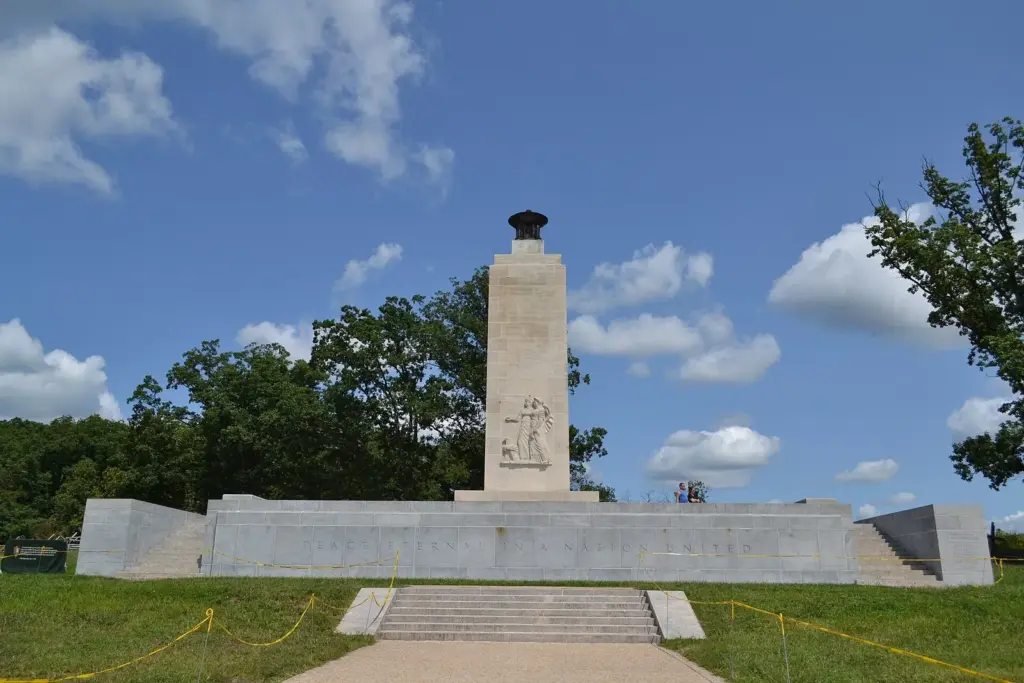
Free; year-round; Oak Hill, north of town. Franklin Roosevelt dedicated this memorial in 1938 at a reunion of Union and Confederate veterans marking the battle’s 75th anniversary, and its flame is meant to symbolize “peace eternal in a nation united.” Oak Hill was where Confederate artillery opened on the Union’s first-day line, and the view across the northern fields is one of the best on the battlefield. From the memorial, drive or walk along Doubleday Avenue on Oak Ridge, where Union troops faced north against the Confederate attack, and climb the observation tower there for a clear picture of the first day’s ground.
Plan it: On Oak Hill off Mummasburg Road. Allow 20 minutes. Best for: everyone.
5. Barlow Knoll
Free; year-round; north of town on Harrisburg Road. On the afternoon of July 1, Union general Francis Barlow pushed his division onto this rise, too far forward, and the Union line north of town collapsed around it. Here you can see how the first day was lost and why the retreat through the streets followed. Many of the Union soldiers who fought here belonged to the XI Corps, which had a large share of German immigrants and was unfairly blamed for years afterward for the collapse.
Plan it: Off Harrisburg Road (Route 15 Business). Allow 15 minutes. Best for: history buffs.
6. Seminary Ridge and the Seminary Ridge Museum
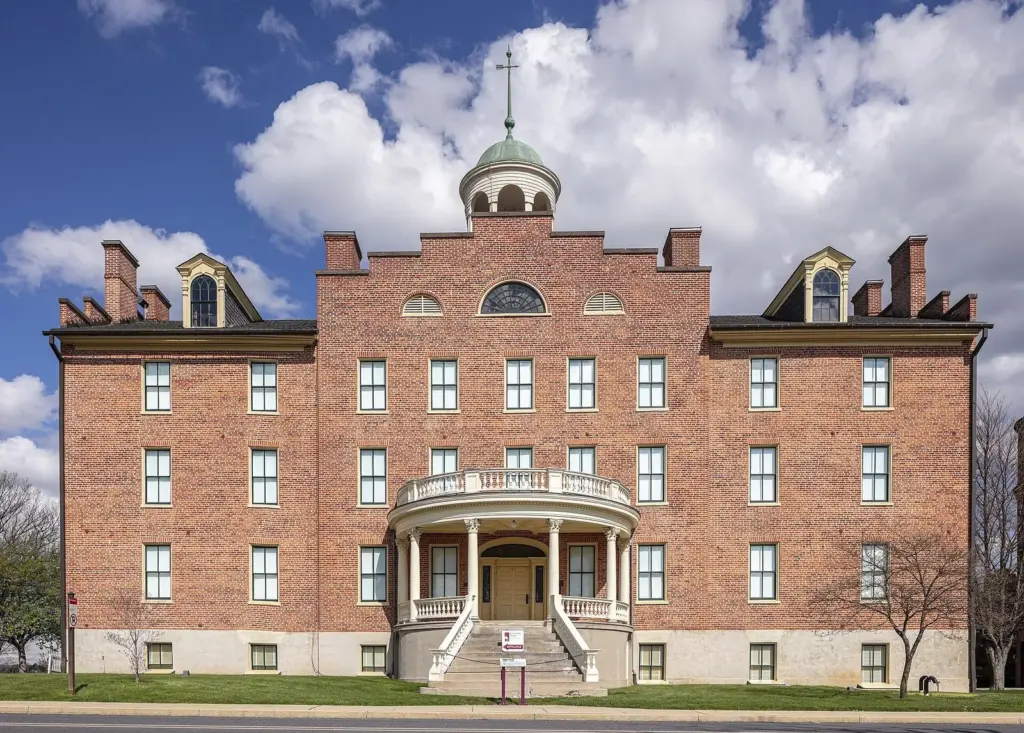
Paid; Wednesday to Sunday; west of town. Buford watched the first day’s fighting from the cupola of the Lutheran seminary’s main building, which then served as a field hospital for weeks. Since 2013 the building has housed the Seminary Ridge Museum, with four floors on the battle, the wounded and the moral questions of the war, and a guided cupola tour that climbs to the lookout itself. The exhibits also cover the care of the thousands of wounded who filled the building and the moral and religious arguments over slavery that divided the country, which makes it a good complement to the military story told at the visitor center.
Plan it: On the seminary campus off Seminary Ridge. Open Wednesday to Sunday from 9am. The cupola tour costs extra, isn’t wheelchair accessible and requires children to be at least 48 inches tall. Allow 1.5 to 2 hours. Best for: history buffs.
7. The Virginia Memorial
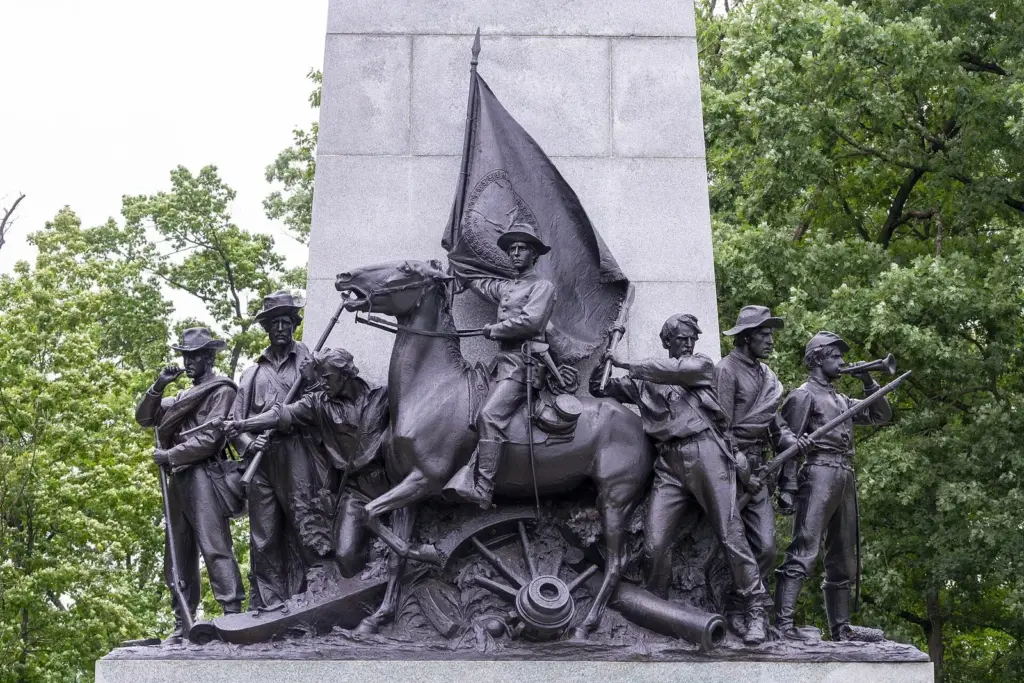
Free; year-round; West Confederate Avenue. A 1917 monument crowned by Robert E. Lee on his horse, Traveller, stands near the spot where Lee watched Pickett’s Charge unfold. Walk out past it into the open field and look east to the clump of trees on Cemetery Ridge, nearly a mile away, and the scale of the attack becomes clear. A little south along West Confederate Avenue, the North Carolina Memorial is the work of Gutzon Borglum, the sculptor who went on to carve Mount Rushmore.
Plan it: On West Confederate Avenue along Seminary Ridge. Allow 30 minutes, longer if you walk into the field. Best for: everyone.
8. The Peach Orchard
Free; year-round; the Emmitsburg Road. On July 2, Union general Daniel Sickles moved his corps forward from the main line to this higher ground without orders, creating a salient that Longstreet’s attack shattered. The orchard is replanted, and standing in it you can see both why Sickles wanted the ground and why it was so hard to hold. Sickles lost his right leg to a cannonball near here; he later gave the bone to the Army Medical Museum in Washington and, the story goes, visited it for years afterward.
Plan it: Along the Emmitsburg Road. Allow 20 minutes. Best for: history buffs.
9. The Wheatfield
Free; year-round; south-central battlefield. A 20-acre field that changed hands several times on the evening of July 2 as brigade after brigade was fed into the fight. At its edge stands a statue of Father William Corby, the Irish Brigade’s chaplain, who gave the troops general absolution from a rock before they went in. Nearby, the Irish Brigade monument, a Celtic cross with an Irish wolfhound lying at its base, honors the New York regiments who went into the field with his blessing. Walking trails cross the Wheatfield and the woods around it; in the quiet of a weekday morning, it’s one of the most affecting places on the battlefield.
Plan it: Along Wheatfield Road; the Corby statue is on Hancock Avenue. Allow 30 minutes. Best for: history buffs.
10. Devil’s Den
Free; year-round; below Little Round Top. A jumble of enormous boulders where Texans, Alabamians and Georgians fought Union troops on July 2, and where the photographer Alexander Gardner later moved a dead soldier’s body to stage one of the war’s most famous images. Kids love scrambling on the rocks; remember it’s a place where men died. Walk down to the Slaughter Pen along Plum Run, below the boulders, and look up at Little Round Top from the valley the soldiers called the Valley of Death; the climb they faced becomes obvious.
Plan it: Parking is limited on busy days. Allow 30 minutes. Best for: families, photographers.
11. Little Round Top
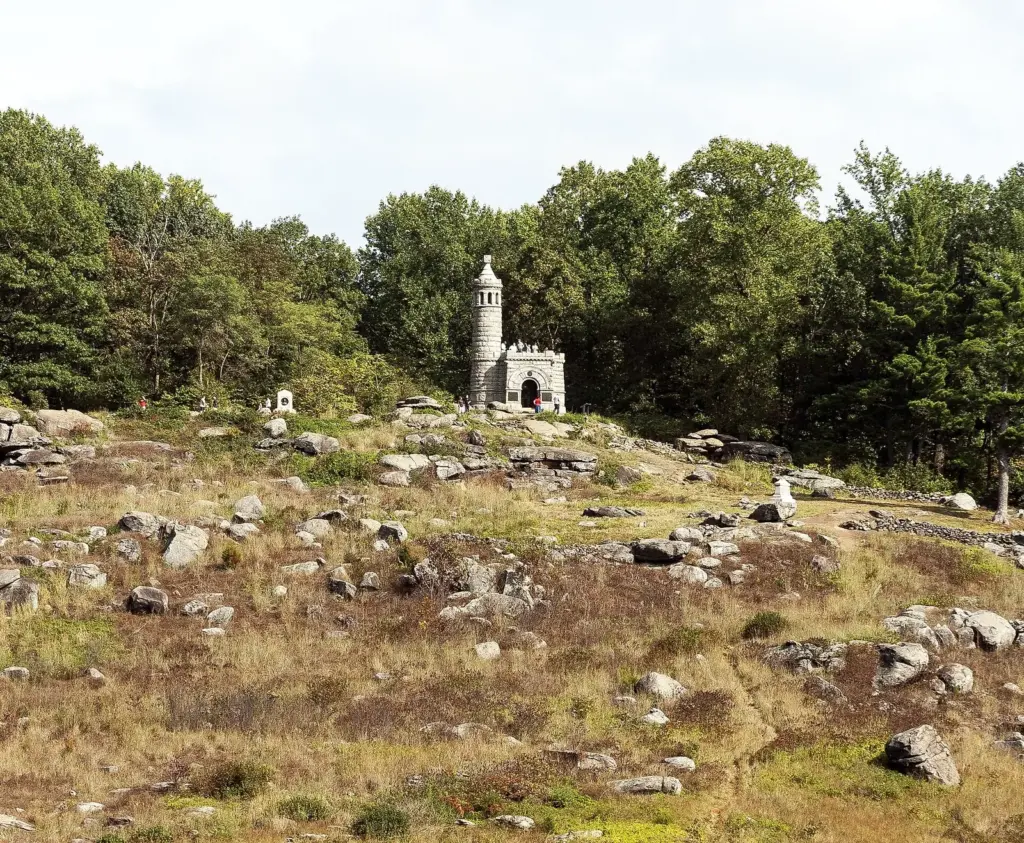
Free; year-round; the south end of the Union line. Union engineer Gouverneur Warren spotted that this rocky hill was nearly undefended on July 2 and rushed troops to it just in time; on its southern slope, the 20th Maine under Joshua Chamberlain held the end of the line and finally charged downhill with bayonets. Warren’s statue still looks out from the summit. The hill reopened in June 2024 after a 22-month rehabilitation that rebuilt its trails, parking and accessibility. Walk the short trail along the southern slope to the 20th Maine’s monument, in the woods where Chamberlain’s men fought, and to the castle-like 44th New York monument near the summit, which you can climb for a wider view.
Plan it: On Sykes Avenue. Come early or late in the day; the summit is the most crowded spot on the battlefield. Allow 45 minutes. Best for: everyone.
12. The Pennsylvania Memorial
Free; year-round; Hancock Avenue on Cemetery Ridge. The largest state monument on the battlefield, a domed granite memorial topped by a statue of Victory, lists the names of the Pennsylvanians who fought here on bronze tablets around its base, along with statues of Lincoln and Pennsylvania’s generals. Visitors search for ancestors’ names; bring the regiment if you know it. It was dedicated in 1910 and remains the largest monument on the field. A few steps north, the small monument to the 1st Minnesota marks a regiment that charged into the Confederate advance on July 2 to plug a gap in the line and lost most of its men in minutes.
Plan it: On Hancock Avenue along Cemetery Ridge. Allow 30 minutes. Best for: family historians, everyone.
13. The Angle and the High Water Mark
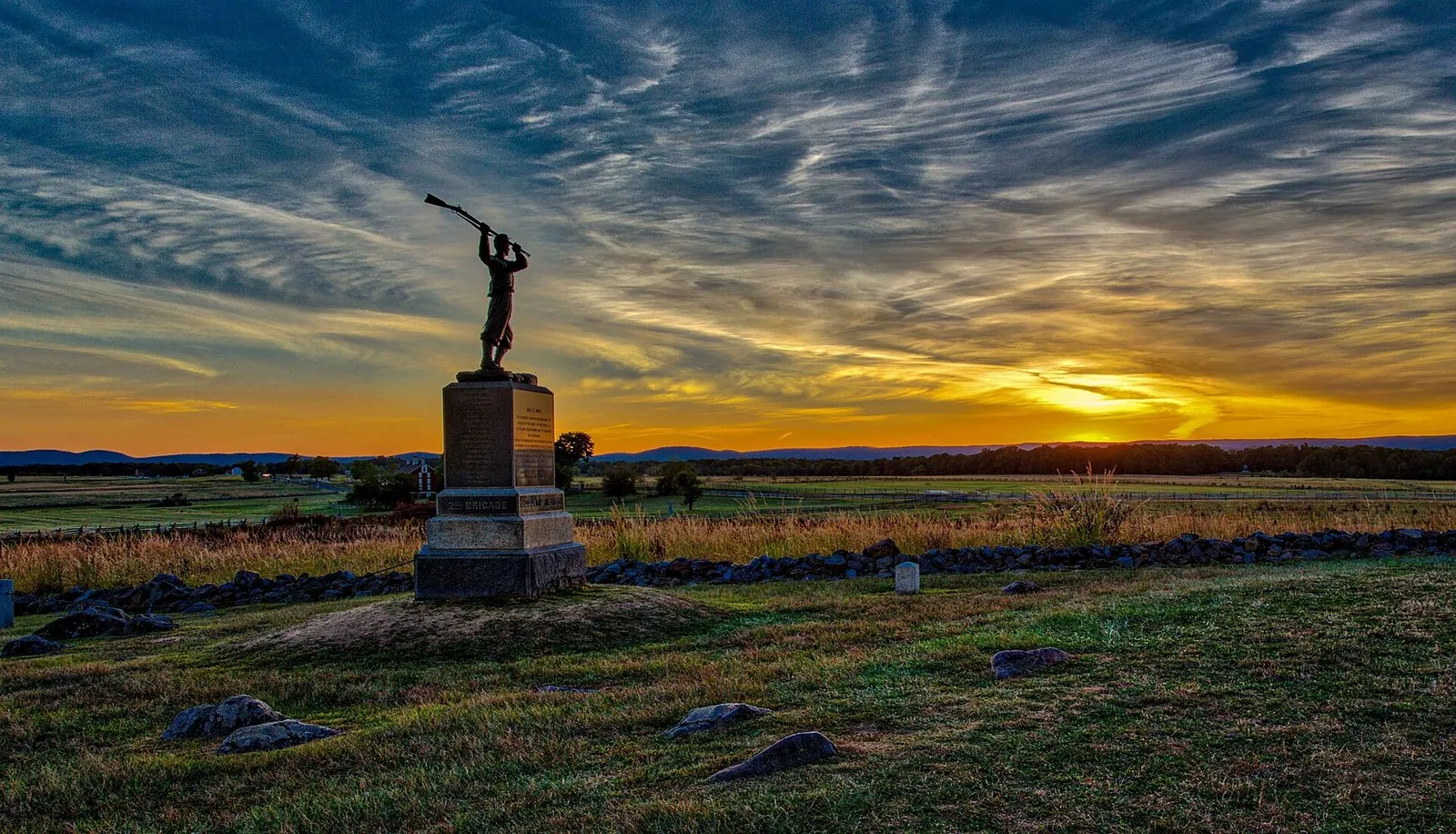
Free; year-round, best at sunset; Cemetery Ridge. This is where Pickett’s Charge struck the Union line at a jog in a low stone wall, near a small clump of trees, and where Confederate general Lewis Armistead fell inside the wall. The spot is often called the High Water Mark of the Confederacy. Stand at the wall, look west to Seminary Ridge, and then walk part of the way across the field yourself. Nearby, the High Water Mark monument, an open bronze book dedicated in 1892, lists the units on both sides that fought here. The 72nd Pennsylvania’s monument, the soldier swinging his musket like a club, stands at the wall after the regiment went to court to have it placed exactly where its men fought.
Plan it: Along Hancock Avenue, a short walk from the Pennsylvania Memorial. Sunset here, with the light behind the Confederate line, is the most moving moment on the battlefield. Allow 45 minutes. Best for: everyone.
14. Culp’s Hill
Free; year-round; southeast of town. The wooded hill at the Union right saw fighting on the evening of July 2 and the morning of July 3, and Union earthworks still snake through the trees. An observation tower on the summit gives a rare overview of the whole northern end of the field. Union soldiers built log-and-stone breastworks along these slopes overnight, and an interpretive trail follows the line through the woods. It’s shady and quiet, a welcome break on a hot afternoon.
Plan it: Off Baltimore Pike. Allow 30 minutes. Best for: history buffs, families.
15. East Cemetery Hill and the Evergreen Cemetery
Free; year-round; the south edge of town. Union artillery on this hill beat back a Confederate assault at dusk on July 2. Beside it, the town’s Evergreen Cemetery, with its 1850s brick gatehouse, gave Cemetery Hill its name; Jennie Wade, the only civilian killed in the battle, is buried here. At dusk on July 2, Confederate troops from Louisiana and North Carolina reached the Union guns on this hill before being driven back in desperate hand-to-hand fighting.
Plan it: Off Baltimore Street at the edge of town. Allow 30 minutes. Best for: history buffs.
16. Spangler’s Spring
Free; year-round; below Culp’s Hill. A shady spring at the foot of Culp’s Hill, famous for a legend that soldiers from both sides drank here during a night truce. Historians doubt it, but the story says something about how the battle has been remembered.
Plan it: On the park road below Culp’s Hill. Allow 15 minutes. Best for: families.
17. Soldiers’ National Cemetery
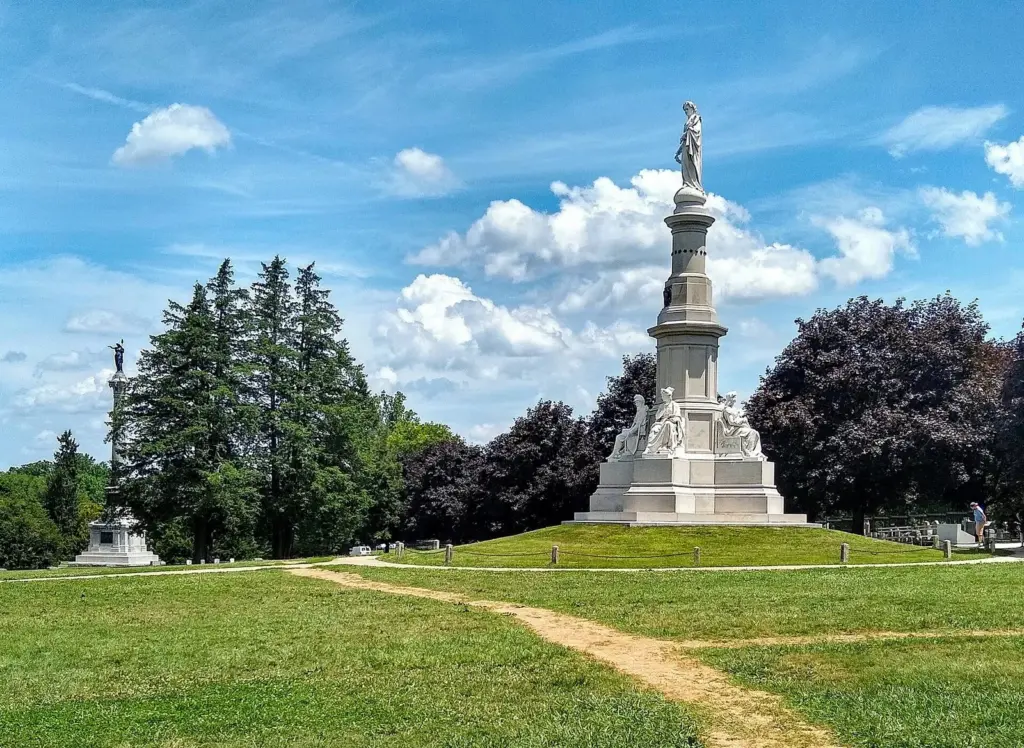
Free; year-round; next to Evergreen Cemetery. The cemetery for the Union dead was dedicated on November 19, 1863, when Lincoln gave the Gettysburg Address. The graves are arranged in curved rows by state around the Soldiers’ National Monument. Walk it slowly at the end of your day, and read the address on the Lincoln Address Memorial before you leave. The memorial, unveiled in 1912, holds a bust of Lincoln and the full text of the speech. Exactly where Lincoln stood is still debated; historians think the platform was probably just over the fence in the town’s Evergreen Cemetery.
Plan it: Between Taneytown Road and Baltimore Street. It’s a cemetery first, so keep voices down. Allow 45 minutes. Best for: everyone.
18. Eisenhower National Historic Site
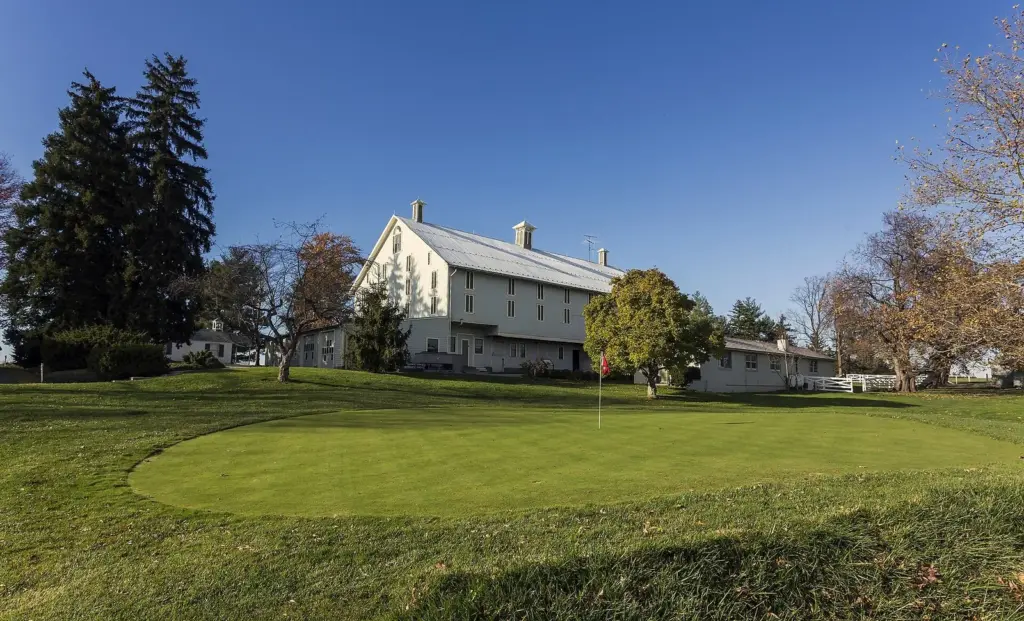
No entrance fee; grounds year-round, home tours seasonal; beside the battlefield. Dwight and Mamie Eisenhower’s farm, the only home they ever owned, is where the president recovered after his 1955 heart attack and hosted world leaders, including Nikita Khrushchev in 1959. The house is kept much as they left it, and the farm, barns and his putting green make a surprisingly personal Cold War stop next to a Civil War battlefield. Eisenhower bought the farm in 1950, used it as a retreat during his presidency and retired here in 1961, and he chose Gettysburg partly because he had commanded a tank training camp on the battlefield in 1918.
Plan it: The grounds are open daily from sunrise to sunset, and tours of the home run seasonally, so check dates first. Parking is limited, and buses, RVs and trailers need approval. Allow 2 hours. Best for: 20th-century history fans.
The Town Under Fire: Gettysburg’s Civilians
The soldiers moved on after July 4, 1863, but the people of Gettysburg lived with the battle for months. When the fighting reached the streets on July 1, families hid in their cellars while Confederate troops occupied most of the town for the next two days. Churches, schools, barns and homes became hospitals, and when the armies left, they left behind more than 20,000 wounded soldiers, far more than the town’s own population, along with thousands of dead in shallow graves.
Some of the best stories of Gettysburg belong to its residents. Elizabeth Thorn, the caretaker of the Evergreen Cemetery, who was six months pregnant, helped bury about a hundred soldiers in the heat of that July, and a statue of her now stands in the cemetery. A teenager named Tillie Pierce later wrote a vivid memoir of carrying water to soldiers and nursing the wounded. East of town, the Army built a huge tent hospital, Camp Letterman, which cared for the most badly wounded until November. Look for these stories at the Shriver House, the Jennie Wade House and the Beyond the Battle Museum; they turn a military landscape into a human one.
A Self-Guided Driving Route, in Battle Order
If you tour on your own, this route follows the three days in sequence and links the stops above. Pick up the free park map at the visitor center first; many park avenues are one-way, and the map shows which.
The first day, northwest and north of town. From the visitor center, drive through town and west on the Chambersburg Pike to McPherson Ridge. Follow Reynolds Avenue and Buford Avenue along the ridge, where the first shots were fired, then cross to the Railroad Cut. Continue north to Oak Hill and the Eternal Light Peace Memorial, and follow Doubleday Avenue along Oak Ridge, where the Union line faced north. Drop down to Barlow Knoll on Howard Avenue to see where the first-day line broke. Allow about an hour.
The Confederate line, Seminary Ridge. Head south along West Confederate Avenue, past the Seminary Ridge Museum, the North Carolina Memorial and the Virginia Memorial, where Lee watched the July 3 charge. This is where the Confederate army formed, and the view east across the fields shows you the ground of Pickett’s Charge before you walk it. Allow 30 to 45 minutes, longer if you walk into the field.
The second day, the south end. Continue south onto South Confederate Avenue toward Big Round Top, then circle back north to the Peach Orchard, the Wheatfield and Devil’s Den. Climb Little Round Top on Sykes Avenue. This is the busiest part of the park, so come before 10am or after 4pm on weekends. Allow about 1.5 hours.
The third day, the Union center. Drive north along Hancock Avenue on Cemetery Ridge, past the Pennsylvania Memorial and the 1st Minnesota, to the Angle and the High Water Mark. Park and walk the stone wall. Allow 45 minutes, and come back for sunset if you can.
The Union right. Finish at Culp’s Hill and Spangler’s Spring, then East Cemetery Hill and the Soldiers’ National Cemetery, a short walk from the edge of town. Allow an hour.
The whole route runs about 3 to 4 hours at a comfortable pace with short walks, and a full day if you walk the fields. Gettysburg’s roads are narrow and busy with cyclists and horseback tours, so drive slowly and pull fully off the road to stop.
Going Deeper: Sites for Return Visitors
Once you’ve done the classic things to do in Gettysburg, these quieter places fill in the story, and most first-time visitors never find them, which makes them some of the hidden gems in Pennsylvania‘s Civil War story.
East Cavalry Field. About three miles east of town, Union and Confederate cavalry clashed on the afternoon of July 3 while Pickett’s Charge was underway, and a young George Armstrong Custer led Michigan cavalry into the fight. The fields are open and rarely crowded, and the monuments tell a story most visitors miss entirely.
The Trostle Farm. On the south end of the field, the Trostle barn still shows damage from the July 2 fighting, when a Massachusetts artillery battery made a desperate stand in the farmyard to buy time for the Union line. Sickles was wounded nearby.
Lee’s Headquarters. The stone house on Seminary Ridge that served as Lee’s headquarters, with grounds restored to their 1863 appearance by the American Battlefield Trust, sits on the Chambersburg Pike on the edge of town.
The field hospitals. Farms all around Gettysburg became hospitals after the battle. The George Spangler Farm, a Union field hospital where Confederate general Lewis Armistead died, is preserved by the Gettysburg Foundation and opens for tours in season, and several other farm hospitals are marked around the county. They show the aftermath that lasted for months after the armies left.
Big Round Top. A wooded trail climbs the taller, forested neighbor of Little Round Top. There’s no big view from the summit, but the walk is quiet and gives a sense of how rough the ground was on the Union left.
Who’s Who at Gettysburg
You’ll meet these names on every monument and marker. A quick guide to the people behind the battle helps the stops make sense.
| Name | Side | Why they matter | Where to find them |
|---|---|---|---|
| George G. Meade | Union | Commanded the Army of the Potomac, days after taking over | Equestrian statue on Cemetery Ridge |
| Robert E. Lee | Confederate | Commanded the Army of Northern Virginia and ordered Pickett’s Charge | Atop the Virginia Memorial |
| John Buford | Union | His cavalry held the ridges west of town on July 1 | Statue on McPherson Ridge |
| John Reynolds | Union | Corps commander killed on the first morning | Near McPherson Ridge |
| Winfield Scott Hancock | Union | Organized the defense of Cemetery Hill and held the center on July 3 | Cemetery Hill |
| James Longstreet | Confederate | Led the July 2 attack and opposed the July 3 charge | Statue in Pitzer Woods |
| Joshua Chamberlain | Union | Commanded the 20th Maine on Little Round Top | The 20th Maine monument |
| George Pickett | Confederate | His division led part of the July 3 charge that bears his name | The fields between the ridges |
| Lewis Armistead | Confederate | Mortally wounded inside the Union line at the Angle | A marker at the Angle |
| Jennie Wade | Civilian | The only civilian killed directly in the battle | The Jennie Wade House and Evergreen Cemetery |
| John Burns | Civilian | The elderly resident who fought on July 1 | Statue near McPherson Ridge |
| Abraham Lincoln | President | Gave the Gettysburg Address on November 19, 1863 | The national cemetery and Lincoln Square |
Walking the Battlefield
Gettysburg is best understood on foot. The car gets you between stops, but walking the ground shows you what the soldiers faced. These are the walks worth making.
The Pickett’s Charge walk. From the Virginia Memorial on Seminary Ridge, walk east across the open fields toward the Angle, roughly the route of the July 3 assault. It’s about a mile each way over uneven farmland and fences, with no shade, so bring water and go early or late on a summer day. Nothing else on the battlefield conveys the scale of that afternoon so clearly.
Little Round Top and the Valley of Death. Park at Devil’s Den, walk the boulders, then follow the trail across Plum Run and up the slope of Little Round Top to the 20th Maine monument and the summit. It’s steep in places but short.
The Wheatfield and the Rose Woods. Trails loop through the field and the surrounding woods, past regimental monuments that mark where each unit fought. It’s shady and quiet, and good in summer heat.
Culp’s Hill. An interpretive trail follows the Union breastworks through the woods on the north end of the battlefield, with the observation tower at the summit.
Baltimore Street in town. Walk from Lincoln Square south to the national cemetery and look for the bullet-scarred walls of the Farnsworth House and the Jennie Wade House along the way. It’s the best way to understand that the fighting happened in people’s homes.
How to Read the Monuments
With more than 1,300 monuments and markers, Gettysburg can look like a sculpture garden without a key. A few rules unlock it.
Regimental monuments mark where a unit fought, usually its position at a key moment, and many have small stone flank markers showing where the regiment’s line began and ended. Read the inscription for the unit’s numbers and losses. State memorials honor all of a state’s troops and are grander; the Pennsylvania Memorial is the largest. Most Confederate state memorials came much later, from 1917 onward, which is why many stand along Seminary Ridge and West Confederate Avenue in a different style from the Union monuments of the 1880s and 1890s.
Placement was taken seriously: veterans argued, and sometimes went to court, over exactly where their monuments would stand. Cannon along the ridges mark artillery battery positions, and the park’s tablets summarize what each unit did. The popular story that the hooves of an equestrian statue reveal how its rider died isn’t a reliable rule here, so don’t count on it.
The Gettysburg Address: What to Know Before You Go
Lincoln was invited to add a few appropriate remarks at the dedication of the Soldiers’ National Cemetery on November 19, 1863. He arrived by train the day before, stayed at David Wills’s house on the town square and rode out to the cemetery the next morning. Edward Everett, the main speaker, talked for about two hours; Lincoln’s speech, fewer than 300 words, took about two minutes, and many in the crowd barely noticed it had begun.
Five copies of the address in Lincoln’s own handwriting survive, and they differ slightly from one another, which is one reason the text you read varies a little from one source to another. The exact spot where Lincoln stood is still debated, but the Soldiers’ National Monument marks the heart of the cemetery he helped dedicate. Stand there, read the address on the nearby memorial, and look out at the rows of graves: it’s the shortest and most powerful stop in Gettysburg.
Museums and Historic Houses in Town (19-26)
The town of Gettysburg lived through the battle too. Its streets were fought over on July 1, its homes and churches became hospitals, and its museums tell the civilian side of the story.
19. Beyond the Battle Museum
Paid; year-round; north of town. The Adams County Historical Society, now branded Gettysburg History, opened this modern museum in 2023 to tell the county’s whole story, from its first peoples to the battle’s aftermath. Its newest immersive exhibit, Caught in the Crossfire, drops you into the noise and chaos of the battle. The rest of the museum tells the county’s wider story, before and after 1863, which makes it a good first stop in town for families who want more than troop movements.
Plan it: 625 Biglerville Road. Check hours and tickets at achs-pa.org. Allow 1.5 to 2 hours. Best for: families, history lovers.
20. Shriver House Museum
Paid; year-round, check days; Baltimore Street. A restored townhouse whose family sheltered nearby while Confederate sharpshooters used their attic. Guided tours tell the story of civilians caught in the battle, and they’re one of the best ways to understand what the town endured. Look for the evidence of the sharpshooters’ nest in the garret, where holes were knocked through the walls, and ask about the family’s return to a house that had been used as a firing position.
Plan it: 307 Baltimore Street, run by Gettysburg History. Allow an hour. Best for: families, history lovers.
21. The Jennie Wade House
Paid; spring to fall, check days; Baltimore Street. Twenty-year-old Jennie Wade was killed by a stray bullet on July 3 while baking bread for soldiers in her sister’s house, the only civilian killed directly in the battle. The house, with bullet holes still in its walls, is now a museum, and a fixture of the ghost tours. Jennie’s story has been retold so often that legend and fact are hard to separate, so it’s worth hearing it from the house’s own guides before you hear it again on a ghost tour after dark.
Plan it: On Baltimore Street near East Cemetery Hill. Allow 45 minutes. Best for: families, the curious.
22. Lincoln Square and the David Wills House
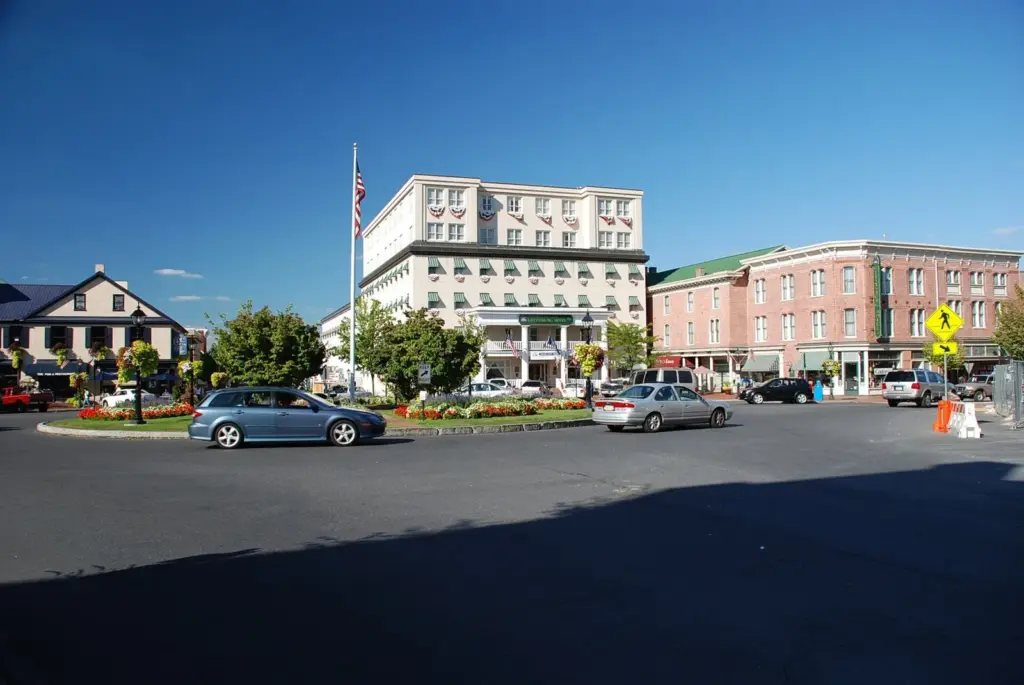
Free to walk; year-round; the center of town. The traffic circle at the heart of town holds a statue of Lincoln beside the house of David Wills, where the president spent the night of November 18, 1863 and worked on his address. The square is also the natural place to start a walk down Baltimore Street past houses scarred by the fighting. The Gettysburg Hotel, on the square since the 1790s, is still a hotel, and its lobby is a comfortable place to rest between museums.
Plan it: The junction of York, Chambersburg, Carlisle and Baltimore Streets. Allow 30 minutes. Best for: first-timers.
23. The Gettysburg Railroad Station
Free to see; year-round; downtown. Lincoln stepped off the train here on November 18, 1863, and the station also served as a hospital after the battle. It’s a quick stop a block from the square. Many of the wounded left Gettysburg by rail from here in the weeks after the battle, on their way to hospitals in Baltimore, Philadelphia and beyond.
Plan it: On Carlisle Street, north of Lincoln Square. Allow 15 minutes. Best for: history buffs.
24. Gettysburg College
Free to walk; year-round; north of the square. The college’s Pennsylvania Hall, with its white cupola, served as a lookout and hospital during the battle, and the leafy campus makes a pleasant walk between the square and the first-day fields.
Plan it: North of Lincoln Square along Carlisle Street. Allow 30 minutes. Best for: couples.
25. The Dobbin House Tavern
Free to look, meals paid; year-round; Steinwehr Avenue. Built in 1776, the stone house of the Reverend Alexander Dobbin is one of the oldest buildings in town, and it celebrates its 250th birthday in 2026 with guided house tours. Its candlelit tavern serves lunch and dinner every day, and the more formal dining rooms should be reserved about a week ahead.
Plan it: On Steinwehr Avenue, near the national cemetery. Open daily, 10am to 9pm, as of September 2026. Allow 1.5 hours for a meal. Best for: couples, history lovers.
26. The Farnsworth House
Free to look, dining and stays paid; year-round; Baltimore Street. An inn named for Union general Elon Farnsworth, whose doomed cavalry charge on July 3 took place south of town, with more than a hundred bullet holes said to scar its brick walls from Confederate sharpshooters who used the attic. It’s a restaurant, an inn and a mainstay of the town’s ghost lore.
Plan it: On Baltimore Street near the Jennie Wade House. Allow an hour for a meal. Best for: couples, the curious.
Photographing Gettysburg
Gettysburg is one of the most photographed landscapes in the country, and the light changes it completely. The best times are the first and last hours of the day, when the long light picks out the stone walls and monuments. Sunset at the Angle, with the sun going down behind Seminary Ridge, is the classic shot; sunrise from Little Round Top looks across the whole southern battlefield; and fall mornings often bring mist over the fields, as in the famous early photographs.
Remember that the roads close 30 minutes after sunset, so plan to leave the park after sunset photos. Drones are not allowed in national parks without a permit. And be respectful at the national cemetery: it’s a working cemetery, not a backdrop.
Gettysburg at Night: Ghost Tours and Evenings
Gettysburg is one of America’s ghost tour capitals, and on any warm evening you’ll see lantern-carrying guides leading groups down Baltimore Street. They’re theater as much as history, and the best ones weave real stories of the battle and the town into the spooky bits.
Companies advertising 2026 seasons include Mark Nesbitt’s Ghosts of Gettysburg candlelight walking tours, based on his long-running book series, Gettysburg Ghost Tours and Haunted Gettysburg Tours, whose candlelight walks run from April to mid-November. Tours usually last 60 to 90 minutes, cost less than dinner, and suit teens and adults better than young children. Book ahead on fall weekends, and check that any company you choose is still operating: some old operators have disappeared, and their websites haven’t always followed.
How to choose a ghost tour: candlelight walking tours are the classic, gentle option and suit mixed groups; paranormal investigations, with equipment and late start times, are for enthusiasts; and tours inside historic buildings add atmosphere but fill fastest. Ask how long the walk is, whether it’s suitable for children, and whether the guide leans on history or on scares. The best guides do both, and they treat the dead of 1863 with respect.
Other good evenings: watch the sunset from the Angle or Little Round Top (the park roads close 30 minutes later), eat at the Dobbin House’s candlelit tavern, or join the crowd at a pub around the square. Evenings are quiet in town on weekdays in winter, so plan dinner early.
Gettysburg With Kids
Gettysburg can be heavy going for young children, but a few choices make it work. Kids under 10 do best with short, physical stops: scrambling on the rocks at Devil’s Den, climbing the Culp’s Hill observation tower, walking the fields at the Angle and hearing a story told well by a Licensed Battlefield Guide, who will happily pitch a tour to the youngest person in the car. The Cyclorama impresses most ages, while the film is best for 8 and up.
Older kids and teens connect with the civilian stories at the Shriver House and the Jennie Wade House, the immersive experience at the Beyond the Battle Museum, and a ghost tour after dark. Ask at the Museum and Visitor Center about the park’s Junior Ranger activities, and at the Eisenhower farm about its program for young visitors. Build in breaks: the town’s candy and ice cream shops were made for them.
Beyond the Battlefield
Gettysburg is the centerpiece of the historical places in Pennsylvania, but Adams County around it is apple country, and it’s worth a detour. The orchards and farm markets on the hills toward Biglerville and Arendtsville sell cider, pies and pick-your-own fruit from late summer into October, and the county’s early-October apple harvest festival draws big crowds. Wineries dot the same hills. In winter, Liberty Mountain, a small ski area southwest of town, is the nearest skiing. Harrisburg and the rest of central Pennsylvania are about 50 minutes north, and the lesser-known Civil War sites across the state make a good follow-up trip.
What to Bring
- Water and sun protection: the fields are open, exposed and hot in summer, and there’s no food or drink on the park roads.
- Shoes with grip: the rocks at Devil’s Den and the trails on Little Round Top and Culp’s Hill are uneven.
- Tick repellent: ticks live in the tall grass and woods, so stay on mowed paths and check yourself afterward.
- The free park map: pick it up at the visitor center; it shows the one-way roads and the auto tour route.
- Binoculars: they bring distant monuments and ridgelines into focus from the overlooks.
- A regiment or an ancestor’s name: if your family has a soldier who fought here, bring the unit, and a guide or the park staff can help you find where it stood.
Accessibility at Gettysburg
Much of the battlefield can be seen from a car, and many stops have viewpoints close to the parking areas. The Museum and Visitor Center is fully accessible, and Little Round Top’s 2022-2024 rehabilitation improved paths and accessibility at the park’s most visited summit. Trails at Devil’s Den, the Wheatfield and Culp’s Hill are uneven and rocky, and the Seminary Ridge Museum’s cupola tour involves steep stairs and isn’t wheelchair accessible. A Licensed Battlefield Guide riding in your own car is one of the most accessible ways to see the whole field, since you choose where to stop and how far to walk.
What a Gettysburg Trip Costs
| Item | Cost (as of September 2026) | How to save |
|---|---|---|
| Battlefield, cemetery and park roads | Free | This is the heart of the trip, and it costs nothing. |
| Film, Cyclorama and museum | $20.75 adults, $19.75 seniors and veterans, $15.75 ages 6-12 | Kids under 6 and active military are free. |
| Licensed Battlefield Guide | $82 for 2 hours, $117 for 3 hours, per car of up to 6 | Split one guide among a full car of family or friends. |
| Eisenhower National Historic Site | No entrance fee | Check the seasonal home tour schedule. |
| Seminary Ridge and town museums | Paid; check current prices | Choose the one or two that match your interests. |
| Ghost tours | Paid per person | Weeknight tours are easier to book than fall weekends. |
| Lodging | Historic inns highest, chains mid-range | Visit midweek and avoid the July anniversary and Remembrance Day weekend. |
Gettysburg is one of the best-value trips in Pennsylvania: a family can spend a full day on the battlefield for the price of a guide and the museum ticket, and many of the most powerful things to do in Gettysburg, from the Angle to the national cemetery, are free.
Where to Eat in Gettysburg
Gettysburg eats well for a small town. The historic taverns, led by the 1776 Dobbin House and the Farnsworth House, serve colonial and Civil War-themed menus in candlelit rooms, and they’re worth it once. Around Lincoln Square and along Steinwehr Avenue you’ll find Irish pubs, cafes, pizza, barbecue and ice cream, and the orchards outside town sell pies and cider.
Three tips. Reserve dinner on fall and summer weekends and during Remembrance Day weekend, when every table fills. Expect waits at the popular spots even on weekday evenings; the Dobbin House itself notes that area restaurants are busy and some close on certain days. And eat an early lunch near the visitor center if you’re spending the afternoon on the battlefield, since there’s no food on the park roads.
For a picnic, pick up sandwiches in town or cider and fruit at an orchard stand outside it, and eat at one of the battlefield’s quieter spots, such as the Eternal Light Peace Memorial or the edge of the Wheatfield. With kids, the town’s ice cream and candy shops around the square make an easy reward after a long day on the fields.
Where to Stay in Gettysburg
| Option | Best for | Worth knowing |
|---|---|---|
| Historic inns on the square | Couples, history lovers | Walk to restaurants, museums and ghost tours; the Gettysburg Hotel anchors Lincoln Square. |
| Battle-era inns and B&Bs | Couples, ghost hunters | The Farnsworth House and the Dobbin House’s Gettystown Inn put you in wartime buildings. |
| Battlefield-view B&Bs | Photographers, return visitors | Quiet, with sunrise over the fields; you’ll drive into town. |
| Chain hotels on the edge of town | Families, budgets | Pools and parking; a short drive to everything. |
| Campgrounds | RVers, families | Several campgrounds sit a few minutes from the battlefield. |
Prices and availability swing with the calendar. The busiest times are the battle anniversary around July 1 to 3, summer and fall weekends, graduation and event weekends at Gettysburg College, and Remembrance Day weekend in November. Midweek in spring is the best value.
Gettysburg by Season
Spring (April to May): green fields, redbuds and dogwoods, thinner crowds and the start of the ghost tour season in April. It’s the best time for a first visit if you can come midweek.
Summer (June to August): the busiest season, with the battle anniversary on July 1 to 3, when rangers lead programs at the exact times and places the fighting happened. It’s hot and humid on the open fields, so walk early and late.
Fall (September to November): the most beautiful season on the battlefield, with color on the ridges in October, apple harvest in the county and ghost tours in full swing through mid-November. Dedication Day on November 19 marks the anniversary of the Gettysburg Address, and Remembrance Day weekend in mid-November brings a big parade of Civil War reenactors through town.
Winter (December to March): quiet, sometimes snowy, and cheap. Many private museums and tours cut back their days, but the battlefield and the visitor center stay open, and a snowy morning at the Angle has its own power. The bare trees also open up views that summer foliage hides, which makes winter a surprisingly good time to understand the lines of sight the commanders had. Check the park’s conditions page after a storm, since some roads may close for snow and ice.
One-Day and Two-Day Gettysburg Itineraries
One day: arrive at the Museum and Visitor Center when it opens and watch the film and Cyclorama. Take a two-hour tour with a Licensed Battlefield Guide, or follow the auto tour to McPherson Ridge, the Virginia Memorial, the Wheatfield, Devil’s Den, Little Round Top and the Angle. After lunch in town, walk Baltimore Street and Lincoln Square, then end at the Soldiers’ National Cemetery. Stay for sunset at the Angle if you can.
Two days: follow the one-day plan with a guide on day one. On day two, visit the Seminary Ridge Museum and its cupola, the Eternal Light Peace Memorial and Barlow Knoll for the first-day story, then the Eisenhower farm in the afternoon. Spend the evening on a ghost tour and dinner at the Dobbin House, and add the Beyond the Battle Museum or the Shriver House if you have time.
Three days: add East Cavalry Field, the Trostle Farm and the field hospitals for a deeper look at the battle, walk the Pickett’s Charge route from the Virginia Memorial to the Angle, and spend an afternoon in the county’s fruit belt, with its orchards, farm markets and wineries.
With more time, combine Gettysburg with Hershey or Lancaster County, both under 1.5 hours away, for one of the classic weekend getaways in Pennsylvania.
Getting to Gettysburg
| From | Drive | Worth knowing |
|---|---|---|
| Harrisburg | 50 minutes | South on US 15. |
| Baltimore | 1 hour 15 minutes | Northwest via PA 97 or MD 140. |
| Washington, D.C. | 1.5 hours | North on US 15 through Frederick. |
| Philadelphia | 2.5 hours | West via the Turnpike or US 30. |
| Pittsburgh | 3 hours 15 minutes | East on the Turnpike to Carlisle or Breezewood, then south. |
| New York City | 3.5 hours | A free-flow estimate; weekend traffic adds more. |
You’ll need a car, or a guided tour, to see the battlefield, which spreads over miles of park roads with no public transit. The Pennsylvania Turnpike is cashless, so use E-ZPass or expect a Toll By Plate bill. Drive times are free-flow estimates; add time on summer and fall weekends.
What’s Changed, and What to Skip
- Little Round Top: open again since June 2024, with new trails and parking. Older guidebooks that say it’s closed are out of date.
- The town’s museums: the Adams County Historical Society rebranded as Gettysburg History in 2025 and runs the Beyond the Battle Museum and the Shriver House Museum.
- Ghost tour operators: at least one long-advertised company’s website is now a parked domain for sale, so check that a tour is still running before you book it.
- Guide rates: the NPS-approved Licensed Battlefield Guide rate is $82 for two hours, as of September 2026.
Skip driving the battlefield without context. Watch the film first or take a guide, or the monuments blur together. Skip Little Round Top at midday on a summer Saturday, when parking is hardest; go early or at sunset. Skip the souvenir shops on Steinwehr Avenue if you’re short on time; the town’s real history is on Baltimore Street and the square. And skip treating it only as a day trip if you can: Gettysburg rewards an overnight, when the evenings in town and a sunrise on the fields change the experience.
Things to Do in Gettysburg: FAQ
Is Gettysburg worth visiting?
Yes. Gettysburg is the most famous battlefield in America and one of the best-preserved, with a first-rate museum, thousands of acres of open fields and monuments, and the cemetery where Lincoln gave the Gettysburg Address. The town adds museums, historic taverns and ghost tours, and the battlefield itself is free to visit.
How long does it take to tour Gettysburg?
Plan at least one full day: two to three hours at the Museum and Visitor Center and three hours or more on the battlefield. Two days lets you add the Seminary Ridge Museum, the Eisenhower farm, the town’s museums and a ghost tour without rushing, and serious history fans often stay three.
What is the best way to tour the Gettysburg battlefield?
For a first visit, hire a Licensed Battlefield Guide to ride in your own car for two hours. The NPS-approved rate is $82 for one to six people, as of September 2026. On a budget, follow the park’s free self-guided auto tour after watching the film, and join a free ranger program if one is running.
Is the Gettysburg museum free?
The Museum and Visitor Center building, bookstore and information desk are free, as is the battlefield. A ticket is needed for the film, the Cyclorama painting and the museum galleries: $20.75 for adults, $19.75 for seniors and veterans and $15.75 for ages 6 to 12, as of September 2026.
Can you drive through the Gettysburg battlefield?
Yes. Park roads loop through the whole battlefield, and you can drive them yourself for free, following the self-guided auto tour in battle order. Roads open 30 minutes before sunrise and close 30 minutes after sunset, some are one-way, and parking at popular stops fills on busy weekends.
What is there to do in Gettysburg at night?
Take a candlelight ghost tour, which run on many evenings from spring to mid-November, watch the sunset at the Angle or Little Round Top before the park roads close, and eat at a historic tavern such as the Dobbin House. The pubs around Lincoln Square stay lively on weekends.
What is there to do in Gettysburg with kids?
Kids enjoy the Cyclorama, the boulders at Devil’s Den, the Culp’s Hill observation tower and a Licensed Battlefield Guide tour pitched to their age. The Shriver House and the Beyond the Battle Museum tell civilian stories well, and teens usually love a ghost tour. Ask about Junior Ranger activities at the visitor center.
When is the best time to visit Gettysburg?
Late spring and fall are best, with mild weather, fewer crowds than summer and, in October, fall color on the ridges. The battle anniversary on July 1 to 3 brings special ranger programs but big crowds and heat, and Dedication Day on November 19 marks the Gettysburg Address anniversary.
Sources and How We Checked
We checked the prices, hours and closures on this page on September 24, 2026 against the official sources below and compiled the guide from them rather than from first-hand visits. Drive times are free-flow estimates from OpenStreetMap data using the Valhalla routing engine, rounded to the nearest 15 minutes.
- National Park Service: Gettysburg fees and tickets
- National Park Service: Licensed Battlefield Guide rates
- National Park Service: Gettysburg park conditions
- National Park Service: Eisenhower National Historic Site
- Gettysburg History (Adams County Historical Society)
- The Dobbin House Tavern
We also used the NPS news release on Little Round Top’s reopening, the websites of the Seminary Ridge Museum, the Farnsworth House Inn and the town’s ghost tour companies, and the Association of Licensed Battlefield Guides.
Pennsylvania Tourism Guide is an independent publication. We are not affiliated with the National Park Service, the Gettysburg Foundation, the Association of Licensed Battlefield Guides or any museum, restaurant, inn or tour company named here, and no one paid to be included.
Photo Credits
- 72nd Pennsylvania Infantry monument at sunset: photo by Richard A. Weaver, via Wikimedia Commons (CC BY-SA 4.0)
- Eternal Light Peace Memorial, Oak Hill: photo by Veggies, via Wikimedia Commons (Attribution)
- Schmucker Hall, Seminary Ridge Museum: photo by Acroterion, via Wikimedia Commons (CC BY-SA 4.0)
- Virginia Memorial, Gettysburg: photo by Veggies, via Wikimedia Commons (CC BY 4.0)
- Little Round Top: photo by Acroterion, via Wikimedia Commons (CC BY-SA 4.0)
- Soldiers' National Cemetery: photo by P. Hughes, via Wikimedia Commons (CC BY-SA 4.0)
- Eisenhower farm putting green and barn: photo by Acroterion, via Wikimedia Commons (CC BY-SA 4.0)
- Lincoln Square, Gettysburg: photo by Unknown authorUnknown author or not provided, via Wikimedia Commons (Public domain)