Pennsylvania has a sea of boulders in the Poconos where almost nothing grows, rocks in Bucks County that ring like bells when you tap them with a hammer, a coal town that has been burning underground since 1962 and a cave you tour by boat. None of them is a secret, exactly. But most visitors drive straight past all of them on the way to Hershey or Philadelphia. These are the hidden gems in Pennsylvania worth the detour: 60 caves, ghost towns, castles, geological oddities, haunted sites and small, strange museums, each with a straight answer on whether it’s legal and safe to visit.
Quick answer: Start with the Boulder Field at Hickory Run, Ringing Rocks Park, Penn’s Cave, Eckley Miners’ Village and Fonthill Castle: all five are legal, easy to reach and unlike anything else in the state. Centralia is legal to drive through on public roads, but most of the land around it is private, the Graffiti Highway was buried in 2020, and there’s little left to see. For haunted history, Eastern State Penitentiary and Fort Mifflin in Philadelphia and the Old Jail in Jim Thorpe run proper tours.
Last updated September 24, 2026. Hours, prices, seasons and closures were checked that day against the websites of the Pennsylvania Department of Conservation and Natural Resources (DCNR), the Pennsylvania Historical and Museum Commission (PHMC), the National Park Service and the caves, museums and sites themselves.
- Reading Pagoda: mid-restoration and open only on announced walkthrough days this fall ($3). Regular hours are planned for 2027.
- Centralia: the Graffiti Highway was buried under dirt in 2020. It’s gone.
- Pithole: the visitor center has closed for the season until June, but the grounds stay open, free, from dawn to dusk.
- Eckley Miners’ Village: the historic buildings close from Labor Day to Memorial Day; the museum stays open Wednesday to Sunday.
- No. 9 Mine: its old web address now leads to an unrelated site. The mine’s current site is no9coalmine.com.
- Roadside America: the Shartlesville miniature village closed in 2020 and isn’t coming back.
On this page: At a glance | Caves | Rocks and landforms | Ghost towns and mines | Castles | Haunted places | Odd museums | River and rail | Dark skies | By region | Trip ideas | Legal and safe? | What’s changed | FAQ
The Best Hidden Gems in Pennsylvania at a Glance
If you only have time for a few, these twelve give you the widest spread: underground, geological, industrial, architectural and plain weird. Drive times are from the nearest of Philadelphia, Pittsburgh and Harrisburg.
| Place | Where | What’s odd about it | Cost | Drive from nearest hub |
|---|---|---|---|---|
| Boulder Field, Hickory Run State Park | Carbon County, Poconos | A treeless field of Ice Age boulders in the middle of a forest | Free | 1¾ hr from Philadelphia |
| Ringing Rocks Park | Upper Black Eddy, Bucks County | Boulders that ring when you strike them | Free | 1¼ hr from Philadelphia |
| Penn’s Cave | Centre Hall, Centre County | A cave you see entirely by boat | Tour fee | 1½ hr from Harrisburg |
| Eckley Miners’ Village | Near Weatherly, Luzerne County | A whole coal patch town kept as a museum | Admission fee | 1¾ hr from Harrisburg |
| Fonthill Castle | Doylestown, Bucks County | A 44-room house of hand-mixed concrete | Guided tours | 1 hr from Philadelphia |
| Centralia | Columbia County | The town above a mine fire that started in 1962 | Free (public roads) | 1 hr from Harrisburg |
| Abandoned Pennsylvania Turnpike | Near Breezewood | Miles of empty 1940 highway and two dark tunnels | Free, at your own risk | 1½ hr from Harrisburg |
| Archbald Pothole | Near Scranton | A 38-foot-deep hole drilled by glacial meltwater | Free (closed mid-Nov to April) | 2¼ hr from Harrisburg |
| Old Jail Museum | Jim Thorpe | The handprint in Cell 17 | Tour fee | 1½ hr from Philadelphia |
| Meadowcroft Rockshelter | Avella, Washington County | Traces of people from about 16,000 years ago | Admission fee, seasonal | 1 hr from Pittsburgh |
| Linesville Spillway | Crawford County | Ducks standing on a carpet of carp | Free | 1¾ hr from Pittsburgh |
| Allegheny Observatory | Pittsburgh | Free night tours of a working observatory | Free, reservation needed | 15 min from downtown Pittsburgh |
A word on timing. Most of these places are at their best from May to October, and several caves, mine tours and small museums are seasonal. Fall is a strong time to go: the crowds thin after Labor Day and the hills turn color, so a cave or a ghost town pairs nicely with a leaf drive. If that’s your plan, check where to see fall foliage in Pennsylvania for the peak weeks by region.
Caves and Caverns: Pennsylvania’s Underground Hidden Gems
Pennsylvania’s limestone valleys are riddled with caves, and a handful have been lit, paved and guided for most of a century. Show caves stay cool all year, so bring a layer even in August, and wear shoes that grip on wet stone. Tours are guided, photography rules vary by cave, and bats set part of the calendar: at least one cave on this list closes while its bats hibernate. Touching formations is off limits everywhere, because skin oils stop them growing.
| Cave | Where | How you see it | Season as posted, September 2026 | Drive from nearest hub |
|---|---|---|---|---|
| Penn’s Cave | Centre Hall | By boat | Daily through November | 1½ hr from Harrisburg |
| Lost River Caverns | Hellertown | Walking tour, 30-45 min | Reservations required | 1¼ hr from Philadelphia |
| Laurel Caverns | Near Farmington | Walking tour, steep | Open for 2026; pay on arrival | 1½ hr from Pittsburgh |
| Indian Echo Caverns | Hummelstown | Walking tour, about 45 min | Daily except three holidays | 20 min from Harrisburg |
| Crystal Cave | Near Kutztown | Walking tour | March through November | 1¼ hr from Harrisburg |
| Lincoln Caverns and Whisper Rocks | Near Huntingdon | Walking tour, two caves | Daily in September; Halloween tours in October | 1¾ hr from Harrisburg |
| Woodward Cave | Woodward, Centre County | Walking tour | Summer season from Memorial Day | 1¾ hr from Harrisburg |
1. Penn’s Cave and Wildlife Park
Tour fee; open daily into late fall. Most caves make you walk. Penn’s Cave puts you in a boat and floats you through the whole thing, which is why it markets itself as an all-water cavern. You go down a flight of steps from the old Penn’s Cave Hotel to a landing inside the cave mouth, climb aboard, and the guide steers you along a flooded limestone passage under the formations. It’s the most relaxed cave tour in the state and the one to choose if you have small children or knees that don’t love wet stairs. The same ticket counter sells a farm-nature-wildlife tour of the surrounding land and a Central PA Cave Passport that also covers Woodward Cave and Lincoln Caverns, so a caves weekend can take in all three.
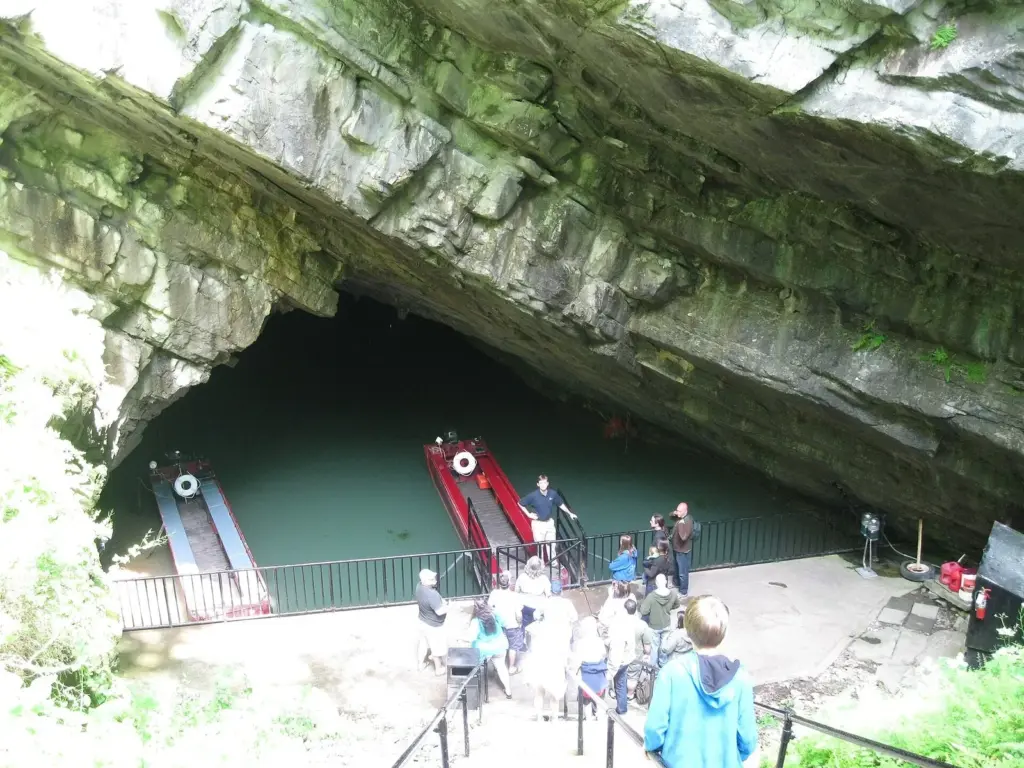
Plan it: Penn’s Cave, Centre Hall (Centre County), close to State College. About 1½ hours from Harrisburg, 3 from Pittsburgh and 3¼ from Philadelphia. October 2026 hours: visitors center 10am-5pm, boat tours daily on the hour from 10am to 4pm; in November, tours run 11am-4pm, closed Thanksgiving. Check prices on the cave’s website. Allow 2 hours with the wildlife tour. Best for: families, anyone who’d rather sit than climb.
2. Lost River Caverns
From $17.50; reservations required. Hellertown’s cave takes its name from the stream that runs through it and disappears into the rock, the lost river of the sign. It’s a compact cave, and the guided walk takes 30 to 45 minutes, which makes it a good first cave for young kids and an easy add-on to a Lehigh Valley day. The visitor building has a collection of minerals and gems that’s worth a look on the way out. Book ahead: this is not a walk-up operation.
Plan it: Lost River Caverns, 726 Durham Street, Hellertown (Northampton County). About 1¼ hours from Philadelphia and 1½ from Harrisburg. As of September 2026, tours are $17.50 for adults and $12.50 for ages 3-11, by reservation on lostcave.com. Allow 1 hour. Best for: young kids, a rainy Lehigh Valley afternoon.
3. Laurel Caverns
Pay on arrival; steep. Laurel Caverns, high on Chestnut Ridge in Fayette County, calls itself Pennsylvania’s largest cave, with more than four miles of passages. It’s a sandstone cave, so don’t come expecting stalactites. Come for a maze of tilted rock rooms and a descent the operators describe as one of the steepest in the world. The land is now Laurel Caverns State Park, but tours still run on site, tickets are sold at the door and no reservations are needed for 2026. Fallingwater and Ohiopyle are both a short drive away, which makes this the easy underground add-on to a Laurel Highlands weekend.
Plan it: Laurel Caverns, off US 40 near Farmington (Fayette County). About 1½ hours from Pittsburgh and 3½ from Harrisburg. Tickets on arrival (724-438-3003); see laurelcaverns.com for 2026 tour times and prices. Wear shoes with real grip. Allow 1½ hours. Best for: older kids and teens, Laurel Highlands trips.
4. Indian Echo Caverns
Posted rates from $14.50 (ages 2-11); open daily. A few minutes from Hershey, this is the least hidden cave on the list, and it earns its place anyway. The 45-minute tour follows lit paths through the formations in the bluffs above Swatara Creek, and the guides tell the story of William Wilson, a hermit who lived in the cave for years in the early 1800s. It’s open every day except Thanksgiving, Christmas and New Year’s Day, which makes it the obvious rainy-day plan for a Hershey trip.
Plan it: Indian Echo Caverns, 368 Middletown Road, Hummelstown (Dauphin County). About 20 minutes from Harrisburg, 1¾ hours from Philadelphia and 3½ from Pittsburgh. Hours as posted in September 2026: 10am-4pm daily, 9am-5pm from Memorial Day to Labor Day. The posted rates start at $14.50 for ages 2-11, and adults pay more; check the rates page. Allow 1½ hours. Best for: families on a Hershey trip.
5. Crystal Cave
Tour fee; March through November. Discovered in 1871, Crystal Cave bills itself as Pennsylvania’s first show cave, and the whole place leans into its age. Besides the guided tour, the ticket covers a shaded picnic area, a nature trail and a small history exhibit. It isn’t the biggest cave in the state, but it keeps an old-fashioned roadside-attraction feel, in a good way. It’s also the easiest cave to pair with Hawk Mountain on a fall day.
Plan it: Crystal Cave, near Kutztown (Berks County). About 1¼ hours from Harrisburg and 1½ from Philadelphia. Guided tours run rain or shine from March through November; hours vary by month, so check the hours page before you go. Allow 1½ hours. Best for: a Berks County day with Hawk Mountain or the Reading Pagoda.
6. Lincoln Caverns and Whisper Rocks
Tour fee; in its 96th season. Two caves for one stop on US 22 west of Huntingdon. Lincoln Caverns and its neighbor, Whisper Rocks, are classic limestone show caves, and the operators take the science seriously, with cave and karst workshops for kids on top of the regular tours. In October the tone changes: the 43rd annual Ghosts & Goblins Evening Terror Tours run October 9-31, 2026, which is about as close to a haunted cave as Pennsylvania gets.
Plan it: Lincoln Caverns, 7703 William Penn Highway (US 22), near Huntingdon (Huntingdon County). About 1¾ hours from Harrisburg, 2¼ from Pittsburgh and 3½ from Philadelphia. Open daily 9am-4pm in September 2026; tickets in advance or at the door through lincolncaverns.com. Allow 1½ hours. Best for: a Raystown Lake weekend, pairing with Balanced Rock.
7. Woodward Cave
Tour fee; summer season. Woodward Cave, in the farm country of eastern Centre County, is celebrating its 100th season in 2026 and keeps a shorter calendar than the others. Tours start on Memorial Day, and the cave closes to visitors while its bats hibernate. The cave counts itself about 50 minutes from State College and 45 from Lewisburg, and it shares the Central PA Cave Passport with Penn’s Cave and Lincoln Caverns. Of the three, it’s the one to fit in if you’re camping or staying in Penns Valley in summer.
Plan it: Woodward Cave, Woodward Cave Drive, Woodward (Centre County). About 1¾ hours from Harrisburg and 3¼ from Pittsburgh. Seasonal: 2026 tours began Memorial Day, so check woodwardcave.com for the fall schedule before driving out. Allow 1 hour. Best for: completing the cave passport.
Strange Rocks, Boulder Fields and Gravity Tricks
The last ice sheet stopped in northern Pennsylvania, and the cold at its edge did strange things to the rock below it: frost shattered ridgetops into boulder fields, and meltwater drilled holes in the bedrock. Add a sandstone maze, a road that seems to run uphill and the highest point in the state, and you have the best free oddities in Pennsylvania. All of these are legal to visit. The risks are ankles, cliff edges and traffic. Every state park here is free to enter and park in, as all Pennsylvania state parks are.
8. Ringing Rocks Park
Free; bring a hammer. In a clearing in the woods near the Delaware River, a field of gray boulders lies in a jumble several feet deep, with almost nothing growing in it. Hit the right rock with a hammer and it rings like a struck bell; hit the wrong one and you get a dull clack. Nobody fully agrees on why some ring and others don’t, which gives you something to argue about on the walk back to the car. Bring a carpenter’s hammer, not a sledge, and go easy: the point is the sound, not a souvenir. After rain, a waterfall runs on the creek just past the boulder field. A smaller Ringing Rocks Park near Pottstown has ringers of its own.
Plan it: Ringing Rocks County Park, Ringing Rocks Road, Upper Black Eddy (Bridgeton Township, Bucks County). About 1¼ hours from Philadelphia and 2 from Harrisburg. Free; part of the Bucks County park system. The boulder field is a short walk from the lot. Wear boots, because the rocks shift and the gaps swallow ankles, and in summer the stones throw off heat. Allow 1 hour. Best for: kids who like noise, a New Hope day.
9. Boulder Field, Hickory Run State Park
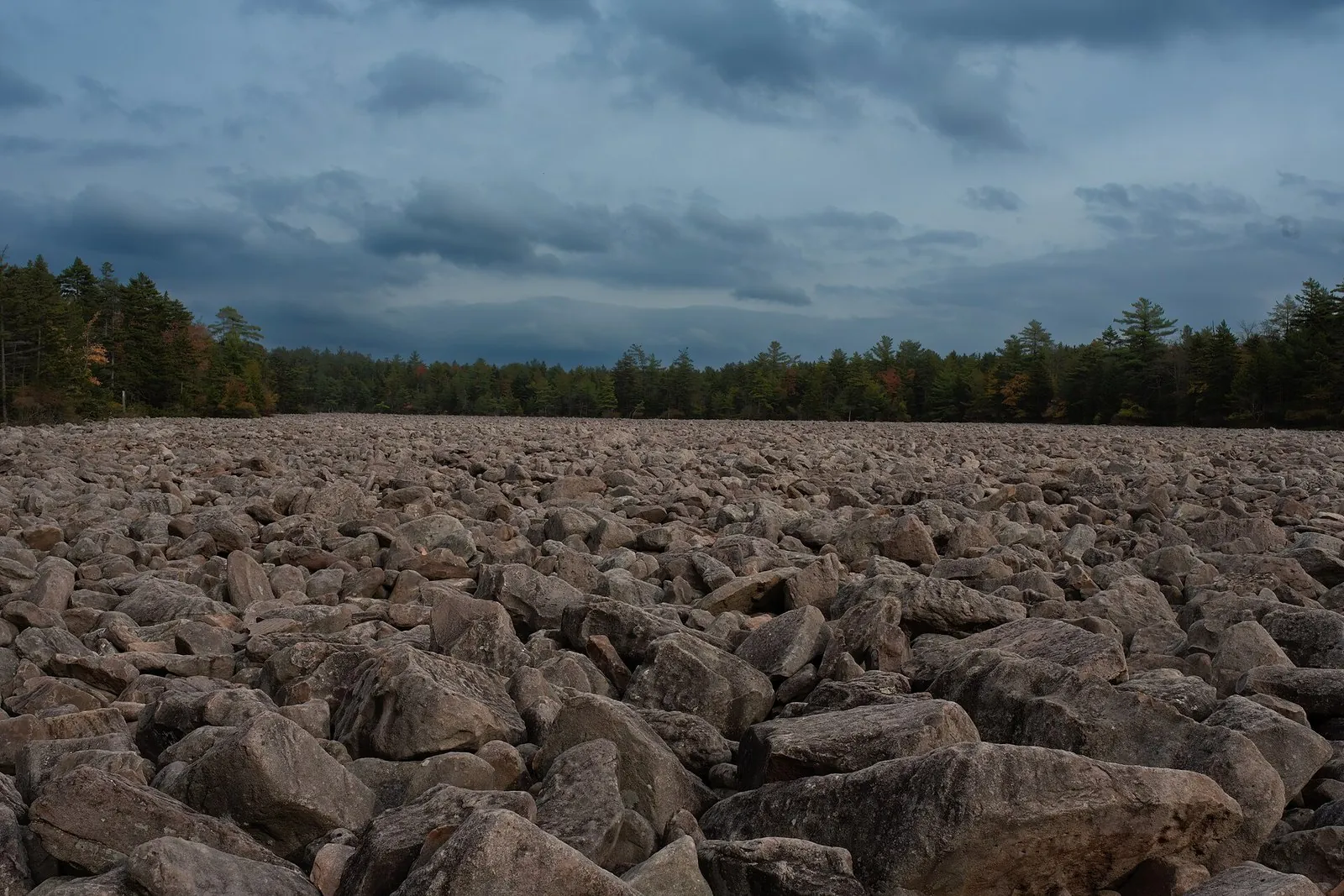
Free; a National Natural Landmark. This is the photo at the top of the page, and it looks unreal in person too: a flat, open expanse of boulders in the middle of a forest, left by freezing and thawing when the ice sheet sat just to the north. DCNR lists it as a National Natural Landmark. You can walk out onto it, carefully, and the quiet out in the middle is part of the appeal. Hickory Run is a big park, 15,990 acres with more than 40 miles of trails, so make a day of it with a hike to Hawk Falls.
Plan it: Hickory Run State Park, off PA 534 near White Haven (Carbon County). About 1¾ hours from Philadelphia or Harrisburg. Free, open daily from sunrise to sunset; reach the field by car on a gravel access road or on foot by trail. DCNR warns that trailhead lots can fill early on busy days, even midweek. See DCNR’s Hickory Run page. Allow 1-3 hours. Best for: photographers, a break on the drive home from the Poconos.
10. River of Rocks, Hawk Mountain
$10 trail fee; rugged. Hawk Mountain is famous for its fall raptor count, and its lookouts are packed on October weekends. Far fewer people go down to the River of Rocks, a long boulder field in the valley below the ridge, reached by a steep and rocky loop trail. It’s the same freeze-thaw geology as Hickory Run, with fewer people and more sweat. Hawk Mountain is a private nonprofit sanctuary, not a state park, so the trail fee applies and dogs aren’t allowed.
Plan it: Hawk Mountain Sanctuary, near Kempton (Berks County). About 1¼ hours from Harrisburg and 1½ from Philadelphia. Trail fees as of September 2026: adults $10, seniors $7, ages 6-12 $5; the Visitor Center and trails are open 9am-5pm daily, closed Thanksgiving, Christmas Eve, Christmas and New Year’s Day (admission and hours). No pets. Allow half a day. Best for: strong hikers.
11. Archbald Pothole
Free; closed mid-November to April. About 15,000 years ago, meltwater pouring through a crack in the ice spun stones against the bedrock here and drilled a hole. It’s big: DCNR measures it at 38 feet deep and 42 by 24 feet across at its widest, with room for about 140,000 gallons if you could plug the bottom. It sits in a small 150-acre park on Business Route 6, nine miles north of Scranton, with a fence around the rim and parking a few steps away. It takes ten minutes, and it’s worth every one of them if you’re passing.
Plan it: Archbald Pothole State Park, US Business Route 6, Archbald (Lackawanna County). About 2¼ hours from Harrisburg and 2½ from Philadelphia. Free; the park closes the third Saturday of November and reopens the second Friday of April, and day-use areas close at dusk (DCNR). Allow 20 minutes. Best for: a Scranton stopover.
12. Balanced Rock, Trough Creek State Park
Free; a short, steep climb. A boulder perches on the lip of a cliff above Great Trough Creek, looking as if one good shove would tip it into the gorge. It has looked that way for a very long time. Trough Creek is a narrow gorge where the creek cuts through Terrace Mountain on its way to Raystown Lake, and rugged trails lead to both the rock and Rainbow Falls, a small cascade that’s best after rain. Pair it with Lincoln Caverns for a full day in Huntingdon County.
Plan it: Trough Creek State Park, Todd Township (Huntingdon County), at the edge of Raystown Lake. About 2 hours from Harrisburg and 2¾ from Pittsburgh. Free, open daily from sunrise to sunset (DCNR). The climb to the rock is steep, with steps and drop-offs, so keep kids close. Allow 1½ hours. Best for: a Raystown weekend.
13. Bilger’s Rocks
Free; listed as open dawn to dusk. A sandstone “rock city” in the woods of Clearfield County, where formations more than 300 million years old rise up to 50 feet over some 20 acres. The fun is in the gaps: crawlspaces, body-width passages and overhangs that feel like a maze with the roof taken off. The Bilger’s Rocks Association keeps it free. Kids love it, and adults tend to spend longer than they planned squeezing through places they’d never try at home. The squeezes are optional.
Plan it: Bilger’s Rocks, 1921 Bilgers Rocks Road, Grampian (Clearfield County). About 2¼ hours from Pittsburgh and 2½ from Harrisburg. Listed as free and open daily from dawn to dusk; details on thebilgersrocks.com. Wear shoes with grip, and skip the crawls after rain, when the rock turns slick. Allow 1-2 hours. Best for: kids 6 and up, a break from I-80.
14. Gravity Hill, New Paris
Free; a public road, so drive like it. Stop your car at the right spot on a country road in Bedford County, shift into neutral and it seems to roll uphill. It doesn’t, of course. The lay of the land around you fools your eyes about which way is down. Knowing that doesn’t make it less fun, and people have been testing it with cars, water bottles and balls for decades. The catch is that it’s a working road with farm traffic and blind bends. Pull fully off before you experiment, check your mirrors and never stop on a curve.
Plan it: Gravity Hill, near New Paris (Bedford County), north of Bedford. About 2 hours from Pittsburgh or Harrisburg. Free. Load directions before you leave Bedford, because phone signal fades on the back roads. Allow 30 minutes. Best for: a Turnpike road trip, kids in the back seat.
15. Mount Davis
Free; the roof of Pennsylvania. The state’s highest point, 3,213 feet, is a fairly flat stretch of woods in Forbes State Forest, and the only way to see anything from it is to climb the High Point Observation Tower. From the top you look out over the ridges and farmland of the Laurel Highlands. As a summit it’s an anticlimax. As an outing, with a picnic and a short walk, it’s a fine hour, and high-point collectors have to come anyway.
Plan it: Mount Davis, Forbes State Forest, near Salisbury (Somerset County). About 1¾ hours from Pittsburgh and 3 from Harrisburg. Free, open daily (DCNR Forbes State Forest). The tower is a short walk from the parking area. Allow 45 minutes. Best for: high-pointers, a Laurel Highlands loop.
16. The Pinnacle and Pulpit Rock
Free; a full-day hike. On the Appalachian Trail north of Hamburg, the Pinnacle is a rock outcrop with a sheer drop and one of the widest views on the Pennsylvania section of the trail, out over the patchwork farms of Berks County. The usual loop from the Hamburg Reservoir lot runs close to nine miles, with long rocky stretches that slow everyone down. Pulpit Rock, on the same ridge, has its own view, and the Lehigh Valley Amateur Astronomical Society’s observatory sits near the top. In October this is one of the best leaf-peeping hikes in eastern Pennsylvania; our Pennsylvania fall foliage guide has the timing.
Plan it: Hamburg Reservoir trailhead, north of Hamburg (Berks County). About 1¼ hours from Harrisburg and 1½ from Philadelphia. Free. Parking fills on fall weekends, so start early. Bring boots, water and a map; the rock scrambles eat time. Allow 5-6 hours for the loop. Best for: experienced hikers.
17. Chickies Rock
Free; easy. A quartzite cliff rises straight up from the Susquehanna between Columbia and Marietta, and a short walk from the parking lot on PA 441 brings you out on top, with the river spread out below. It’s a sunset spot for locals, and Chickies Rock County Park adds woodland trails and a riverside trail at the bottom. Stay back from the edge: boots have polished the rock smooth, and the drop is real.
Plan it: Chickies Rock County Park, PA 441 between Columbia and Marietta (Lancaster County). About 1 hour from Harrisburg and 1¾ from Philadelphia. Free. Allow 1 hour. Best for: pairing with the watch and clock museum in Columbia.
18. Boiling Springs
Free; a village, not an attraction. Springs bubble up so strongly here that they fill Children’s Lake in the middle of the village, and the water stays clear and cold enough for trout. The Appalachian Trail walks right past the lake, so thru-hikers share the shore with fly anglers and families feeding the ducks. There’s nothing to buy a ticket for. Come for an hour’s stroll around the lake and a coffee, and stay longer if you fish.
Plan it: Boiling Springs, South Middleton Township (Cumberland County), south of Carlisle. About 30 minutes from Harrisburg and 2 hours from Philadelphia. Free parking around the lake. Allow 1 hour. Best for: a quiet stop on the way to the Appalachian Trail Museum.
Ghost Towns, Coal Mines and Ruins
Pennsylvania’s coal and oil booms built towns that emptied almost as fast as they filled. A few are museums now, one is still smoldering, and one is a highway nobody drives. Go underground only on guided tours. Abandoned mine openings can hold bad air and loose rock, and they have killed explorers. The tours below take you into real mines, safely, with guides who explain what the work did to the men and boys who did it.
19. Centralia
Free to drive through; most of the land is private. In 1962 a fire got into the coal seams under Centralia, and it has burned underground ever since. After years of gas scares and collapsing ground, most residents took a government buyout in the 1980s, the houses came down, and only a handful of people still live there. What you see now is a grid of empty streets going back to woods, a few homes, the cemeteries and, on the hill above town, a Ukrainian Catholic church that still holds services. The famous Graffiti Highway, a buckled stretch of old Route 61 covered in spray paint, was buried under dirt by its owner in 2020 and is gone. Steam vents come and go with the fire and the weather, so there may be nothing to see at all.
It’s legal to drive the public roads and to visit the cemeteries respectfully. Much of the rest is private, and the ground over the fire can sink or vent gas. Stay on paved roads, keep out of fenced and posted areas, and leave the church to its parishioners.
Plan it: Centralia (Columbia County), a few miles north of Ashland. About 1 hour from Harrisburg and 2¼ from Philadelphia. Free; no facilities, so plan food and restrooms in nearby Ashland. Allow 30-45 minutes. Best for: pairing with Pioneer Tunnel.
20. Eckley Miners’ Village
Admission fee; buildings open Memorial Day to Labor Day. This is what most coal towns looked like: rows of company houses along a dirt road, churches, a company store and the mine always in view. Eckley was a patch town built by a coal company in the 1850s, and the state now runs it as a museum. Hollywood used it as the set for The Molly Maguires in 1970, and the coal breaker built for the film still stands at the end of the street. Off-season you can still walk the village and see the museum’s exhibits, but the historic buildings are closed from Labor Day to Memorial Day.
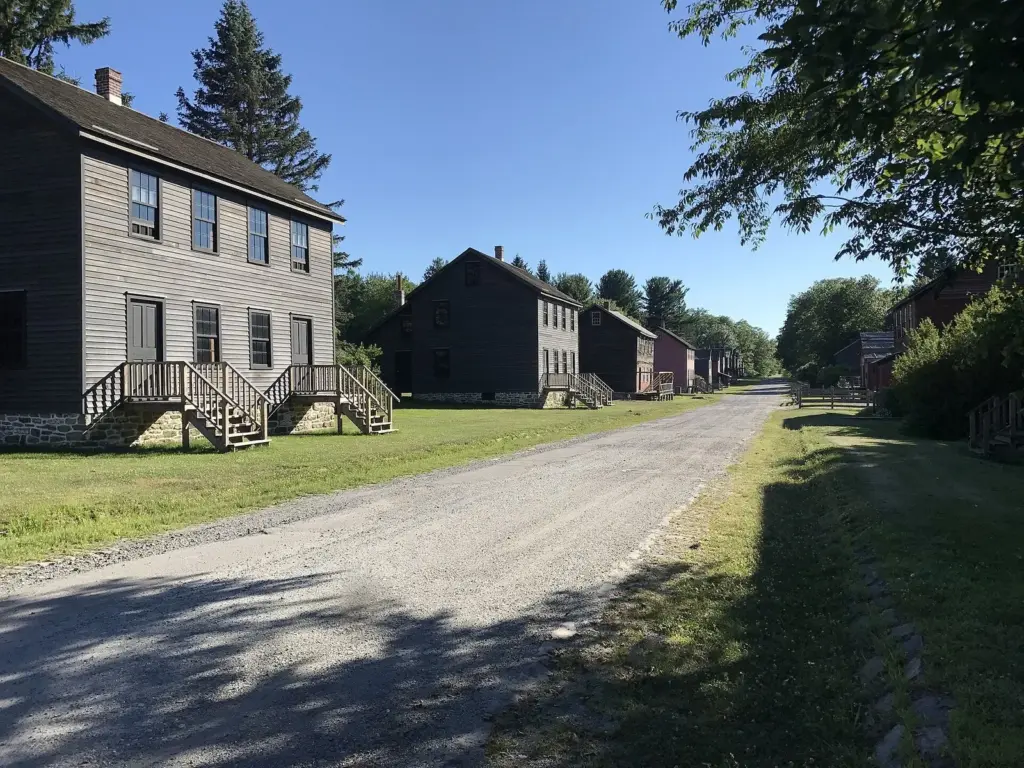
Plan it: Eckley Miners’ Village Museum, 2 Eckley Main Street, Weatherly (Luzerne County), near Hazleton. About 1¾ hours from Harrisburg and 2 from Philadelphia. Museum open Wednesday-Sunday 10am-4pm as of September 2026; guided walking tours on summer Saturdays cost $2 extra at the door (admission and tours). Not every building is accessible. Allow 2 hours. Best for: coal-region history, photographers.
21. Pioneer Tunnel Coal Mine and Steam Train
Tour fee; seasonal. Ashland’s tour takes you into Mahanoy Mountain in an open mine car, straight into a horizontal drift mine, where guides explain how anthracite was dug and what it cost the people who dug it. Outside, a narrow-gauge steam train runs along the side of the mountain past old strip-mine scars. It calls itself anthracite’s longest-operating mine tour, and it runs like a place that has done this for decades. While you’re in town, look for the Mothers’ Memorial, a statue based on Whistler’s painting of his mother.
Plan it: Pioneer Tunnel, 19th and Oak Streets, Ashland (Schuylkill County). About 1 hour from Harrisburg and 2¼ from Philadelphia. Hours change month to month and shrink in the fall; check the table on the rates and hours page. Bring a jacket, because mines stay cold in August. Allow 2 hours. Best for: families, pairing with Centralia.
22. No. 9 Mine and Museum
Tour fee; April through November. In Lansford, the No. 9 Mine takes you into a mine that worked for more than a century: a ride in a mine car deep into the mountain, then a guided walk along the old mule way and past a miners’ hospital cut into the rock. The museum in the old mine buildings fills in the rest, from lamps and tools to the story of the families who lived by the whistle. One practical warning: the mine’s old web address now leads to an unrelated site, so use no9coalmine.com.
Plan it: No. 9 Coal Mine and Museum, 9 West Dock Street, Lansford (Carbon County). About 1½ hours from Harrisburg and 1¾ from Philadelphia. Open April-November, Wednesday-Sunday 10am-4pm; tours leave on the hour from 11am to 3pm, rain or shine; closed Easter and Thanksgiving (no9coalmine.com, September 2026). Allow 1½ hours. Best for: pairing with Jim Thorpe and Eckley.
23. Lackawanna Coal Mine Tour
Tour fee; spring to fall. Scranton’s county-run tour puts you in a mine car that rides down the slope into a real anthracite mine under McDade Park, where the guides walk you through the working levels and the dangers the miners lived with. It’s the most straightforward mine tour in the northeast and an easy half day from downtown Scranton. For 2026, Lackawanna County announced a season from April 2 to November 30, with tours Friday through Monday.
Plan it: McDade Park, Scranton (Lackawanna County). About 2 hours from Harrisburg and 2¼ from Philadelphia. The county listed 2026 tours Friday-Monday, first tour 10:45am and last 2:45pm, closed Easter and Thanksgiving; confirm with the county before you drive. Bring a layer. Allow 1½ hours. Best for: a Scranton weekend with the Houdini Museum.
24. Pithole
Free grounds; visitor center on summer weekends only. In January 1865 a well came in on Pithole Creek, and within months a boomtown of thousands went up on a muddy hillside in Venango County. By 1866 the oil price had crashed, a pipeline had put the teamsters out of work, and seventeen fires had burned wells, hotels and boarding houses. The town emptied almost as fast as it filled. Today nothing stands. Mown paths mark the streets, and signs mark where the buildings were, which is exactly why it’s eerie: you’re walking through a city that isn’t there.
Plan it: Historic Pithole City, Cornplanter Township (Venango County), near Pleasantville. About 2 hours from Pittsburgh. The grounds are free and open daily, dawn to dusk, year-round. The Visitor Center opens Saturdays and Sundays 10am-4pm, June-August ($5 adults, $3 ages 3-11), and had closed for the season by late September 2026 (Drake Well Museum). Allow 1 hour. Best for: pairing with the Oil Creek and Titusville Railroad.
25. Austin Dam Memorial Park
Free; a memorial park. On September 30, 1911, a two-year-old concrete dam above the paper-mill town of Austin gave way and sent a wall of water through the valley, killing 78 people. Huge broken sections of the dam still lie tipped and cracked across the creek bed, inside a memorial park with a campground. It’s a sobering stop and one of the strangest sights in the Pennsylvania Wilds: ruins you’d expect from an earthquake, sitting quietly in the woods.
Plan it: Austin Dam Memorial Park, Keating Township, just north of Austin (Potter County). About 3¾ hours from Pittsburgh or Harrisburg. Free. Allow 45 minutes. Best for: a Pennsylvania Wilds loop with Ole Bull and Cherry Springs.
26. Abandoned Pennsylvania Turnpike
Free; at your own risk. When the Turnpike widened its tunnels, it skipped two of them near Breezewood and built a bypass instead, leaving miles of the original 1940 highway to the weeds. The Southern Alleghenies Conservancy has owned the stretch since 2001, and walkers and cyclists use it to reach the two tunnels: Rays Hill, 0.7 miles long, and Sideling Hill, 1.3 miles long and pitch black in the middle. It isn’t a finished trail yet, and you go at your own risk. The pavement is cracked and weedy, the tunnels are unlit, and there’s no one around to help.
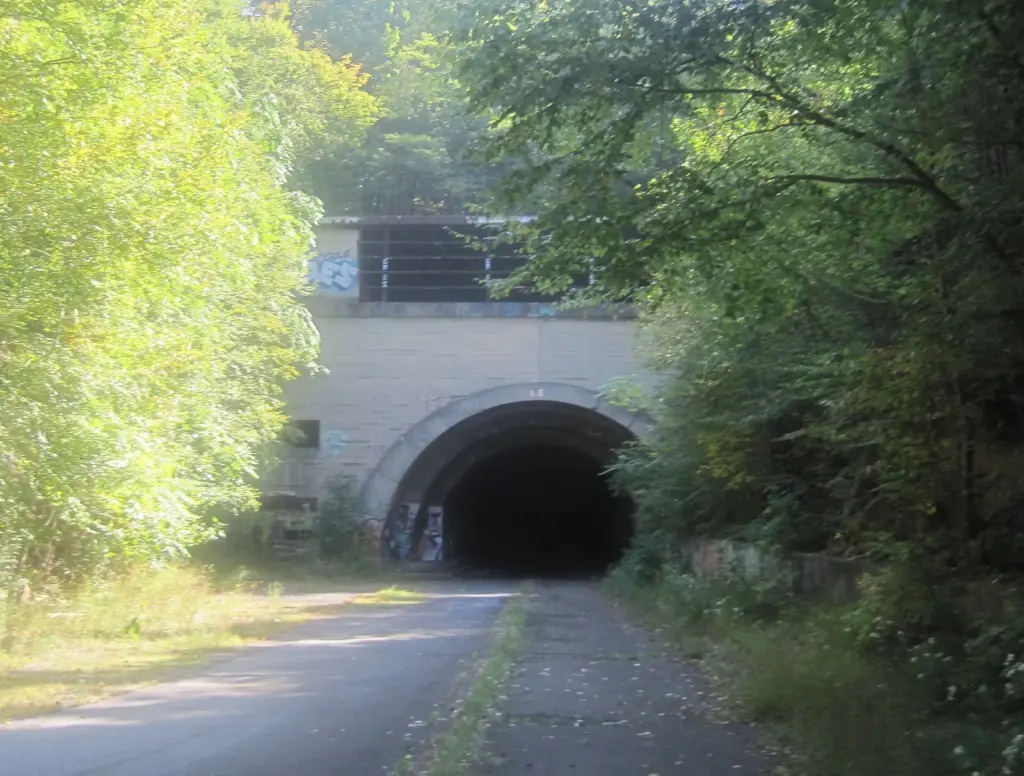
Bring a bright bike light or a headlamp, not your phone, and go with someone. Sideling Hill is long enough that the far portal stays a pinhole of light for much of the way, and tunnels stay cool even in summer. Bedford and Fulton counties have been working for years to turn the road into an official trail, so access points and conditions can change.
Plan it: Near Breezewood (Bedford and Fulton counties). About 1½ hours from Harrisburg, 2 from Pittsburgh and 3 from Philadelphia. Free. Check Fulton County’s Pike2Bike page for the trail plans. Allow half a day to ride the length and back. Best for: cyclists, photographers who like their ruins legal.
27. Cornwall Iron Furnace
Admission fee; Friday to Sunday. PHMC calls it the only surviving intact charcoal cold-blast furnace in the Western Hemisphere, and it looks the part: stone buildings around the furnace stack, the machinery that blew air into it and the rooms where ore and charcoal were loaded. It ran from 1742 to 1883 at the heart of an iron plantation that cast cannon during the Revolution, and guided tours explain how the whole operation worked. It’s the best industrial site in the Hershey area, and hardly anyone on a Hershey trip knows it’s there.
Plan it: Cornwall Iron Furnace, 94 Rexmont Road, Cornwall (Lebanon County). About 45 minutes from Harrisburg and 1½ hours from Philadelphia. As of September 2026, open Friday and Saturday 9am-4pm and Sunday noon-4pm; tours Friday and Saturday at 9:30, 11, 12:30 and 2, and Sunday at 12:30 and 2:30 (PHMC). Allow 1½ hours. Best for: history fans, a Hershey-area half day.
28. Staple Bend Tunnel
Free; a walk or bike ride. Cut through a ridge in the early 1830s for the Allegheny Portage Railroad, Staple Bend is widely described as the first railroad tunnel in the United States. It’s 901 feet long, with carved stone portals, and you reach it on an old railbed along the Conemaugh River from a trailhead near Mineral Point. The National Park Service runs it as part of Allegheny Portage Railroad National Historic Site, which charges no entrance fee. It’s a quiet, shady walk, and standing at the portal you realize how much of the country’s early rail history happened in these hills.
Plan it: Staple Bend Tunnel trailhead, Mineral Point (Cambria County), east of Johnstown. About 1½ hours from Pittsburgh. Free (NPS hours and seasons). The tunnel is dark inside, so bring a light. Allow 2 hours. Best for: pairing with Horseshoe Curve.
Castles, Follies and Odd Buildings
Pennsylvania’s castles were built by rich eccentrics, not kings, which makes them more interesting. Most are museums you see on guided tours, so book ahead for fall weekends and December, when the holiday tours sell out. The one free castle on the list is a ruin in the woods.
29. Fonthill Castle
Guided tours only; holiday tours November 14 to December 22, 2026. Henry Chapman Mercer, an archaeologist and tile maker, built his house in Doylestown out of poured concrete between 1908 and 1910, designing it from the inside out, room by room. A horse named Lucy hoisted the concrete, which was all mixed by hand. The result has 44 rooms, staircases in odd places and Mercer’s own Arts and Crafts tiles set into walls and ceilings alongside Persian, Chinese, Spanish and Dutch tiles he collected. It’s the strangest house in Pennsylvania and one of the best house tours anywhere.
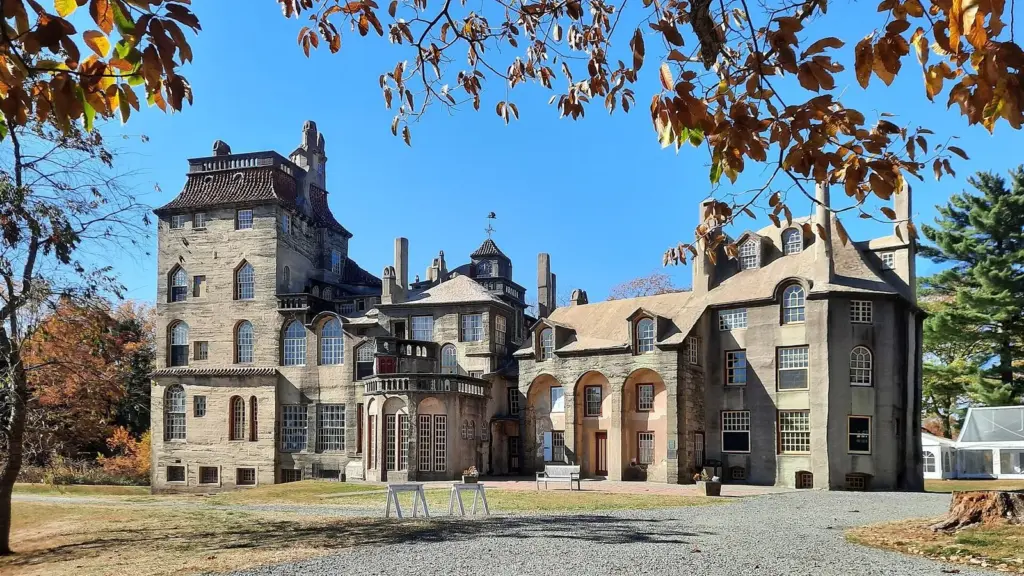
Plan it: Fonthill Castle, 525 East Court Street, Doylestown (Bucks County). About 1 hour from Philadelphia and 2 from Harrisburg. Hour-long guided tours only; book timed tickets through Mercer Museum and Fonthill Castle. Holiday Daily Tours as of September 2026: $20 adults, $17 seniors, $15 students, $10 ages 6-17, free for 5 and under. Expect many stairs. Allow 1½ hours. Best for: architecture fans, December.
30. Mercer Museum
$15; open daily. Mercer’s second concrete building, finished in 1916, is a six-story castle built to hold his collection of tools from America’s pre-industrial trades, and he displayed it like nobody else would. A whaleboat, a stagecoach and a Conestoga wagon hang in the air over the central atrium, while the balconies around it are crammed with the tools of dozens of vanished crafts. It’s one of the strangest museum interiors in the country and the best $15 you can spend in Bucks County. If you only do one of Mercer’s three buildings, do this one.
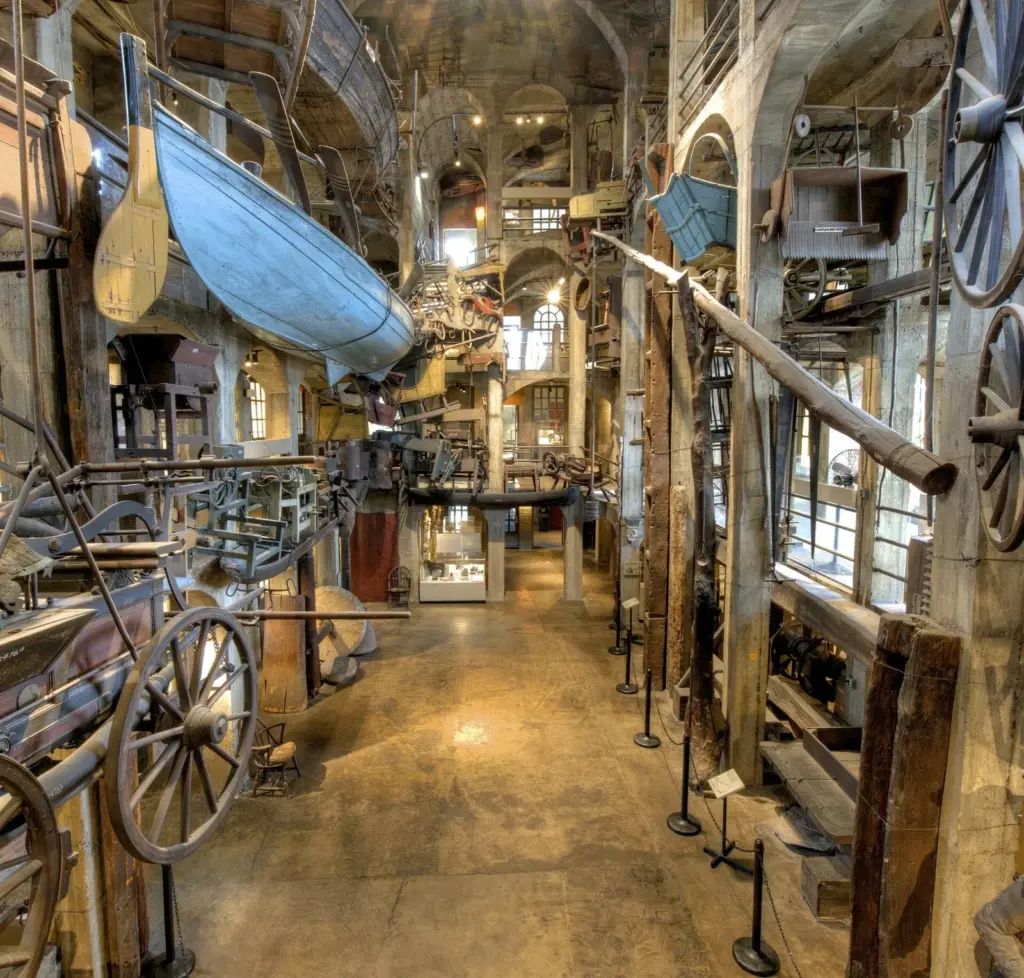
Plan it: Mercer Museum, South Pine Street, Doylestown (Bucks County). About 1 hour from Philadelphia. As of September 2026: open Monday-Saturday 10am-5pm and Sunday noon-5pm; adults $15, seniors $13, ages 6-17 $8, 5 and under free (mercermuseum.org). Allow 2 hours. Best for: everyone.
31. Moravian Pottery and Tile Works
Admission fee; a working tile factory. The third of Mercer’s concrete buildings, a mission-style factory on the edge of Doylestown, still makes his tiles by hand from the original designs. Bucks County runs it as a historic site, and the short tour through the kilns and work rooms is the best way to understand what you saw on the walls of Fonthill next door. Buy a tile on the way out; it’s the one souvenir from this list you can hang in your kitchen.
Plan it: Moravian Pottery and Tile Works, Swamp Road, Doylestown, next to Fonthill (Bucks County). About 1 hour from Philadelphia. Check days and hours with Bucks County Parks before a weekday visit. Allow 45 minutes. Best for: finishing the three Mercer buildings in one day.
32. Grey Towers
Free grounds; tours seasonal. Above Milford, the Pinchot family’s 1886 stone mansion, designed by Richard Morris Hunt, looks more like a French chateau than anything in Pike County has a right to. It was the home of Gifford Pinchot, the first chief of the US Forest Service and a two-term Pennsylvania governor, and the Forest Service runs it today as a national historic site. The grounds, gardens and trails are open daily; first-floor museum tours resumed for the season in late May 2026.
Plan it: Grey Towers National Historic Site, 151 Grey Towers Drive, Milford (Pike County). About 2½ hours from Philadelphia and 2¾ from Harrisburg. Grounds free and open daily; check tour days and fees on the Forest Service’s Grey Towers site. Allow 1½ hours. Best for: pairing with the Delaware Water Gap or Roebling’s aqueduct.
33. Glencairn Museum
Admission fee; afternoon hours. In Bryn Athyn, north of Philadelphia, Raymond and Mildred Pitcairn built themselves a Romanesque castle between 1928 and 1939, next to the cathedral the family had already built, and filled it with medieval and religious art. It’s now a museum of religious art and history, and the building is as much the exhibit as the collection: hand-carved stone, stained glass and great halls built by craftsmen who worked on site for years. The Sacred Art of Ethiopia runs through November 8, 2026, and the Christmas show, World Nativities, opens November 27 and runs to January 24, 2027.
Plan it: Glencairn Museum, 1001 Cathedral Road, Bryn Athyn (Montgomery County). About 35 minutes from Philadelphia. Tuesday-Sunday 1-4:30pm during the Ethiopia exhibition; World Nativities costs $5 per person, included with a guided tour (glencairnmuseum.org, September 2026). Allow 1½ hours, plus time for Bryn Athyn Cathedral next door. Best for: art and architecture lovers, a December outing.
34. Ole Bull’s Castle
Free; a short, steep hike. In 1852 the Norwegian violin star Ole Bull bought a huge tract of Potter County forest to found a colony for Norwegian immigrants. The land was steep, rocky and hopeless for farming, and the colony fell apart almost at once. The “castle” he started on a hilltop above Kettle Creek was never finished, and a steep trail from Ole Bull State Park climbs to its stone remains and a view down the valley. Come for the story as much as the ruin. At night the same valley is some of the darkest country in the state.
Plan it: Ole Bull State Park, PA 144 near Cross Fork (Potter County). About 3¼ hours from Harrisburg and 4½ from Pittsburgh. Free, open daily from sunrise to sunset (DCNR). Allow 1½ hours. Best for: a Pennsylvania Wilds loop with Cherry Springs.
35. The Reading Pagoda
$3 walkthroughs only, fall 2026. A red, seven-story Japanese-style pagoda on the ridge above Reading is the city’s symbol, and it has an odd backstory. Its own site says it was built in 1907 as a planned luxury resort; the resort never happened, and the building was handed to the city in 1911. It stands 620 feet above the city with a view of about 30 miles, and 87 steps take you to the top floor. It’s in the middle of a restoration, so for now it opens only on announced walkthrough days: $3, with September 6, September 19 and October 4 already sold out and tickets for October 24 on sale from October 5. Regular hours are planned for 2027. The overlook on Skyline Drive is worth the drive even when the doors are shut.

Plan it: The Pagoda, Skyline Drive, Reading (Berks County). About 1¼ hours from Philadelphia or Harrisburg. Walkthrough tickets through readingpagoda.com; the outdoor overlook costs nothing. Allow 45 minutes. Best for: a Berks County day with Crystal Cave or Hawk Mountain.
36. Columcille Megalith Park
Free; open daily, dawn to dusk. Near Bangor, two friends began raising standing stones in the late 1970s to create a place inspired by Iona, the Scottish island of the Celtic saint Columba. Today there are stone circles, dolmens, a small chapel and paths through the woods, run as a nonprofit outdoor sanctuary where visitors are asked to walk quietly. It feels like the Hebrides by way of the Slate Belt, and it costs nothing.
Plan it: Columcille Megalith Park, Fox Gap Road, Bangor (Northampton County). About 1¾ hours from Philadelphia and 2 from Harrisburg. Free, open daily from dawn to dusk, with donations welcome (columcille.org). Allow 1 hour. Best for: a quiet hour near the Delaware Water Gap.
Haunted Places and Dark History
Every old Pennsylvania town has a ghost story. The places below back theirs with real history and run proper tours, which is the only legal way in after dark. Keep a little respect in your pocket: people suffered and died at most of these sites, and the best guides never let you forget it. Pennhurst in Spring City, a former state institution whose abuses led to a landmark disability-rights lawsuit in the 1970s, is private property now; the only legal way onto it is a ticketed event, and many people find a haunted attraction there hard to stomach.
37. Eastern State Penitentiary
Timed tickets; Halloween Nights October 2 to November 7, 2026. Pennsylvania’s most famous haunted building is a genuine ruin in Philadelphia’s Fairmount neighborhood: the 1829 prison built around solitary confinement, with crumbling cellblocks, Al Capone’s surprisingly comfortable cell and a great deal of peeling paint. Every fall it runs Halloween Nights, with five haunted houses, historic tours and bars on select nights from October 2 to November 7, 2026. Daytime tours are the better history lesson; Halloween Nights is the better party.
Plan it: Eastern State Penitentiary, 2027 Fairmount Avenue, Philadelphia. About 5 minutes from Center City by car, or a walk from the Philadelphia Museum of Art. Halloween Nights entry is timed every half hour, and buying ahead is the only way to guarantee a slot. Allow 2 hours. Best for: history fans by day, teens and adults by night.
38. Fort Mifflin
Paranormal nights in October 2026. Out on Mud Island by the airport, Fort Mifflin held off a weeks-long British bombardment in the fall of 1777 and bought Washington’s army time before Valley Forge. It later held prisoners during the Civil War. Jets from Philadelphia International roar in low overhead, which only adds to the mood after dark. The fort leans into its haunted reputation with Open Investigation Evenings (the next is October 3, 2026), and Visit Philadelphia lists candlelight ghost tours there on select nights from October 9 to 23.
Plan it: Fort Mifflin, 6400 Hog Island Road, Philadelphia. About 15 minutes from Center City. Paranormal events need advance tickets, and daytime hours are seasonal, so check the fort’s paranormal programs page and calendar. The ground is uneven and the casemates are dark; bring a flashlight at night. Allow 2 hours. Best for: Revolutionary War fans, ghost hunters.
39. Old Jail Museum
Guided tours; closed Wednesdays. Jim Thorpe’s stone county jail, finished in 1871, held accused Molly Maguires, members of the secret society of Irish coal miners, and four of them were hanged there on a single day in June 1877. The story everyone comes for is Cell 17, where a handprint on the wall is said to have been left by a condemned man swearing his innocence, and to have survived every attempt to scrub or paint it away. The tour also takes you down to the basement cells used for solitary confinement. Believe what you like about the handprint; the history is grim enough.
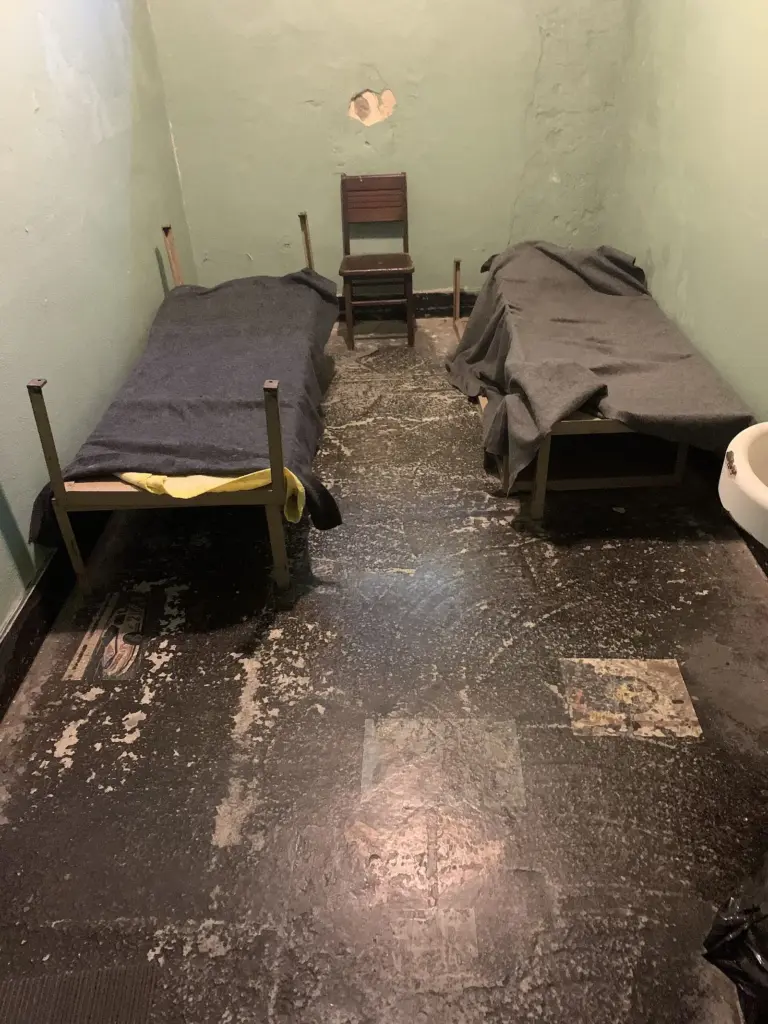
Plan it: Old Jail Museum, 128 West Broadway, Jim Thorpe (Carbon County). About 1½ hours from Philadelphia and 1¾ from Harrisburg. As of September 2026: guided tours of about 30-35 minutes; weekdays by reservation, weekends first come, first served from noon to 4pm with tickets sold in person only; closed Wednesdays; open into late November, weather allowing (theoldjailmuseum.com). Saturday tours have sold out by 3pm. Allow 1 hour. Best for: Molly Maguires history, pairing with the No. 9 Mine.
40. Bube’s Brewery and the Catacombs
A restaurant, so the price is dinner. In Mount Joy, a 19th-century lager brewery kept its old buildings when the beer stopped, and they now hold bars and dining rooms. The one to book is the Catacombs, down in the stone cellars where the lager once aged, a dining room that feels like a crypt. Bube’s turns up on most lists of haunted places in Pennsylvania, and eating dinner underground in a brewery vault is strange enough even if you don’t believe a word of it.
Plan it: Bube’s Brewery, 102 North Market Street, Mount Joy (Lancaster County). About 35 minutes from Harrisburg and 1½ hours from Philadelphia. The Catacombs keeps its own hours, separate from the main brewery, so check bubesbrewery.com and reserve. Allow 2 hours. Best for: couples, a night out after a Lancaster County day.
41. Gettysburg After Dark
Ghost walks nightly from spring to mid-November. Three days of fighting in July 1863 left about 51,000 men killed, wounded, captured or missing, and the town has built a small industry of candlelit ghost walks on top of that fact. Mark Nesbitt’s Ghosts of Gettysburg is the long-running name, and several other companies advertise nightly walks from April to mid-November. Pick one that treats the battle as history rather than a punchline. For the battlefield, museums and the town by daylight, start with our guide to the things to do in Gettysburg.
Plan it: Gettysburg (Adams County). About 50 minutes from Harrisburg, 2½ hours from Philadelphia and 3¼ from Pittsburgh. Walks usually start between 7 and 10pm; book ahead on October weekends. Allow 90 minutes. Best for: teens and adults.
Odd Museums and One-of-a-Kind Collections
Pennsylvania is full of museums built by one person’s obsession: tools, clocks, lighters, magic, handmade furniture, artifacts set into walls. The small ones are volunteer-run or family-run and keep short hours, so call before a long drive.
42. Mütter Museum
Timed tickets; no photos in the galleries. Philadelphia’s museum of medical history, run by the College of Physicians, is the one weird museum in the state everyone has heard of: skulls, preserved specimens, antique instruments and the kind of anatomical exhibits that make teenagers go quiet. It adopted formal human-remains and image policies in August 2025, and photos and video are banned in the galleries; the lobby, reading room and medicinal plant garden are fine. It offers timed options such as sensory-friendly and masked hours.
Plan it: Mütter Museum, 19 South 22nd Street, Philadelphia. A short ride or walk from Center City; the PHLASH visitor shuttle’s West Loop added a Mütter stop in 2026. Book timed tickets on the museum’s site, which also explains the photo policy. Allow 1½-2 hours. Best for: the medically curious, teens and up.
43. Wharton Esherick Museum
Reservations required. Wharton Esherick, a sculptor and furniture maker, spent four decades building and rebuilding his hilltop home and studio near Valley Forge by hand, starting with the 1926 studio: carved doors, sculpted stairs, built-in furniture and a spiral staircase that’s a work of art on its own. It’s preserved much as he left it and shown on small reserved tours. If you care about wood, design or how one person can turn a whole house into a single artwork, it’s the best hour you’ll spend in the Philadelphia suburbs.
Plan it: Wharton Esherick Museum, 1520 Horseshoe Trail, Malvern (Chester County). About 35 minutes from Philadelphia. Visits by reservation only through whartonesherickmuseum.org. The house has steps and tight spaces. Allow 1½ hours. Best for: design lovers, a Valley Forge day.
44. National Watch and Clock Museum
Admission fee; check hours. In Columbia, on the Susquehanna, the National Association of Watch and Clock Collectors runs a museum that’s much bigger and stranger than the name suggests: tower clocks, sundials, pocket watches, novelty clocks and the whole mechanical history of keeping time, with enough ticking in the air to make you check your own watch. It rewards people who like to see how things work, and it pairs neatly with Chickies Rock a few minutes up the river.
Plan it: National Watch and Clock Museum, 514 Poplar Street, Columbia (Lancaster County). About 45 minutes from Harrisburg and 1½ hours from Philadelphia. Check days and prices before you go. Allow 1½ hours. Best for: tinkerers, a river day.
45. Houdini Museum
Weekends most of the year. Scranton has a museum devoted to Harry Houdini, run by working magicians, where the visit is a guided look at Houdini memorabilia followed by a live magic show. It’s more show than museum, which is the appeal. Listings say it opens daily from July 1 to Labor Day and on weekends the rest of the year; call ahead, because schedules shift.
Plan it: Houdini Museum, North Main Avenue, Scranton (Lackawanna County). About 2 hours from Harrisburg and 2¼ from Philadelphia. Book by phone or online; allow 2-3 hours for the tour and show. Best for: families with kids 8 and up, a Scranton weekend.
46. Zippo/Case Museum
Free; open seven days a week. Bradford is where Zippo makes its lighters, and the company museum beside its flagship store is a surprisingly good slice of American design history: walls of lighters, the company’s World War II story, Case pocketknives and an exhibit on the repair clinic behind the famous “It works or we fix it free” promise. It’s free, self-guided and accessible, and it’s the easiest indoor stop in the Allegheny National Forest region.
Plan it: Zippo/Case Museum and Flagship Store, 1932 Zippo Drive, Bradford (McKean County). About 3½ hours from Pittsburgh and 4 from Harrisburg. Free, with wheelchair access and free bus parking (zippo.com). Allow 1 hour. Best for: a Kinzua or Allegheny National Forest trip.
47. Indian Steps Museum
Small museum; check hours. On the Susquehanna in southern York County, an early 1900s collector built a stone lodge and set Native American artifacts into its walls and floors. The building tells you as much about how early collectors treated Indigenous objects as it does about the people who lived along this river for thousands of years, and it’s worth seeing with that in mind. The Conservation Society of York County runs it, and the river-hills setting is half the reason to go.
Plan it: Indian Steps Museum, 205 Indian Steps Road, Airville (York County). About 1¼ hours from Harrisburg and 2 from Philadelphia. The museum’s site lists Friday-Monday, 11am-4pm, but it’s volunteer-run, so call 717-862-3948 before driving. Allow 1 hour. Best for: a Susquehanna river-hills drive.
48. Meadowcroft Rockshelter and Historic Village
Admission fee; open May to late November. Under a sandstone overhang above Cross Creek in Washington County, archaeologists found traces of people going back roughly 16,000 years, some of the oldest evidence of humans in North America. You see the excavation from a walkway under a protective roof, then wander a recreated 19th-century village where you can watch a blacksmith forge red-hot iron or sit through a lesson in a one-room schoolhouse. The Heinz History Center runs it.
Plan it: Meadowcroft, 401 Meadowcroft Road, Avella (Washington County). About 1 hour from Pittsburgh. Open May through November 23: weekends in May, Wednesday-Sunday 10am-4pm from Memorial Day to Labor Day, then a reduced weekend schedule (Heinz History Center, September 2026). Allow 2-3 hours. Best for: families, archaeology fans.
49. Old Economy Village
Admission fee; Friday to Sunday, April to December. In Ambridge, the Harmony Society, a celibate Christian community that expected the Second Coming any day, built a model town in the 1820s, grew rich on textiles, wine and later oil and railroads, and then died out because it had no children to carry it on. Their village survives as a state museum: the Great House, gardens, a feast hall and workshops, all on a few blocks of an old steel town.
Plan it: Old Economy Village, Visitor Center at 270 16th Street, Ambridge (Beaver County). About 30 minutes from Pittsburgh. Open Friday and Saturday 10am-4pm and Sunday noon-4pm, April-December, as of September 2026 (oldeconomyvillage.org). Allow 2 hours. Best for: history fans, a half day from Pittsburgh.
50. Appalachian Trail Museum
Seasonal. Billed as the first museum devoted to hiking, it sits in an old grist mill at Pine Grove Furnace State Park, near the halfway point of the Appalachian Trail. It’s small and personal: the gear, shelters and stories of early thru-hikers, including Earl Shaffer, who first walked the whole trail in 1948. Across the lot, the park’s general store is home of the half-gallon challenge, in which thru-hikers mark the midpoint by eating a half gallon of ice cream in one sitting. Spectators welcome.
Plan it: Appalachian Trail Museum, Pine Grove Furnace State Park (Cumberland County). About 1 hour from Harrisburg and 2¾ from Philadelphia. Seasonal; check atmuseum.org for hours. Allow 1 hour. Best for: hikers, a drive with Boiling Springs.
River, Rail and Engineering Oddities
The Susquehanna and the railroads gave Pennsylvania its strangest engineering: stone bridges longer than any in the world, a concrete viaduct that dwarfs its town, a paddlewheel ferry and a statue in the middle of a river. Most can be seen from a public road or a park. Stay off the tracks: every railroad bridge here still carries freight trains.
51. Millersburg Ferry
Seasonal; cars and walk-ons. The ferry across the Susquehanna at Millersburg says it runs the last known wooden double stern-wheel paddle boats in the United States, the Roaring Bull V and the Falcon III, and riding one is as slow and odd as it sounds. A few cars roll onto a flat deck, the paddlewheels churn, and you cross a wide, shallow river to the Perry County side. It began its 2026 season in spring, and river levels decide whether it runs. Reported 2026 fares were $20 per car with driver and $5 per extra passenger.
Plan it: Millersburg Ferry landing, Millersburg (Dauphin County). About 35 minutes from Harrisburg. Check the season and hours on millersburgferry.org before driving up. Allow 1 hour for the round trip and a walk in town. Best for: kids, anyone who likes slow travel.
52. Dauphin Narrows Statue of Liberty
Free; a roadside view. On an old bridge pier in the middle of the Susquehanna north of Harrisburg stands a 25-foot copy of the Statue of Liberty. A local activist first put one up in 1986, built from venetian blinds; after wind wrecked it, a sturdier replica went up in the late 1990s. You see it from the pull-offs along US 22/322 at the Dauphin Narrows, and it’s a quick, happy surprise if nobody warned you.
Plan it: US 22/322 at the Dauphin Narrows, just south of Dauphin (Dauphin County). About 10 minutes from Harrisburg. Free. Use a pull-off, never the shoulder, because traffic moves fast. Allow 15 minutes. Best for: the drive up to the Millersburg Ferry.
53. Rockville Bridge
Free; view it from the riverbank. Finished in 1902, Rockville Bridge carries trains 3,820 feet across the Susquehanna on 48 stone arches, and it’s billed as the longest stone masonry arch railroad bridge in the world. Norfolk Southern freights still rumble across it. The best free views are from the river roads on either bank near Marysville and Rockville, and a train crossing at sunset is the bonus.
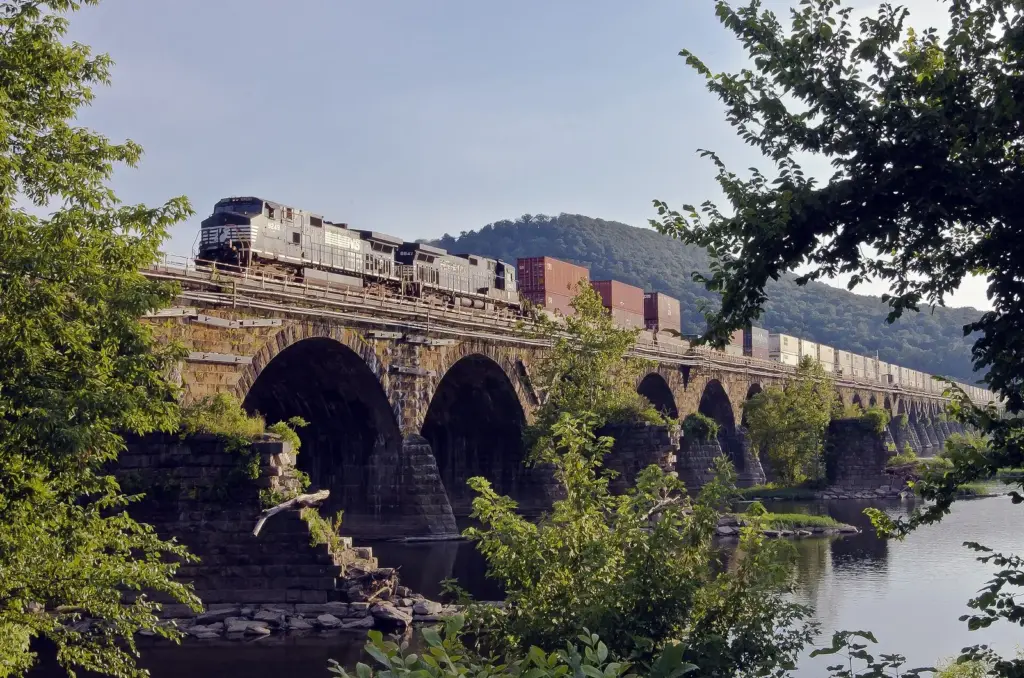
Plan it: Rockville Bridge, between Marysville (Perry County) and Rockville (Dauphin County). About 15 minutes from Harrisburg. Free; watch from public roads and never walk onto the tracks. Allow 20 minutes. Best for: rail fans, a Harrisburg evening.
54. Roebling’s Delaware Aqueduct
Free; drive or walk across. Before he designed the Brooklyn Bridge, John A. Roebling built this suspension aqueduct in 1847 and 1848 to carry the Delaware and Hudson Canal over the Delaware River. The canal is long gone, but the bridge survives as the oldest existing wire suspension bridge in the United States, carrying a one-lane road between Lackawaxen, Pennsylvania, and Minisink Ford, New York. The National Park Service owns it as part of the Upper Delaware Scenic and Recreational River, and the western writer Zane Grey’s old house is just up the road.
Plan it: Lackawaxen (Pike County), on the New York line. About 2¾ hours from Harrisburg and 3 from Philadelphia. Free. Park on the Pennsylvania side and walk across. Allow 30 minutes. Best for: pairing with Grey Towers.
55. Tunkhannock Viaduct
Free; view it from Nicholson. The concrete railroad bridge that towers over the small town of Nicholson looks like a Roman aqueduct scaled up for freight trains. Opened in 1915, it’s 2,375 feet long and about 240 feet high, and it was billed as the largest concrete structure in the world when it was built. It still carries trains, and the view from the road through town, looking up at the arches over the rooftops, is the whole point.
Plan it: Nicholson (Wyoming County), north of Scranton. About 2½ hours from Philadelphia or Harrisburg. Free. Allow 20 minutes. Best for: an Endless Mountains drive with Starrucca.
56. Starrucca Viaduct
Free; view it from Lanesboro. Older and smaller than Nicholson’s giant, Starrucca Viaduct was built of stone in 1848 and is still in use, one of the oldest stone railroad bridges in the country that trains cross every day. It’s about 1,040 feet long and 100 feet high, and it fills the valley behind the tiny village of Lanesboro. Seen together, the two viaducts show you nearly 70 years of railroad engineering in one drive.
Plan it: Lanesboro (Susquehanna County). About 3 hours from Philadelphia or Harrisburg. Free. Allow 20 minutes. Best for: rail fans, a scenic northeast loop.
57. Horseshoe Curve
Admission fee; check hours. In 1854 the Pennsylvania Railroad beat the Allegheny Front by bending its main line into a giant horseshoe west of Altoona, and trains still grind around it every day. A funicular or a long staircase takes you up to a trackside viewing park, and you watch long freights snake around the curve below and above you at once. The Railroaders Memorial Museum runs it and posts hours on social media rather than a fixed schedule.
Plan it: Horseshoe Curve National Historic Landmark, 2400 Veterans Memorial Highway, Altoona (Blair County). About 1¾ hours from Pittsburgh and 2¼ from Harrisburg. Check current hours through the Railroaders Memorial Museum; admission stops 45 minutes before closing. Allow 1½ hours. Best for: rail fans of every age.
58. Linesville Spillway
Free; bring bread. “Where the ducks walk on the fish” is Linesville’s motto, and it’s barely an exaggeration. Carp crowd so thickly below the Pymatuning Reservoir spillway that ducks and geese stand on their backs to snatch bread thrown by visitors, a tradition that started almost as soon as the reservoir filled. DCNR counts more than 300,000 visitors a year. It’s silly, a little gross and completely worth the stop.
Plan it: Linesville Spillway, Pymatuning State Park, Linesville (Crawford County). About 1¾ hours from Pittsburgh. Free, open daily from sunrise to sunset (DCNR Pymatuning wildlife watching). Allow 30 minutes. Best for: kids, a drive to Lake Erie.
Dark Skies and Observatories
Light pollution washes out the sky over most of eastern Pennsylvania, but the northern tier still gets properly dark. Plan around the new moon, bring a red light, and pack warmer clothes than you think you need, because a ridgetop at midnight is much colder than town at dinner.
59. Cherry Springs State Park
Free; among the darkest skies in the East. Cherry Springs, on a Potter County hilltop, is Pennsylvania’s best-known dark-sky park, and on a clear, moonless night the Milky Way looks like a cloud bank. The Night Sky Public Viewing Area is for short visits, with red light only, and white light must go off during programs; the park added a new entrance in 2024 so arriving headlights don’t sweep across the field. No pets are allowed on the Astronomy Observation Field at night.
Plan it: Cherry Springs State Park, PA 44 (Potter County). About 3½ hours from Harrisburg and 4¼ from Pittsburgh. Free (DCNR stargazing rules). Allow a whole night; camp or stay in Coudersport. Watch for deer on the drive back. Best for: stargazers, astrophotographers.
60. Allegheny Observatory
Free; reservations required. The University of Pittsburgh’s Allegheny Observatory in Riverview Park is a working research lab, and twice a week from April through October it opens its doors for an evening: a short presentation, a walk through the domed building and, if the sky cooperates, a look through the telescope at whatever is in range. Tours are free but fill weeks ahead.
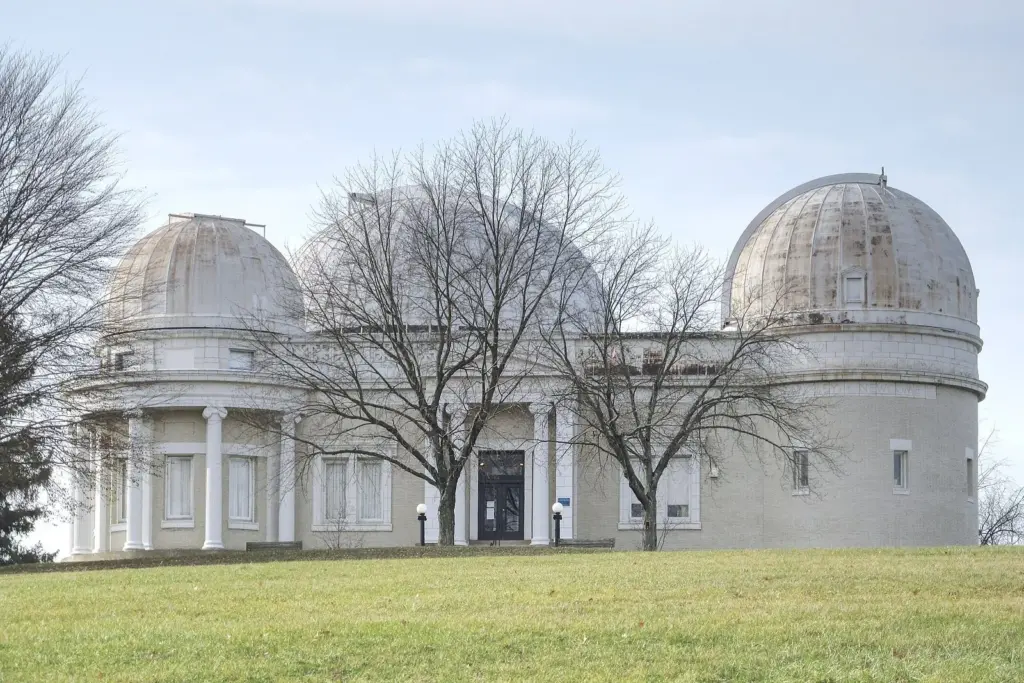
Plan it: Allegheny Observatory, 159 Riverview Avenue, Pittsburgh. About 15 minutes from downtown. Tours run 8pm to about 10pm, free, with reservations through Eventbrite or 412-321-2400 (public tours); the 2026 season ends in late October and resumes in April. Dress warmly, even in summer. Allow 2 hours. Best for: families with older kids, science fans.
Hidden Gems in Pennsylvania by Region
Pennsylvania is big: more than five hours end to end on the Turnpike. Group your stops by region, and use the numbers to jump back to each entry.
- Philadelphia and the southeast: Ringing Rocks (8), Fonthill, the Mercer Museum and the Tile Works in Doylestown (29-31), Glencairn (33), Eastern State (37), Fort Mifflin (38), the Mütter (42) and the Wharton Esherick Museum (43).
- Lehigh Valley and the Poconos: Lost River Caverns (2), the Boulder Field (9), the No. 9 Mine (22), Grey Towers (32), Columcille (36), the Old Jail (39) and Roebling’s aqueduct (54).
- Coal region and the northeast: Archbald Pothole (11), Centralia (19), Eckley (20), Pioneer Tunnel (21), the Lackawanna Coal Mine (23), the Houdini Museum (45) and the two viaducts (55-56).
- Dutch Country, Berks County and the Susquehanna: Indian Echo (4), Crystal Cave (5), the River of Rocks (10), the Pinnacle (16), Chickies Rock (17), Boiling Springs (18), Cornwall (27), the Pagoda (35), Bube’s (40), Gettysburg (41), the clock museum (44), Indian Steps (47), the Appalachian Trail Museum (50), and the ferry, statue and bridge north of Harrisburg (51-53).
- Central mountains: Penn’s Cave (1), Lincoln Caverns (6), Woodward Cave (7), Balanced Rock (12), Bilger’s Rocks (13), Staple Bend (28) and Horseshoe Curve (57).
- Western Pennsylvania: Laurel Caverns (3), Gravity Hill (14), Mount Davis (15), Pithole (24), the abandoned Turnpike (26), Meadowcroft (48), Old Economy Village (49), the Linesville Spillway (58) and the Allegheny Observatory (60). If someone asks you for hidden gems in western Pennsylvania, Meadowcroft and the spillway are the two most people have never heard of.
- The Pennsylvania Wilds and the northern tier: Austin Dam (25), Ole Bull’s castle (34), the Zippo/Case Museum (46) and Cherry Springs (59).
Four Offbeat Day Trips and a Weekend
Hidden gems work best strung together. These routes put three or four on one road, with drive times that stay sane.
The Mercer Mile and the ringing rocks (from Philadelphia)
Drive to Doylestown for a 10am Fonthill tour, walk over to the Tile Works, then eat lunch in town before the Mercer Museum in the afternoon. Doylestown to Upper Black Eddy is a pretty drive north through Bucks County farm country to Ringing Rocks, where you can bang on boulders until the light goes. Back in Philadelphia by dinner. Book the Fonthill tour first; it sets the day.
The coal region loop (from Harrisburg or Philadelphia)
Start at Pioneer Tunnel in Ashland when it opens, then drive the few miles to Centralia and walk the empty streets from the road. Head northeast to Eckley Miners’ Village, then east to Lansford for the last No. 9 Mine tour, or to Jim Thorpe for the Old Jail. It’s a full day, and in the fall you’ll want to check each site’s reduced hours first. Jim Thorpe makes the best overnight stop, with dinner and a walk around the old town.
River oddities (from Harrisburg)
Watch a freight cross Rockville Bridge from the Marysville side, then drive north on US 22/322 past the Statue of Liberty at the Dauphin Narrows to Millersburg, and ride the paddlewheel ferry across the Susquehanna and back. Finish at Indian Echo Caverns on the way home. It’s the easiest half day on this page, and kids love all four stops.
Railroad day (from Pittsburgh)
Walk out to Staple Bend Tunnel in the morning, have lunch in Altoona, and spend the afternoon watching trains at Horseshoe Curve. Add the Allegheny Portage Railroad’s main site near Gallitzin if you have the time. For a different day from Pittsburgh, pair Meadowcroft with Old Economy Village on opposite sides of the city.
A Pennsylvania Wilds weekend
Day one: Austin Dam in the morning, the Zippo/Case Museum in Bradford, then back south to camp or stay near Coudersport. Day two: hike to Ole Bull’s castle, rest in the afternoon, and spend the night at Cherry Springs under the stars. Cell signal is patchy across the whole region, so download maps before you leave the interstate.
Is It Legal? Is It Safe? Rules for Offbeat Pennsylvania
Nearly everything on this page is plainly legal and safe with ordinary care. A few places come with real risks, and a few famous “abandoned” spots aren’t on the list at all because the only way in is trespassing. Here’s the short version.
| Place or type | Legal to visit? | Main risk | What to do |
|---|---|---|---|
| Centralia | Yes on public roads and at the cemeteries; most other land is private | Sinking ground and gas near fire areas; no facilities | Stay on paved roads and out of posted areas |
| Abandoned Pennsylvania Turnpike | Used by walkers and cyclists at their own risk; not an official trail yet | Unlit tunnels, broken pavement, no help nearby | Go in daylight, in pairs, with strong lights |
| Gravity Hill | Yes, it’s a public road | Traffic | Pull fully off the road before you try it |
| Ringing Rocks, Boulder Field, River of Rocks, Bilger’s Rocks | Yes | Twisted ankles, slick rock after rain | Boots with grip; hammers only at Ringing Rocks |
| The Pinnacle, Balanced Rock, Chickies Rock | Yes | Cliff edges | Stay back from the edge and keep kids close |
| Coal mines | Only on guided tours | Bad air and collapse in abandoned workings | Tour Pioneer Tunnel, No. 9 or Lackawanna; never enter an old mine opening |
| Abandoned hospitals, factories and company towns | Usually no | Trespass charges, rotten floors, asbestos | Skip them, or go only on a ticketed event |
Three habits cover most of the rest. First, treat “no trespassing” signs as final: Pennsylvania landowners post land for good reasons, and a ghost town is still someone’s property. Second, leave what you find. Chipped ringing rocks don’t ring back, and cave formations that people touch stop growing. Third, respect the people and the dead. Battlefields, mine disasters, the Austin Dam and old prisons are places of real loss, and Amish and Mennonite families you pass on back roads are neighbors, not scenery; don’t photograph them.
Practical notes: cell signal disappears in the northern tier and the coal-region valleys, so download maps; deer are thick on rural roads at dusk; and small museums close without much notice, so a phone call saves a wasted drive.
What’s Changed, and What to Skip
- Centralia’s Graffiti Highway is gone. The owner buried the painted stretch of old Route 61 under dirt in April 2020, using about 400 truckloads. It’s a grassy berm now, and old photos show a place you can’t visit.
- Roadside America closed for good in 2020. The miniature village in Shartlesville shut in March 2020, and many of its pieces were auctioned in January 2021.
- The Reading Pagoda isn’t on regular hours yet. It opens only on announced walkthrough days in fall 2026, with regular operations planned for 2027.
- Pithole’s visitor center is closed until June 2027, but the grounds stay open daily and free.
- Archbald Pothole State Park closes on the third Saturday of November and reopens on the second Friday of April.
- The Kinzua Bridge Skywalk is open only until October 31, 2026, then closes again for repairs that are scheduled to finish in time for fall 2027. It’s a Pennsylvania Wilds sight covered with the region; if you’re going this October, pair it with the color in our fall foliage guide.
- Glen Onoko Falls is closed while DCNR rebuilds the trail, with no reopening date. Don’t hike around the barriers.
- Skip trespass “urbex” spots. Closed hospitals, company towns and factories that show up on social media are usually private, often dangerous and sometimes patrolled. The legal ruins on this page are better anyway.
- Roadside giants are their own genre. The Haines Shoe House near York and the Bedford Coffee Pot are great fun on a road trip, but they’re drive-by photo stops rather than places to plan a day around.
Hidden Gems in Pennsylvania: Your Questions
What are the best hidden gems in Pennsylvania?
For a first trip, pick the Boulder Field at Hickory Run State Park, Ringing Rocks Park, Penn’s Cave, Eckley Miners’ Village and Fonthill Castle. Each is legal, easy to reach, unlike anything else in the state and doable in a few hours. Add the Mercer Museum if you have a whole day in Bucks County.
What are some hidden gems in western Pennsylvania?
Meadowcroft Rockshelter near Avella, Old Economy Village in Ambridge, the Linesville Spillway at Pymatuning, Pithole’s ghost-town grounds, Laurel Caverns, Mount Davis, Gravity Hill and the abandoned Turnpike near Breezewood. The Allegheny Observatory runs free night tours in Pittsburgh from April through October, with reservations.
Can you still visit Centralia, PA?
Yes, on public roads. You can drive through, visit the cemeteries respectfully and see the Ukrainian Catholic church on the hill. Much of the land is private, the ground over the mine fire can be unsafe, and the Graffiti Highway was buried in 2020. Stay on paved roads and out of posted areas.
What is the most haunted place in Pennsylvania?
Eastern State Penitentiary in Philadelphia has the biggest reputation and runs Halloween Nights from October 2 to November 7, 2026. Gettysburg has the most ghost walks; see our Gettysburg guide for the town. Fort Mifflin and Jim Thorpe’s Old Jail Museum are the best smaller choices.
What is the largest cave in Pennsylvania?
Laurel Caverns, near Farmington in Fayette County, calls itself the largest cave in Pennsylvania, with more than four miles of passages. It’s a steep sandstone cave rather than a classic limestone cave with stalactites. For something easier, Penn’s Cave near State College is toured entirely by boat.
Where is the best stargazing in Pennsylvania?
Cherry Springs State Park in Potter County has the darkest, best-known sky, with a public viewing area and red-light rules. The surrounding Pennsylvania Wilds, including Ole Bull State Park, are dark too. Near Pittsburgh, the Allegheny Observatory’s free tours let you look through a historic research telescope.
What are good hidden gems in Pennsylvania for couples?
Dinner in the Catacombs at Bube’s Brewery in Mount Joy, a reserved tour of the Wharton Esherick Museum, sunset from Chickies Rock, a quiet walk through Columcille Megalith Park, and a night under the stars at Cherry Springs. For an overnight, Jim Thorpe pairs the Old Jail with an old-town dinner.
Are Pennsylvania’s hidden gems free?
Many are. Ringing Rocks, the Boulder Field, Archbald Pothole, Balanced Rock, Bilger’s Rocks, Gravity Hill, Mount Davis, Centralia, the abandoned Turnpike, Pithole’s grounds, Columcille, the Zippo/Case Museum, the Allegheny Observatory tours and Cherry Springs cost nothing. Caves, mine tours and most museums charge admission.
Related Pennsylvania Guides
- Where to See Fall Foliage in Pennsylvania: peak weeks by region, the best parks, drives and train rides.
- Things to Do in Gettysburg: the battlefield, museums and the town.
Sources and How We Checked
Everything on this page was checked on September 24, 2026 against the official websites below and compiled from them; we don’t claim first-hand visits. Drive times are free-flow estimates from OpenStreetMap-based routing (the Valhalla engine) from downtown Philadelphia, Pittsburgh and Harrisburg, rounded to the nearest 15 minutes, so add time for October and summer weekend traffic.
- DCNR, Archbald Pothole State Park: the pothole’s size and age and the park’s seasonal closing. DCNR’s pages for Hickory Run, Trough Creek, Ole Bull, Pymatuning and Cherry Springs supplied the other park details.
- PHMC, Cornwall Iron Furnace: hours, tour times and the furnace’s history.
- Drake Well Museum, Historic Pithole City: the visitor center season, fees and the town’s history.
- National Park Service, Allegheny Portage Railroad NHS: fees and seasons, including Staple Bend Tunnel.
- Reading Pagoda: the 2026 walkthrough dates and the restoration timeline.
- University of Pittsburgh, Allegheny Observatory public tours: the tour season and reservation rules.
- Fulton County, Pike2Bike: the abandoned Turnpike’s history and tunnel lengths.
We also checked the websites of Penn’s Cave, Lost River Caverns, Laurel Caverns, Indian Echo Caverns, Crystal Cave, Lincoln Caverns, Woodward Cave, Hawk Mountain Sanctuary, Bilger’s Rocks, Eckley Miners’ Village, Pioneer Tunnel, the No. 9 Mine, the Mercer Museum and Fonthill Castle, Glencairn Museum, Columcille, Fort Mifflin, the Old Jail Museum, Bube’s Brewery, the Mütter Museum, the Wharton Esherick Museum, the Zippo/Case Museum, the Indian Steps Museum, Meadowcroft, Old Economy Village, the Appalachian Trail Museum, the Millersburg Ferry and the Railroaders Memorial Museum.
Pennsylvania Tourism Guide is an independent publication. We are not affiliated with DCNR, the Pennsylvania Historical and Museum Commission, the National Park Service, the USDA Forest Service, the University of Pittsburgh, the Heinz History Center or any cave, mine tour, museum or site named here, and no one paid to be included.
Photo Credits
- Boulder Field, Hickory Run State Park: photo by Tyler Savitski, via Wikimedia Commons (CC BY-SA 4.0)
- Entrance to Penn's Cave, Centre Hall: photo by Ruhrfisch, via Wikimedia Commons (CC BY-SA 3.0)
- Eckley Miners' Village: photo by Dbenford, via Wikimedia Commons (CC BY-SA 4.0)
- Sideling Hill Tunnel, abandoned Pennsylvania Turnpike: photo by Mr. Matté (if there is an issue with this image, contact me using this image's Commons talk page, my Commons user talk page, or my English Wikipedia user talk page; I'll know about it a lot faster), via Wikimedia Commons (CC BY-SA 3.0)
- Fonthill Castle, Doylestown: photo by Phil Buchenrauch, via Wikimedia Commons (CC BY-SA 4.0)
- Mercer Museum atrium, Doylestown: photo by Bestbudbrian, via Wikimedia Commons (CC BY-SA 3.0)
- The Pagoda, Reading: photo by firoz-ansari, via Wikimedia Commons (CC BY-SA 4.0)
- Cell at the Old Jail Museum, Jim Thorpe: photo by Andrew Ratto, via Wikimedia Commons (CC BY 2.0)
- Rockville Bridge over the Susquehanna: photo by Rlibrandi, via Wikimedia Commons (CC BY-SA 3.0)
- Allegheny Observatory, Pittsburgh: photo by Cbaile19, via Wikimedia Commons (CC0)