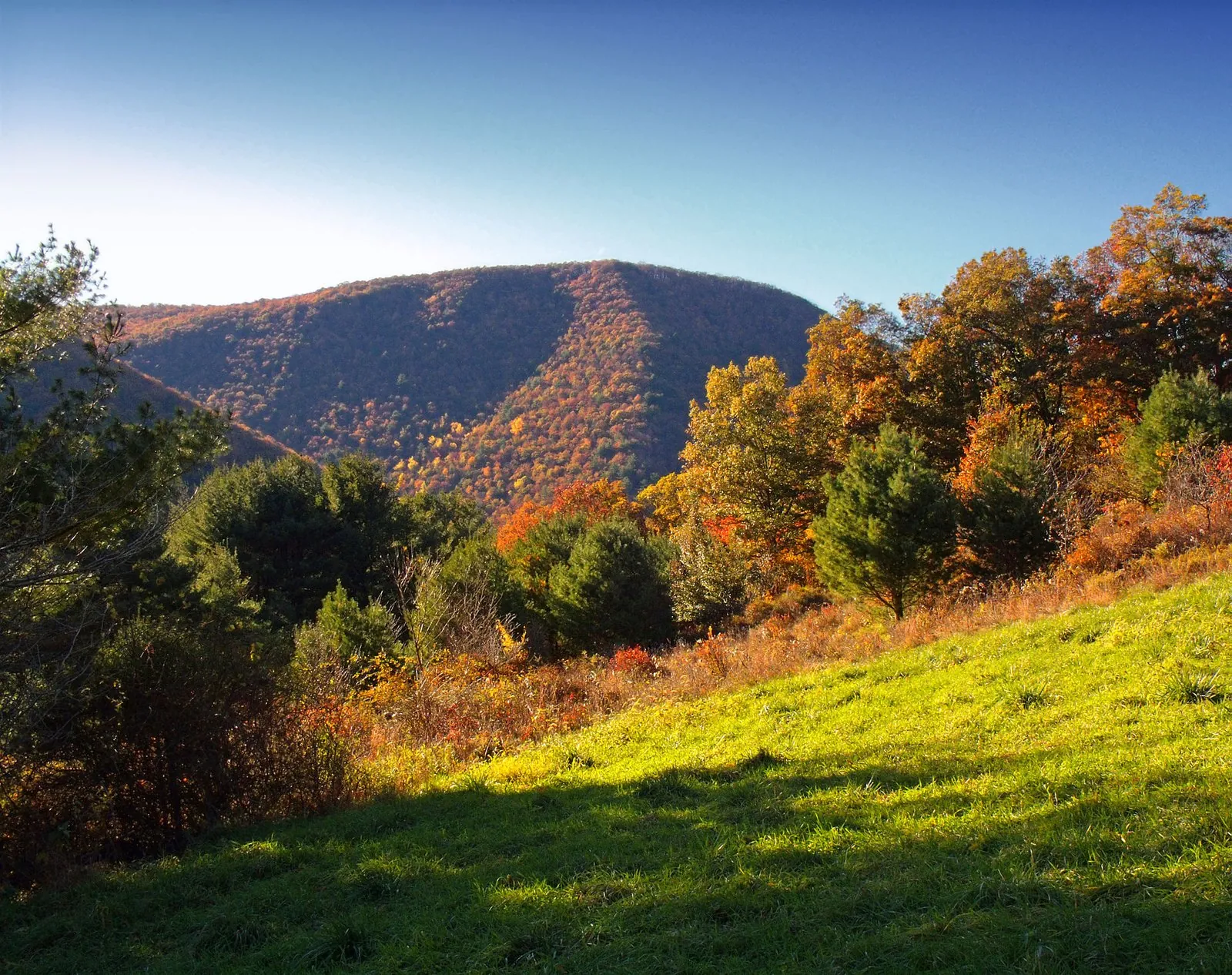
Pennsylvania’s fall color doesn’t arrive in one wave. It starts on the high plateaus along the New York line in the first days of October, then slides south and east for most of a month, so the ridges above Pine Creek can be past their best while the bluffs over the lower Susquehanna are barely turning. That slow roll is the most useful thing to know about where to see fall foliage in Pennsylvania: choose the place by the week you can travel, not the other way around.
Quick answer: In the first half of October, go north: the Pennsylvania Grand Canyon near Wellsboro, Worlds End, Ricketts Glen, Kinzua Bridge and the Allegheny National Forest. From about October 10 to 20, central Pennsylvania’s ridges, the Laurel Highlands around Ohiopyle and Mount Davis, and Jim Thorpe’s Lehigh Gorge take over. In the last third of the month, head southeast, where Hawk Mountain, the lower Susquehanna overlooks and the Philadelphia area hold color longest. DCNR’s weekly report, out every Thursday in season, tells you which week you’re actually in.
Last updated September 24, 2026. Peak windows, fees, train fares, closures and event dates were checked that day against the websites of the Pennsylvania Department of Conservation and Natural Resources (DCNR), the National Park Service, the Pennsylvania Game Commission and the parks, railroads and festivals themselves. DCNR hadn’t posted its first 2026 report yet; in 2025 the first one covered September 25 to October 1.
- When: DCNR’s typical peaks are October 1-10 in the northern counties, October 10-20 in the central counties and October 20-31 in the south central and southeastern counties.
- What it costs: Pennsylvania state parks charge nothing to enter or park. Hawk Mountain, a private sanctuary, charges a $10 adult trail fee, and the scenic railroads sell tickets (prices as of September 2026).
- The 2026 outlook: After summer drought stressed trees in parts of the mid-Atlantic, AccuWeather expects a sharp contrast between central and northern Pennsylvania and the southeast.
- Changed this year: The Kinzua Bridge Skywalk is open only through October 31, 2026, Dingmans Falls in the Delaware Water Gap is closed for construction, and Glen Onoko Falls near Jim Thorpe is still off-limits.
On this page: At a glance | Peak weeks by region | Reading the DCNR report | 16 best places | Drives | Train rides | Festivals | Day trips | Planning tips | What’s changed | FAQ
The 16 Best Places at a Glance
The “aim for” column follows DCNR’s regional windows, nudged for elevation. Drive times are free-flow estimates from OpenStreetMap-based routing from downtown Philadelphia and Pittsburgh, rounded to the nearest 15 minutes. On a peak October Saturday, add time near Jim Thorpe, Ohiopyle and Wellsboro.
| Place | Region | Aim for | From Philadelphia | From Pittsburgh | Cost |
|---|---|---|---|---|---|
| Pennsylvania Grand Canyon | North (Tioga County) | Oct 1-15 | 4h 30m | 4h 45m | Free |
| Worlds End State Park | North (Sullivan County) | Oct 5-15 | 3h 30m | 4h 30m | Free |
| Ricketts Glen State Park | Northeast plateau | Oct 5-15 | 3h | 4h 45m | Free |
| Kinzua Bridge State Park | North (McKean County) | Oct 1-15 | 5h 30m | 3h 15m | Free |
| Rimrock and Jakes Rocks | Allegheny National Forest | Oct 1-15 | 6h | 3h 15m | Not confirmed |
| Cook Forest State Park | Northwest | Oct 5-20 | 5h | 2h | Free |
| Hyner View State Park | North central | Oct 5-15 | 4h 15m | 4h | Free |
| Benezette elk country | North central | Oct 1-15 | 4h 45m | 2h 45m | Free to watch |
| Ohiopyle State Park | Laurel Highlands | Oct 10-25 | 5h | 1h 45m | Free (some lots charge) |
| Mount Davis | Laurel Highlands | Oct 10-20 | 4h 30m | 1h 45m | Free |
| Jo Hayes Vista | Central (State College) | Oct 10-20 | 3h 15m | 2h 30m | Free |
| Jim Thorpe and the Lehigh Gorge | Poconos | Oct 10-25 | 1h 30m | 4h 45m | Train from $25 |
| Big Pocono State Park | Poconos | Oct 10-20 | 2h | 5h | Free |
| Hawk Mountain Sanctuary | Southeast ridge | Oct 15-31 | 1h 30m | 4h 15m | $10 adults |
| Lower Susquehanna overlooks | South central | Oct 20-31 | 1h 45m | 4h 30m | Free |
| McConnells Mill State Park | West | Oct 15-30 | 5h 30m | 45m | Free |
When Pennsylvania’s Leaves Turn, Region by Region
DCNR says Pennsylvania has one of the longest and most varied fall foliage seasons in the world, and the reasons are easy to see on a map. The state runs about 160 miles from the Maryland line to the New York line, it climbs from tidewater on the Delaware at Philadelphia to 3,213 feet on Mount Davis, and it has 134 native tree species, each on its own schedule. Put those together and there is almost always somewhere in Pennsylvania at or near peak from the first week of October to the first days of November.
The species follow a rough order you can plan around. Black gum, sassafras, dogwood and Virginia creeper redden early. Maples and birches bring the big oranges and yellows, with tulip poplar adding a clear yellow. Oaks finish last in russet and bronze, which is why the oak ridges of the southeast still look colorful when the northern hardwoods are bare.
| Region | DCNR’s usual peak | Where to go that week |
|---|---|---|
| Northern counties: the New York border tier, the Allegheny Plateau, the Endless Mountains | October 1-10 | Pennsylvania Grand Canyon, Kinzua Bridge, Allegheny National Forest, Worlds End, Ricketts Glen, Benezette |
| Central counties: State College, the ridge-and-valley country, the West Branch Susquehanna | October 10-20 | Jo Hayes Vista and Rothrock State Forest, Hyner View, Big Pocono, Jim Thorpe |
| South central and southeastern counties: Lancaster, York, Gettysburg, Philadelphia | October 20-31 | Hawk Mountain, the lower Susquehanna overlooks, Philadelphia’s parks |
DCNR’s three bands don’t break out the southwest. In practice the Laurel Highlands’ high ridges behave like the central band, coloring around mid-October, while Pittsburgh’s river valleys run later. Elevation matters as much as latitude: a ridgetop usually turns ahead of the valley floor below it, so if a report says a district is past peak, look downhill before you look south.
Weather decides the rest. A warm, stable stretch can stall the change: DCNR’s October 2025 report said exactly that about the previous week, then noted that a drop in daily temperatures should drive big changes. Dry summers dull the color and a windy rain near peak can strip a ridge overnight. For 2026, AccuWeather’s forecast, published August 26, flagged drought stress across parts of the mid-Atlantic and quoted senior meteorologist Paul Pastelok: “The contrast from central and northern Pennsylvania to southeast Pennsylvania/Maryland/Virginia will be drastic.” If you can make only one trip this year, that’s an argument for going north or west, and for reading the southeast’s reports closely before you drive there.
How to Read DCNR’s Weekly Fall Foliage Report
The DCNR fall foliage report is the one source worth checking every week. It comes out every Thursday during the peak season, and in 2025 it ran six weeks, from the week of September 25 to a final report on October 30. It isn’t a forecast model. The entries come from the foresters in each state forest district, who report what they actually see.
Each report is split into regions: Northwestern, Northcentral, West-central/Southwestern, Central/Southcentral, Northeastern and Southeastern. Under each, district staff describe the stage of color, name the species that are turning and suggest where to go, often down to a road. One 2025 entry from the Cornplanter district pointed readers to Route 62 along the Allegheny River for the contrast of red Virginia creeper and dogwood against yellow tulip poplar. That’s the level of detail that makes the report useful.
How to turn the words into plans:
- “Just starting” or “a few trees turning”: look at districts one band north, or on higher ground, for the coming weekend.
- “Approaching peak”: this is your signal. Plan for the coming weekend or the one after.
- “Peak”: go now. Color at any one spot holds its best for days, not weeks, and one storm can end it.
- “Declining” or “past peak”: move south, or downhill into the valleys, where the same week can still be at its best.
DCNR also publishes an interactive fall foliage map. A simple routine works: book refundable rooms for two candidate weekends in two different regions, then cancel one after Thursday’s report.
Where to See Fall Foliage in Pennsylvania: 16 Best Places
These run roughly in the order they peak, north first. Every state park here is free to enter and park in; fees at state parks apply only to camping, cabins and rentals.
1. Pennsylvania Grand Canyon: Leonard Harrison and Colton Point
Free; usually best in the first half of October. Pine Creek Gorge is the reason many people drive to Tioga County in October, and it earns the trip. DCNR puts it at about 47 miles long and 1,450 feet deep at its deepest point, at Waterville near the southern end. Two state parks face each other across the northern end. Leonard Harrison, on the east rim 10 miles west of Wellsboro, has the developed overlook and an environmental center that stays open through the foliage season. Colton Point, the 368-acre park on the west rim, keeps its 1930s Civilian Conservation Corps look and tends to be quieter.
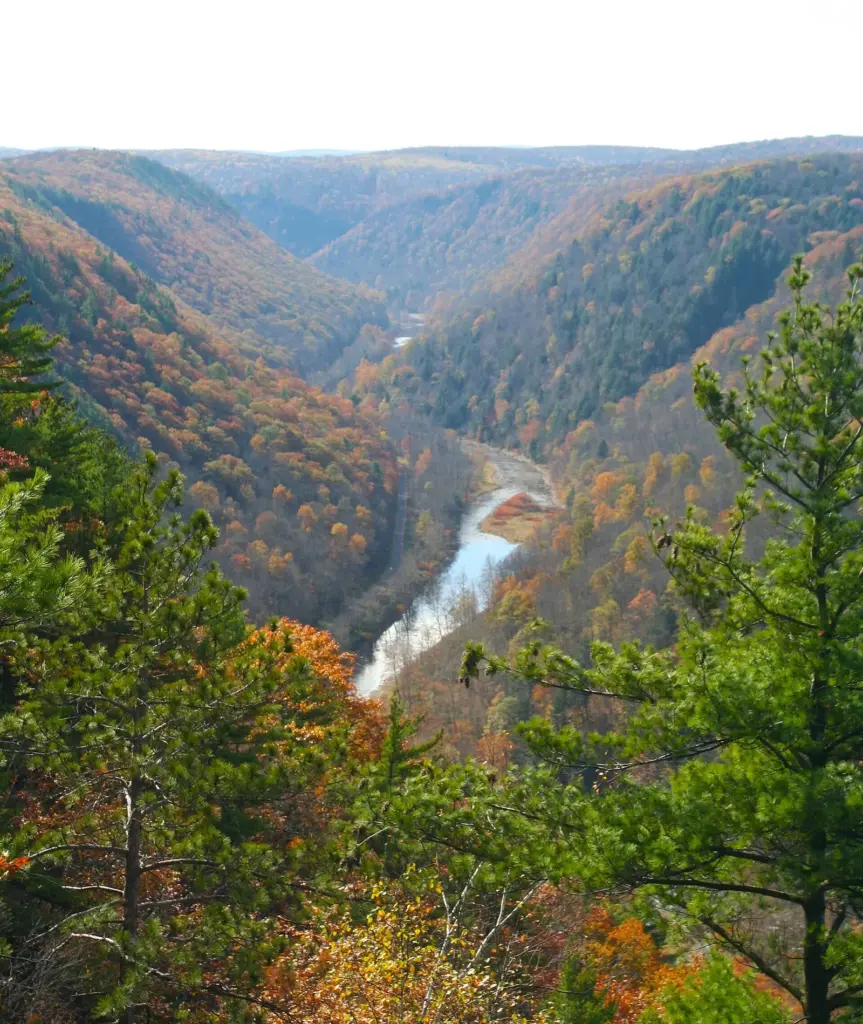
See the east rim in the morning and the west rim in the afternoon, so the sun is behind you and lighting the far wall instead of glaring into your lens. With a second day, ride part of the Pine Creek Rail Trail, which runs 62 miles from Jersey Shore to Wellsboro Junction and follows the creek for 55 of them. DCNR named it Pennsylvania’s 2026 Trail of the Year, and the new 3.2-mile Marsh Creek Greenway links its north end to downtown Wellsboro. Most visitors only see the gorge from the rims; the canyon floor at bike speed is the better half.
Plan it: Leonard Harrison State Park, 4797 Route 660, Wellsboro. About 4.5 hours from Philadelphia, 4.75 from Pittsburgh and 3 from Harrisburg. Free entry and parking; open daily from sunrise to sunset. Allow half a day for both rims, a full day with a ride on the rail trail. Best for: first-timers, photographers, cyclists.
2. Worlds End State Park and Loyalsock Creek
Free; DCNR singles out October. Worlds End sits in a tight S-bend of Loyalsock Creek just south of Forksville in Sullivan County, wrapped by Loyalsock State Forest. The view you want is Loyalsock Canyon Vista, reached by Mineral Spring and Cold Run roads and accessible to wheelchair users, with High Knob Vista nearby for a wider look over the Endless Mountains. DCNR’s own page picks two seasons for the scenery here, the June mountain laurel bloom and the fall foliage period in October. October is the one to plan for.
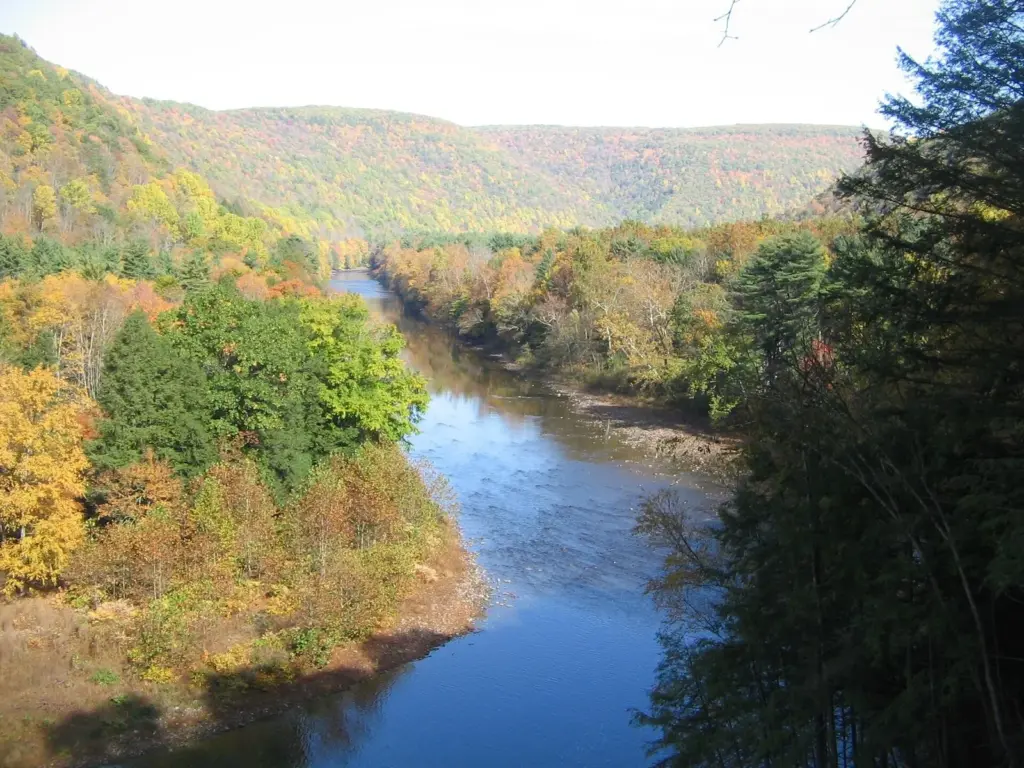
Drive in on PA 87, which follows the Loyalsock up from Lycoming County. It’s slow, two lanes and one of the better creek roads in the state in the second week of October. Ricketts Glen is about 70 minutes away, which makes the two a natural weekend pair.
Plan it: 82 Cabin Bridge Road, Forksville. About 3.5 hours from Philadelphia, 4.5 from Pittsburgh and 2.5 from Harrisburg. Free. Allow two hours for the vistas and a creekside walk, a full day if you hike part of the Loyalsock Trail. Best for: photographers, couples, anyone who wants canyon scenery with fewer people than the Grand Canyon.
3. Ricketts Glen State Park
Free; strenuous; early to mid-October. Ricketts Glen is a waterfall hike first and a foliage stop second, which is exactly why it works in fall: the color frames the water instead of competing with it. The 13,193-acre park has 22 named waterfalls, and the Falls Trail passes 21 of them in the Glens Natural Area, a National Natural Landmark. They range from 11 feet to the 94-foot Ganoga Falls. The full loop is 7.2 miles. A 3.2-mile loop using the Highland Trail and the Ganoga Glen and Glen Leigh sides takes in most of the falls.
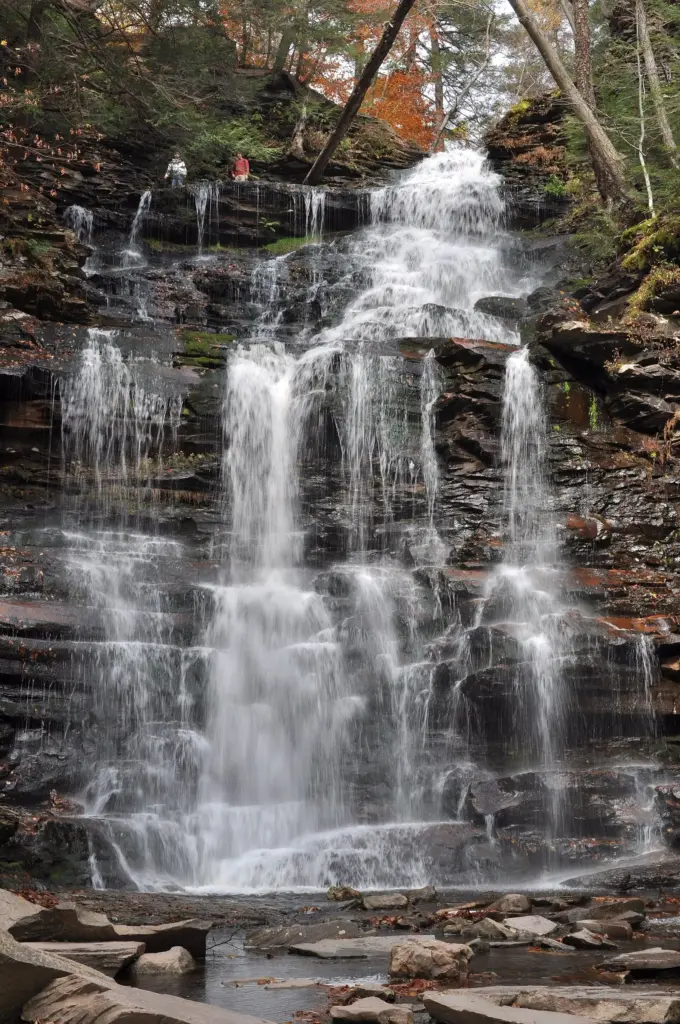
Be honest about your knees before you go. DCNR describes the terrain as rocky, slippery and steep, and wet leaves on stone steps make it worse. Wear boots with real tread, skip it in steady rain, and leave the stroller in the car. The drive has its own warning: PA 487 climbs very steeply from Red Rock up to the Lake Jean area, and DCNR tells anyone towing a heavy trailer to avoid that hill.
Plan it: 695 State Route 487, Benton, about 30 miles north of Bloomsburg. About 3 hours from Philadelphia, 4.75 from Pittsburgh and 2.5 from Harrisburg. Free; open daily from sunrise to sunset. Allow at least 2 hours for the short loop and 4 to 5 for the full one. Best for: hikers, photographers, families with older kids.
4. Kinzua Bridge State Park
Free; the Skywalk is open only until October 31, 2026. The Kinzua Viaduct was once the longest and tallest railroad structure of its kind, 2,053 feet long and 301 feet high, until a tornado knocked much of it down in 2003. What survived became the Skywalk in 2011: a walkway running 600 feet out on the remaining towers, ending at a partial glass floor that lets you look straight down into the gorge.
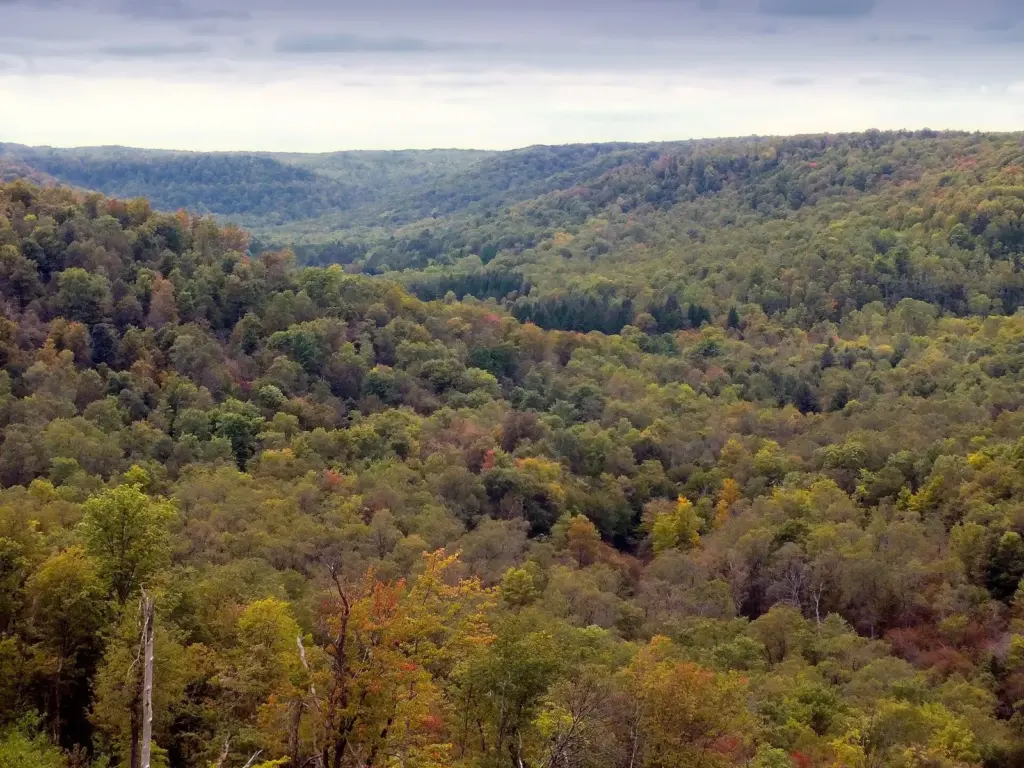
This fall is a special case. The Skywalk has been closed for structural rehab, and DCNR reopened it only for the foliage season, from September 1 to October 31, 2026, with the Kinzua Creek Trail reopening on September 5. After October 31 both close again, and the work is scheduled to finish in time for fall 2027. Snow, ice, thunderstorms and high winds can also close the walkway on short notice, so check the alerts on the park’s page the morning you go. If Kinzua is on your list at all, go before the end of October.
Plan it: 339-acre park in McKean County, a few miles north of US 6 near Mount Jewett. About 3.25 hours from Pittsburgh and 5.5 from Philadelphia; the Grand Canyon is about two hours east. Free. Allow 1 to 2 hours, including the visitor center’s exhibits. Best for: families, road-trippers on US 6, anyone who enjoys a little vertigo.
5. Allegheny National Forest: Rimrock and Jakes Rocks Overlooks
Two easy overlooks above the Allegheny Reservoir. Pennsylvania’s only national forest has two classic viewpoints just off the Longhouse National Scenic Byway, which loops around the Kinzua Creek arm of the Allegheny Reservoir. Rimrock Overlook looks down on the water from a rock ledge. Jakes Rocks, built onto a rock outcrop, adds a panorama of the reservoir and Kinzua Dam. Water with color on both shores is a better picture than hillsides alone, and a clear October afternoon here is hard to beat.
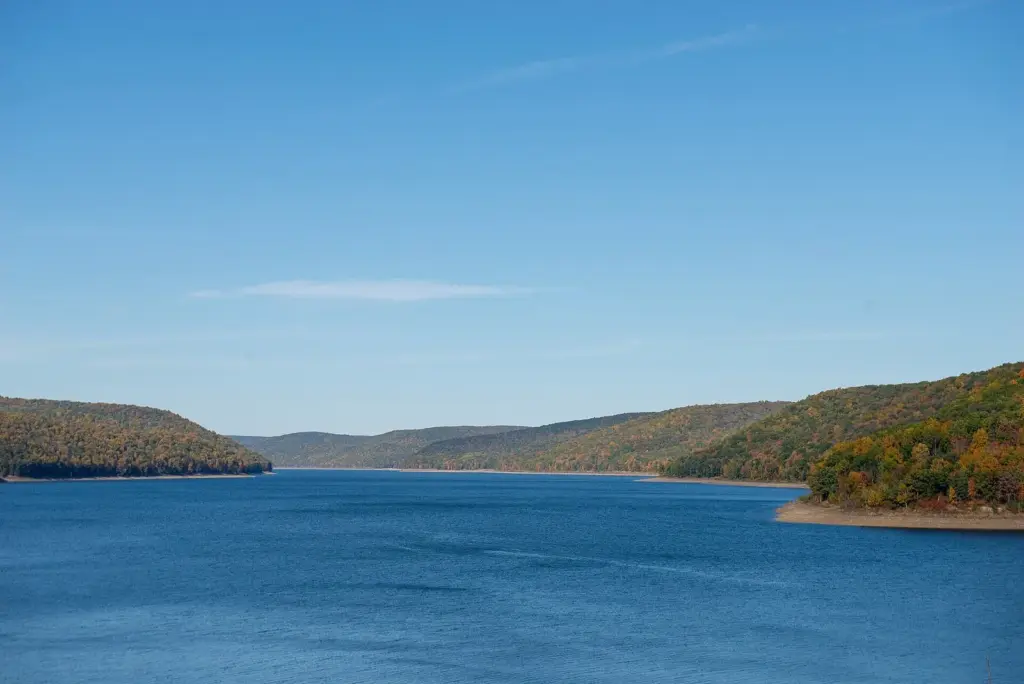
One caveat. Fees and gate dates for the overlook roads can change by season, so look at the Allegheny National Forest’s byway page before you commit to it late in the season.
Plan it: Warren and McKean counties, east of Warren. About 3.25 hours from Pittsburgh and 6 from Philadelphia; Kinzua Bridge is about 55 minutes east of Rimrock. Allow 2 to 3 hours for the byway and both overlooks. Best for: road-trippers, photographers, a Kinzua Bridge add-on.
6. Cook Forest State Park and the Clarion River
Free; climb the fire tower. Cook Forest is better known for its old-growth pines and hemlocks than for fall color, and that’s part of the appeal: the dark evergreens make the reds and oranges around them look brighter. Two views sit off Fire Tower Road, about 1.5 miles from Route 36. Seneca Point Overlook looks over the Clarion River valley from rock ledges, and DCNR is blunt that the outcrops outside the fence are hazardous, so stay inside it. Historic Fire Tower #9 is an 80-foot climb to a view of 15 to 20 miles on a clear day.
Plan it: Clarion County, at Cooksburg. About 2 hours from Pittsburgh and 5 from Philadelphia. Free. Allow 2 to 3 hours. Benezette’s elk are about 90 minutes east if you’re making a weekend of it. Best for: families, and Pittsburghers who want northern-style color without the four-hour drive.
7. Hyner View State Park
Free; a drive-up view over the West Branch. At six acres, Hyner View is barely a park, and it doesn’t need to be more. It’s a vista and hang-gliding launch high above the West Branch Susquehanna, with long views up and down the river and across the mountains around it. From PA 120 at the village of Hyner, take Hyner Run Road (PA 1014) for about two miles, then Old View Road for about three more.
PA 120 is half the reason to come. It follows the West Branch between Lock Haven and Renovo, and in the second week of October you’ll want to stop every few miles. Pair it with the Grand Canyon, about two hours north, or Benezette, about an hour and a half west.
Plan it: Clinton County. About 4 hours from Pittsburgh, 4.25 from Philadelphia and 2.75 from Harrisburg. Free; open sunrise to sunset. Allow 30 minutes at the top, plus the drive. Best for: photographers, drivers on a loop through the north.
8. Benezette and Elk Country
Free to watch; the rut runs September into October. You come to Benezette for the elk and stay for the color. The Pennsylvania Game Commission says the rut, when bulls bugle and spar, typically begins in September and carries through October, which lines up neatly with the northern foliage. Elk are most active in the mornings and evenings. The Elk Country Visitor Center, run by the Keystone Elk Country Alliance at 134 Homestead Drive, opens daily from 8am to dusk in September and October and suggests the hours just after daylight and just before dusk.
The honest downside is traffic. On October weekends the valley’s two-lane roads fill with cars that stop wherever an elk appears. The visitor center asks people not to stop in the road, so pull fully off, keep your distance and let the animals come to the fields.
Plan it: Elk County. About 2.75 hours from Pittsburgh, 3 from Harrisburg and 4.75 from Philadelphia. Allow a morning or an evening, timed for the first or last hours of light. Best for: families, wildlife watchers, photographers with long lenses.
9. Ohiopyle State Park
Free; mid-October onward. Ohiopyle packs a lot into a small area: Ohiopyle Falls beside the borough, the waterfall on Cucumber Run, the Ferncliff Peninsula loop and, for the big view, Baughman Rocks, which DCNR says overlooks the deepest gorge in Pennsylvania. Tharp Knob is the picnic spot with a view. The Great Allegheny Passage runs through town if you’d rather see the Youghiogheny gorge from a bike seat.
Entry to the park is free, but some borough and private lots in Ohiopyle charge, and on October weekends parking is the hard part. Go early or on a weekday. If you’re adding Fallingwater, the Frank Lloyd Wright house nearby, reserve ahead: tours need advance reservations, and it’s closed on Wednesdays.
Plan it: Fayette County, in the Laurel Highlands. About 1.75 hours from Pittsburgh, 3.5 from Harrisburg and 5 from Philadelphia. Allow a full day with a short hike and the falls. Mount Davis is about 70 minutes away. Best for: Pittsburghers, hikers, cyclists, families.
10. Mount Davis and the Laurel Highlands Ridges
Free; the highest ground in the state. Mount Davis tops out at 3,213 feet, the highest point in Pennsylvania, and the High Point Observation Tower in Forbes State Forest lifts you above the trees for a look across the ridges. The summit is a broad plateau rather than a peak, so the tower matters. Nearby High Point Overlook, accessible to wheelchair users, looks over High Point Lake, and Forbes has more vistas at Pine Knob, Beam Rocks and Wolf Rocks.
If you’d rather drive than climb, DCNR publishes two Discover Fall driving loops through the Laurel Highlands (details under drives, below).
Plan it: Somerset County. About 1.75 hours from Pittsburgh, 3 from Harrisburg and 4.5 from Philadelphia. Free. Allow an hour at the tower and overlook, or a full day on one of the loops. Best for: drivers, peak-baggers, anyone combining Ohiopyle and Fallingwater.
11. Jo Hayes Vista and Rothrock State Forest
Free; a roadside view just south of State College. DCNR calls the Jo Hayes Vista the best known and easiest to reach overlook in Rothrock State Forest. It sits atop Tussey Mountain on PA 26 at the Centre-Huntingdon county line and looks back over State College and the valleys around it, squarely in DCNR’s central band, so mid-October is the usual target.
For more, DCNR lists roadside overlooks along several Rothrock forest roads, including Colerain, Pennsylvania Furnace and Bear Gap, and hiking vistas along the Mid-State Trail on Tussey Mountain. One practical note: if Penn State has a home football game that weekend, book early or stay farther out.
Plan it: Centre County. From Philadelphia about 3.25 hours, from Pittsburgh 2.5 and from Harrisburg 1.5 (to State College). Free. Allow 30 minutes at the vista, a half day with a forest-road loop. Best for: drivers, Penn State visitors, anyone crossing the state on a fall weekend.
12. Jim Thorpe and the Lehigh Gorge
Train tickets needed; expect crowds on October weekends. Jim Thorpe is the easiest big foliage trip from Philadelphia: a Victorian town in a river gorge, with a train that runs up the Lehigh Gorge and back. For 2026 the Lehigh Gorge Scenic Railway runs its Autumn Leaf season daily from September 26 to November 15. Rides are 45 minutes round trip, shorter than the usual 70 but covering the full route. Standard coach costs $25 for adults and $9 for children 3 to 12, and the open-air car is $28 and $10. Children 2 and under ride free but still need a ticket.
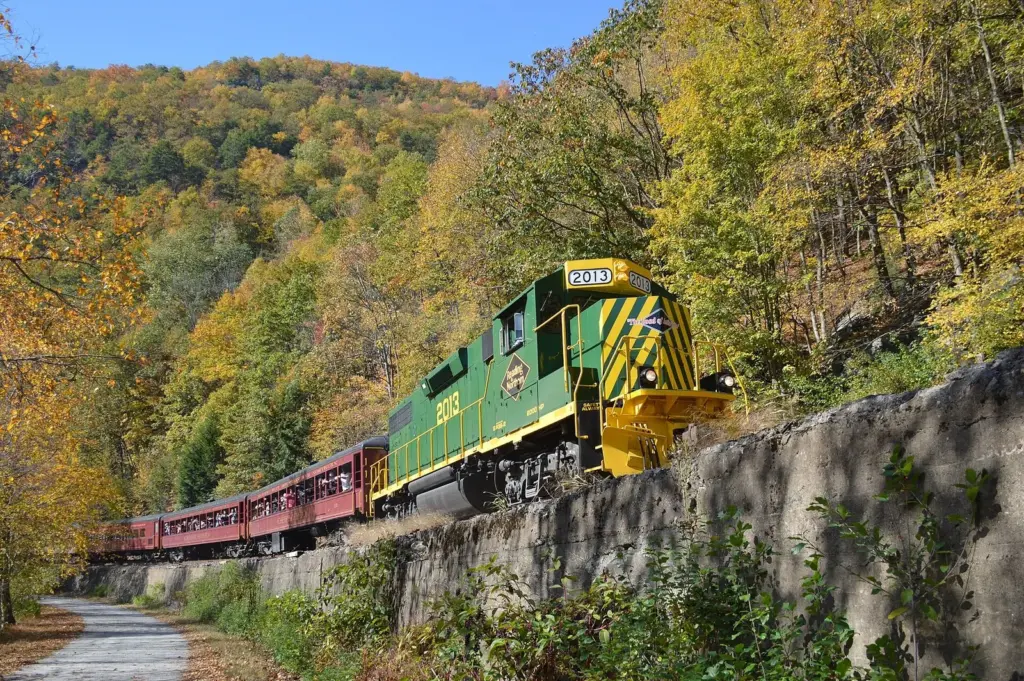
The logistics catch people out. Presales, online or by phone, cover trains leaving up to 3pm; the 4pm and later trains are sold only in person, on the day. Even with a presale receipt, you have to collect your actual ticket at a window in Jim Thorpe before boarding. The town’s Fall Foliage Festival adds crafts and music on October 3-4, 10-11 and 17-18, 2026, and Jim Thorpe opens extra lots and shuttles on October weekends. Our advice: take a weekday train, or be in town before the first weekend departure.
Don’t hike to Glen Onoko Falls, the old trail up a side ravine of the gorge. It has been closed since 2019 after repeated rescues and deaths, and DCNR’s rebuild keeps it off-limits through 2026, with no reopening date.
Plan it: Carbon County. About 1.5 hours from Philadelphia, 1.75 from Harrisburg and 4.75 from Pittsburgh. Allow a full day. Hawk Mountain is about 45 minutes southwest and Big Pocono about an hour northeast. Best for: Philadelphians, families, train fans, first-timers.
13. Big Pocono State Park
Free; three-state views from the top of Camelback. Big Pocono covers 1,306 acres on the summit and slopes of Camelback Mountain, and DCNR says the views reach three states. It’s the simplest way to see the Poconos’ color from above without a long hike, and it’s close enough to pair with Jim Thorpe or the Delaware Water Gap. The Poconos have far more foliage options than fit on one list, from Promised Land to the Lake Region; this one sticks to the summit. To build a whole weekend around it, from the Delaware Water Gap to Jim Thorpe, see our guide to the best things to do in the Poconos.
If the Water Gap is on your route, know that Dingmans Falls, one of its best-known walks, is closed. The National Park Service’s current conditions page lists the access road, visitor center and trail as shut for bridge replacement and trail work, with all traffic, including people on foot, prohibited.
Plan it: Monroe County, above Tannersville. About 2 hours from Philadelphia and 2.25 from Harrisburg. Free. Allow 1 to 2 hours. Best for: families, quick views, Poconos weekenders.
14. Hawk Mountain Sanctuary
$10 adult trail fee; raptors and color on the same ridge. Hawk Mountain is a private, nonprofit sanctuary on the Kittatinny Ridge in Berks County, not a state park, and the October crowds come as much for birds as for leaves. Its counters work the North Lookout daily from August 15 to December 15, tallying the southbound raptor migration, and anyone who pays the trail fee can sit on the rocks with them. The ridge is oak country, so it keeps color late.
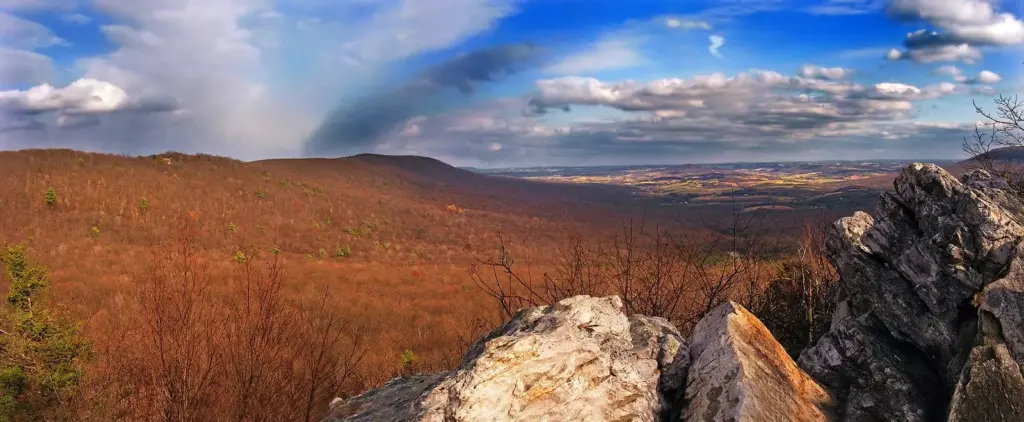
Trail fees as of September 2026 are $10 for adults, $7 for seniors 65 and up and $5 for children 6 to 12; children 5 and under and members get in free. Pay at the Visitor Center or buy online. Trails and the Visitor Center are open daily from 9am to 5pm, and pets aren’t allowed. The Lookout Trail is the quickest way up to the North Lookout, and it’s rocky, so wear real shoes.
Plan it: Kempton, Berks County. About 1.5 hours from Philadelphia and 1.25 from Harrisburg. Allow 2 to 3 hours. Best for: birders, hikers, Philadelphians who want a ridge view without an all-day drive.
15. The Lower Susquehanna Overlooks
Free; often the last good color in the state. When the north is bare, the lower Susquehanna is often just reaching its best, right in DCNR’s October 20-31 window for the south central counties. The Susquehannock State Park complex strings together three viewpoints above the river in southern Lancaster County: Urey Overlook, Pinnacle Overlook and the 224-acre state park itself, on a wooded plateau high over the water. Together they cover nearly 450 acres of public land.
Plan it: Park office at 1880 Park Drive, Drumore. About 1.75 hours from Philadelphia and 1.25 from Harrisburg. Free. Allow a half day to see two overlooks. Best for: late-season trips, Lancaster County weekends, Philadelphians who missed the north.
16. McConnells Mill State Park
Free; the nearest real gorge to Pittsburgh. McConnells Mill protects 2,546 acres of Slippery Rock Creek Gorge, a National Natural Landmark carved when glacial lakes drained thousands of years ago. The steep sides and boulder-strewn floor frame a historic gristmill and a covered bridge, both from the 1800s, and the whole scene is at its best in the second half of October.
Plan it: Lawrence County, near Portersville. About 45 minutes from Pittsburgh. Free. Allow 2 hours. Best for: Pittsburghers, families, photographers.
Seven Drives Built for Leaf-Peeping
Much of Pennsylvania’s best color is seen through a windshield, and the back roads are made for it. These are the drives we’d pick, north to south.
| Drive | Length | Aim for | Highlights |
|---|---|---|---|
| US 6 across the northern tier | About 400 miles end to end | Oct 1-15 | Wellsboro, the Grand Canyon’s north end, Kinzua Bridge |
| Longhouse National Scenic Byway | Listed as a 36-mile loop | Oct 1-15 | Rimrock, Jakes Rocks, Kinzua Dam |
| PA 87 along Loyalsock Creek | Lycoming County to Forksville | Oct 5-15 | Worlds End, High Knob Vista |
| PA 120 along the West Branch | Lock Haven to Renovo | Oct 5-15 | Hyner View |
| Rothrock forest roads | Short loops | Oct 10-20 | Jo Hayes Vista, forest-road overlooks |
| DCNR Laurel Highlands Northern Loop | About 125 miles | Oct 10-20 | Ridge views, four state parks, the Johnstown Inclined Plane |
| DCNR Laurel Highlands Southern Loop | About 70 miles | Oct 10-25 | PA 31, PA 381/711, the Youghiogheny gorge |
US Route 6 across the northern tier
The PA Route 6 Alliance bills US 6 as a 400-mile route across Pennsylvania’s northern tier, through 11 counties from Crawford and Erie in the west to Wayne and Pike in the east, mostly on two-lane rural road. You don’t need to drive it all. The stretch through Potter and Tioga counties gets you to Wellsboro and the Grand Canyon’s north end near Ansonia, and farther west it passes a few miles from Kinzua Bridge. For the first half of October there is no better long drive in the state.
PA 87 and PA 120, two river roads
PA 87 follows Loyalsock Creek north from Lycoming County toward Forksville and Worlds End. PA 120 follows the West Branch Susquehanna from Lock Haven toward Renovo, past the turn for Hyner View. Both are slow and curvy, have few services, and are at their best in the second week of October. Fill the tank before you start.
The Longhouse National Scenic Byway
The Allegheny National Forest’s loop around the Kinzua Creek arm of the reservoir, listed by the Forest Service at 36 miles, strings together Rimrock and Jakes Rocks overlooks. Combine it with Kinzua Bridge, about 55 minutes east of Rimrock, for a full day in the northwest.
DCNR’s Laurel Highlands loops
DCNR’s Discover Fall tours are two mapped loops through the Laurel Highlands. The Northern Loop runs about 125 miles along the ridge, past four state parks and a state forest, a bog walk, the Johnstown Inclined Plane (closed to riders in fall 2026 while it awaits state certification after a rebuild) and what DCNR calls the third-deepest gorge in the state; allow at least four hours. The Southern Loop is about 70 miles through the valleys between the ridges. It starts at Donegal (Turnpike Exit 91), heads east on PA 31 and then south on PA 381/711 toward Normalville, with views of the Youghiogheny gorge from the ridge and from the river; allow at least two and a half hours. The route sheets are older PDFs linked from DCNR’s Forbes State Forest page, so check any stop’s current hours before you count on it.
Rothrock’s forest roads
Around State College, DCNR points drivers to overlooks along Colerain, Pennsylvania Furnace, Bear Gap, Wampler, North Meadows, Kettle, Beidleheimer, Allensville and Turkey Hill roads in Rothrock State Forest, plus the Jo Hayes Vista on PA 26. Several are state forest roads, so expect gravel in places and drive them slowly.
Riding the Rails Through the Color
Pennsylvania has an unusual number of heritage railroads, and fall is their busiest season. Four worth knowing for 2026:
- Lehigh Gorge Scenic Railway, Jim Thorpe: daily Autumn Leaf trains from September 26 to November 15, 2026; 45-minute round trips; $25 to $28 for adults. The ticket rules are in the Jim Thorpe entry above.
- Reading & Northern fall foliage excursions: all-day trips to Jim Thorpe from Reading’s Outer Station, Pottsville and Pittston, including one behind steam locomotive 2102. These are the trains to book for first-class, lounge or dome seats, which the short Jim Thorpe rides don’t offer during Autumn Leaf season.
- Oil Creek & Titusville Railroad: a 27-mile, roughly three-hour round trip from Perry Street Station in Titusville, in 1930 Pullman cars, through the valley where the oil industry began. Regular 2026 rides run through October 16, with a Halloween train on October 24.
- East Broad Top Railroad, Rockhill Furnace: a restored narrow-gauge line in Huntingdon County whose roundhouse still holds steam locomotives from the early 1900s. Its Pumpkin Patch Express runs October 10-31, 2026. It’s about 1.5 hours from Harrisburg.
Plenty of other Pennsylvania railroads run fall trips too. The rule for all of them: book October weekends early and read the pickup and seating rules before you drive.
Festivals and Fall Traditions Worth Timing a Trip Around
Color is the backdrop; an event gives a weekend a center. All dates below are for 2026 and were confirmed on the organizers’ own sites.
- Bedford Fall Foliage Festival: October 3-4 and 10-11, 9am to 5pm, in downtown Bedford. The 62nd festival has more than 400 vendors and needs no tickets, and organizers ask you to leave pets at home.
- National Apple Harvest Festival: October 3-4 and 10-11 at the South Mountain Fairgrounds near Arendtsville in Adams County, 8am to 6pm Saturdays and 8am to 5pm Sundays. Admission is $15 for ages 12 and up and $13 for seniors, with parking and shuttles included. Adams County is the heart of Pennsylvania’s apple country, and picking your own is a trip in itself.
- Jim Thorpe Fall Foliage Festival: October 3-4, 10-11 and 17-18.
- Pennsylvania Renaissance Faire: weekends through October 25 at Mount Hope Estate in Manheim, 11am to 8pm. Tickets are sold online only, not at the gate.
- Eastern State Penitentiary’s Halloween Nights: select nights from October 2 to November 7 in Philadelphia, with half-hour timed entry. Buying ahead is the only way to guarantee getting in.
- The Hawk Watch and the elk rut: not festivals, but both peak with the leaves; see Hawk Mountain and Benezette above.
Pumpkin patches, corn mazes, hayrides and farm festivals run across the state on October weekends, and the haunted attractions ramp up toward Halloween. Each farm and haunt sets its own dates and ticket rules, so check its calendar before you go.
Day Trips From Philadelphia, Pittsburgh and Harrisburg
From Philadelphia
The nearest big color is northwest along the Blue Mountain ridge. Hawk Mountain and Jim Thorpe are each about 1.5 hours away and about 45 minutes apart, so an early start covers both in a day. Big Pocono is about 2 hours out, and the lower Susquehanna overlooks, about 1.75 hours away, are the best late-October play. Closer in, the Wissahickon gorge in Northwest Philadelphia and Valley Forge National Historical Park color up at the end of the month, in DCNR’s southeastern window. The Grand Canyon is a weekend, not a day trip: at about 4.5 hours each way, stay in or near Wellsboro.
From Pittsburgh
McConnells Mill is 45 minutes north. Ohiopyle and Mount Davis are each about 1.75 hours southeast, and Cook Forest and Titusville’s Oil Creek train are each about 2 hours north. Kinzua Bridge, at about 3.25 hours, is the stretch goal for northern color, and worth it this year while the Skywalk is open.
From Harrisburg
Harrisburg sits in the middle of everything. The lower Susquehanna overlooks are about 1.25 hours away, Hawk Mountain about 1.25, State College and the East Broad Top about 1.5, Jim Thorpe about 1.75, and the Grand Canyon about 3. The apple country around Arendtsville is under an hour.
How to Plan a Foliage Trip That Actually Hits the Color
- Pick two regions a week apart and let Thursday’s DCNR report choose between them. Refundable rooms make that painless.
- Book the north early. Wellsboro, Jim Thorpe and the Laurel Highlands fill on October weekends, and the northern towns have only so many rooms.
- Go midweek if you can. The same overlook that’s a parking-lot standoff on Saturday is quiet on a Tuesday.
- Chase the light. Overlooks are best in the first and last two hours of the day. Overcast days are good for forest walks and waterfalls, where soft light makes color look deeper.
- Don’t trust a two-week-old forecast. A warm spell stalls the change and a windy rain can end it. Decide on Thursday, drive on Saturday.
- Wear something orange. Fall is hunting season in much of the state forest and game land you’ll walk through.
- Plan for gaps. Cell service is patchy in the northern forests, and gas stations can be far apart on PA 120, PA 87 and US 6. Download your maps.
- Budget for less than you’d think. State parks are free to enter and park in, most overlooks are free, and the biggest costs are rooms, gas and any train or festival tickets.
What’s Changed for Fall 2026, and What to Skip
- Kinzua Bridge Skywalk: open only from September 1 to October 31, 2026, then closed again for rehab until fall 2027.
- Dingmans Falls: closed for bridge replacement and trail rehabilitation; the NPS bars all traffic, including hikers.
- Glen Onoko Falls: still closed while DCNR rebuilds the trail, with no reopening date.
- Lehigh Gorge Scenic Railway: Autumn Leaf rides are 45 minutes, with standard and open-air seats only; the premium classes are on Reading & Northern’s all-day excursions.
- The 2026 outlook: AccuWeather flags drought stress and a sharp north-south contrast in Pennsylvania this year.
- The DCNR reports: expect the first in late September or early October.
What to skip: a peak Saturday in Jim Thorpe at midday, unless you enjoy sitting in traffic; national “peak map” predictions made weeks out, which can’t see what a week of warm nights or a windstorm will do (DCNR’s foresters can); and the idea that there’s one perfect weekend. There isn’t, and that’s the good news. Pennsylvania gives you about a month of chances.
Where to See Fall Foliage in Pennsylvania: Your Questions
When is the best time to see fall foliage in Pennsylvania?
October, but the week depends on where you go. DCNR’s typical peaks are October 1-10 in the northern counties, October 10-20 in the central counties and October 20-31 in the south central and southeastern counties. Higher ground turns earlier. Check DCNR’s weekly report, published on Thursdays in season, before you commit to a weekend.
What part of Pennsylvania has the best fall foliage?
For scale and reliability, the northern tier: the Pennsylvania Grand Canyon near Wellsboro, Worlds End, Ricketts Glen, Kinzua Bridge and the Allegheny National Forest, which are usually best in the first half of October. The Laurel Highlands are the best bet in the southwest, and Hawk Mountain and the lower Susquehanna hold color latest in the east.
When does fall foliage peak in central Pennsylvania?
DCNR’s usual window for the central counties is October 10-20. Ridges such as Tussey Mountain above State College, and the high ground along the West Branch Susquehanna, tend to run a little ahead of the valleys below them. Warm weather can push the whole schedule back, so confirm with the Thursday report for your state forest district.
When is peak color around Pittsburgh and Lancaster?
Pittsburgh doesn’t fall neatly into one of DCNR’s three bands, but the Laurel Highlands ridges usually color around mid-October, with the city’s river valleys later. Lancaster County is in the south central band, so aim for October 20-31. The Susquehanna overlooks in the county’s south are often the last good color in the state.
What makes a good fall foliage year?
Plenty of sun, cool nights without a hard early frost, and enough summer rain to keep trees healthy. Drought stresses trees and can bring brittle leaves and duller color, which is AccuWeather’s concern for southeastern Pennsylvania in 2026. Warm spells delay the change, and a windy, rainy storm near peak can strip a ridge in a day.
Do Pennsylvania state parks charge admission?
No. Every Pennsylvania state park is free to enter and park in, and fees apply only to camping, cabins and rentals. Some private or borough lots near busy parks, including in Ohiopyle, may charge. Hawk Mountain is a private sanctuary with a $10 adult trail fee, and the scenic railroads sell their own tickets.
Is the Kinzua Bridge Skywalk open in fall 2026?
Yes, but only until October 31, 2026. DCNR reopened the Skywalk for the foliage season on September 1 while its structural rehab continues, and the Kinzua Creek Trail reopened on September 5. Both close again after October 31, and the work is scheduled to finish in time for fall 2027. Bad weather can close the walkway on short notice.
Sources and How We Checked
Everything on this page was checked on September 24, 2026 against the official websites below and compiled from them; we don’t claim first-hand visits. Drive times are free-flow estimates from OpenStreetMap-based routing (the Valhalla engine) from downtown Philadelphia, Pittsburgh and Harrisburg, rounded to the nearest 15 minutes.
- DCNR Fall Foliage Reports: peak windows, the weekly report schedule, 134 native tree species
- DCNR state park prices: free day use, fees for overnight stays and rentals
- DCNR: Kinzua Bridge Skywalk reopens for fall foliage: the September 1 to October 31, 2026 window
- DCNR Forbes State Forest sightseeing: Mount Davis and the Discover Fall loops
- National Park Service, Delaware Water Gap current conditions: the Dingmans Falls closure
- Lehigh Gorge Scenic Railway, Autumn Leaf 2026: dates, fares and ticket rules
- Hawk Mountain Sanctuary, autumn migration count: the August 15 to December 15 Hawk Watch
Also used: DCNR’s pages for Leonard Harrison, Colton Point, Worlds End, Ricketts Glen, Kinzua Bridge, Cook Forest, Hyner View, Ohiopyle, Big Pocono, Susquehannock and McConnells Mill state parks and for Rothrock State Forest; DCNR’s Pine Creek Gorge geology feature and its October 2025 foliage report; the Pennsylvania Game Commission and the Keystone Elk Country Alliance; the Reading & Northern, Oil Creek & Titusville and East Broad Top railroads; the Bedford, National Apple Harvest and Jim Thorpe festival sites; the Pennsylvania Renaissance Faire; Eastern State Penitentiary; and AccuWeather’s 2026 fall foliage forecast as published by UPI.
Pennsylvania Tourism Guide is an independent publication. We are not affiliated with the Pennsylvania Department of Conservation and Natural Resources, the National Park Service, the USDA Forest Service or any park, railroad or festival listed here, and no one paid to be included.
Photo Credits
- Pine Creek Valley from the Golden Eagle Trail: photo by Nicholas A. Tonelli from Pennsylvania, USA, via Wikimedia Commons (CC BY 2.0)
- Pine Creek Gorge, the Pennsylvania Grand Canyon: photo by Snottywong, via Wikimedia Commons (CC BY 3.0)
- Loyalsock Creek from PA 87: photo by User:Ruhrfisch, via Wikimedia Commons (CC BY-SA 3.0)
- Ganoga Falls, Ricketts Glen State Park: photo by Juliancolton, via Wikimedia Commons (Public domain)
- Kinzua Gorge, Kinzua Bridge State Park: photo by Nicholas, via Wikimedia Commons (CC BY 2.0)
- Allegheny Reservoir, Allegheny National Forest: photo by usfs_Eastern_Region, via Wikimedia Commons (Public domain)
- Reading & Northern train on the Lehigh River: photo by Michael Stokes, via Wikimedia Commons (CC BY 2.0)
- Hawk Mountain Sanctuary vista: photo by Nicholas A. Tonelli from Pennsylvania, USA, via Wikimedia Commons (CC BY 2.0)